
Bible Study
The Word Athens Laughed At
Paul in Athens was a man waiting for his friends, provoked by what he saw, and courteous anyway. A study of Acts 17:16–34: the marketplace, the philosophers, an altar with no name, two borrowed lines of poetry, and the one word his audience would not accept.
Scripture Acts 17:16–34 · Acts 17:13–15 · 1 Thessalonians 3:1–2 · Acts 7:48 · 1 Kings 8:27 · Isaiah 42:5 · 1 Corinthians 1:22–24 · 1 Corinthians 2:1–2 · Acts 18:1
Paul did not go to Athens to preach. He was sent there to get him out of danger.
A mob from Thessalonica had followed him to Berea, and the believers “immediately sent Paul to the coast” (Acts 17:14). Silas and Timothy stayed behind. The men who escorted him delivered him to Athens and went home with instructions for his friends to come “as soon as possible.” Paul’s own letter to the Thessalonians remembers those days without much shine: “we were willing to be left on our own in Athens” (1 Thessalonians 3:1). He arrived in the most famous city of Greece alone, waiting, with time on his hands.
What he did with that time is one of the best-known scenes in the New Testament, and one of the most flattened. Some readers make it a model for every apologetic conversation. Others call it Paul’s one failure, the day he tried philosophy and learned his lesson. Luke tells it more carefully than either.
A city full of gods
While Paul was waiting for them in Athens, he was deeply disturbed in his spirit to see that the city was full of idols. (Acts 17:16)
The Greek word behind “full of idols,” kateidōlos, appears nowhere else in the New Testament and is rare anywhere in Greek. It pictures a city thick with images, overgrown with them. Athens in the first century was no longer a great power. It had been a free city under Rome for a long time, living on its reputation as the home of philosophy and on the monuments of its golden age. Temples, shrines, statues of gods and heroes and benefactors stood in the Agora and along the streets and on the Acropolis above them.
“Deeply disturbed” translates paroxynō, a strong verb, the root of our “paroxysm.” The Greek Old Testament uses it more than once for Israel provoking the LORD with idols. Paul walked through Athens and felt something of what the prophets felt. Luke does not soften that, and he does not let it become contempt. The next verse shows what Paul did with his distress.
There is an irony here that Luke may not have intended but Paul would have appreciated. A poem Paul will quote in a few minutes opens with the line “From Zeus let us begin,” and a little further on says, in G. R. Mair’s translation, “full of Zeus are all the streets and all the market-places of men.” The Athenians would have agreed. Paul, looking at the same streets, saw a city full of idols.
Synagogue and marketplace
So he reasoned in the synagogue with the Jews and God-fearing Gentiles, and in the marketplace with those he met each day. (Acts 17:17)
Two audiences, two places, one habit. On the Sabbath he went where Scripture was already read and argued from it, as he had in Thessalonica. On the other days he went to the Agora, the great open square below the Acropolis where Athenians shopped, voted, gossiped and argued, and talked with whoever was there.
That square had its own history with talkers. Socrates had spent his life in it asking questions, four and a half centuries earlier. Along its north side stood the Painted Stoa, the colonnade where Zeno of Citium had taught around 300 BC, and his followers took their name from it: Stoics, the people of the Stoa. Epicurus had taught in his Garden at about the same time. By Paul’s day both schools were old, respectable, and still arguing with each other.
Two schools listening
Some Epicurean and Stoic philosophers also began to debate with him. (Acts 17:18)
It helps to know roughly what each would have heard.
The Epicureans did not deny the gods. They held that the gods live in perfect tranquility, untroubled by the world and uninvolved in it. The world is made of atoms moving in the void; the soul is made of atoms too, and at death it disperses. Fear of divine punishment and fear of death were the two great disturbers of human peace, and philosophy existed to remove both. A god who judges the world and a man raised from the dead would strike an Epicurean as a return of exactly the fears his school had been founded to cure.
The Stoics believed in a divine reason, the logos, that pervades and orders all things. God was not far away; God was, in a sense, the rational fire and breath running through the cosmos. They prized virtue, self-command, and living in agreement with nature. A Stoic could nod along to much of what Paul would say about God giving life and breath and being near. What a Stoic could not easily accept was a God distinct from the world, a day of judgment in history, and a body raised to life.
Neither school had room for the resurrection. That turns out to matter.
A seed-picker
Some of them asked, “What is this babbler trying to say?” Others said, “He seems to be advocating foreign gods.” They said this because Paul was proclaiming the good news of Jesus and the resurrection. (Acts 17:18)
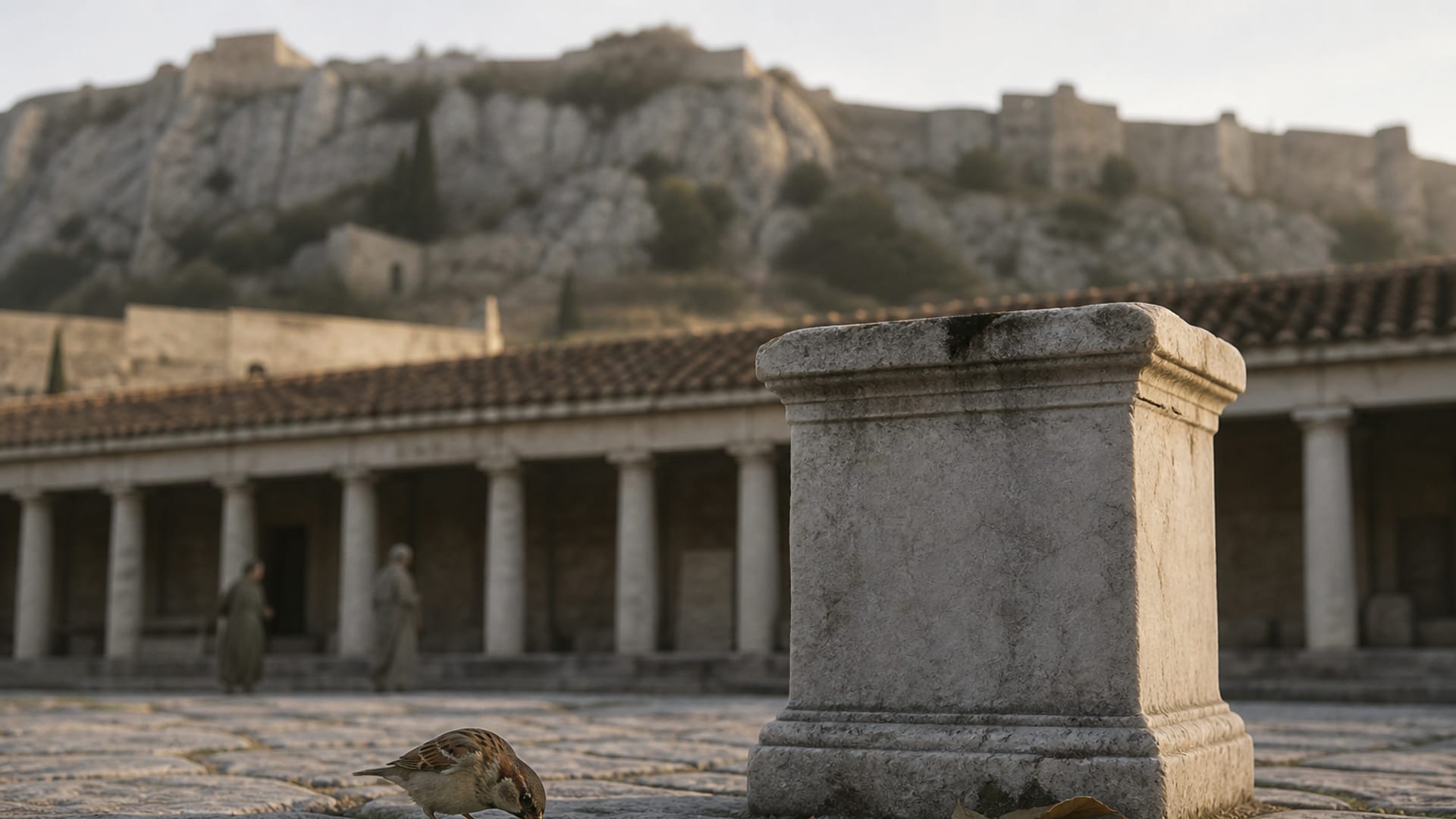
“Babbler” is spermologos, literally a seed-picker. It was the word for a bird that hops about picking up seeds, and from there for a person who picks up scraps of learning here and there and passes them off as his own. It was a street insult, and the Agora was where it lived. When Demosthenes wanted to abuse his rival Aeschines in the speech On the Crown, he called him a spermologos and, in the same breath, a thing worn smooth in the marketplace. The Athenians were telling Paul, in their own idiom, that he was a secondhand intellectual.
The second comment is more serious. “Advocating foreign gods” echoes the charge brought against Socrates in this same city. Plato’s Apology and Xenophon’s Memorabilia both record that he was accused of introducing new divinities. Luke’s Greek readers would have caught the echo, and some would have remembered how that trial ended.
Why “gods,” plural? Luke’s explanation is compressed: Paul was preaching “Jesus and the resurrection.” John Chrysostom suggested, in his homilies on Acts, that the Athenians took Anastasis, the Greek word for resurrection, to be the name of a goddess standing beside Jesus. The Greeks did personify abstractions as deities, and the idea is plausible. It is a guess, not something the text states. But if Chrysostom is right, the misunderstanding already points to the heart of the matter. The word they could not place was resurrection.
Hill or council
So they took Paul and brought him to the Areopagus, where they asked him, “May we know what this new teaching is that you are presenting?” (Acts 17:19)
The Areopagus, the Hill of Ares, is a bare outcrop of rock just northwest of the Acropolis. It also gave its name to the council that had met there since ancient times, originally a court for homicide, and in the Roman period the most prestigious body in Athens, with authority that reached into matters of religion and education.
So when Luke says Paul was brought “to the Areopagus,” did he climb the hill, or appear before the council? The phrase can mean either, and scholars are divided. Several details lean toward the council. In verse 22 Paul stands literally “in the middle of the Areopagus,” a natural way to speak of standing before an assembly. One of his converts is called “Dionysius the Areopagite,” a member of the council. And the question put to him has a formal ring: “May we know what this new teaching is?” Some historians think that by this period the council usually met down in the Agora, perhaps in the Royal Stoa, which would mean Paul never climbed the hill at all. Others think the old site is meant. The honest answer is that we cannot be sure where Paul stood.
Readers of the BSB should know that its rendering of verse 22, “in the meeting of the Areopagus,” makes a decision the Greek leaves open. It is a reasonable decision. It is still a decision.
Bruce Winter has argued that the whole scene reads like the procedure by which Athens considered whether a new deity should be received into the city: someone presents the god, the council inquires, and if the case is accepted, the city arranges a place and a festival. On that reading the Athenians were not simply curious. They were asking whether Paul’s gods qualified. Paul’s answer turns the procedure inside out. The God he proclaims needs no temple from them, no altar, and nothing from their hands at all.
An altar to an unknown god
Then Paul stood up in the meeting of the Areopagus and said, “Men of Athens, I see that in every way you are very religious. For as I walked around and examined your objects of worship, I even found an altar with this inscription: TO AN UNKNOWN GOD. Therefore what you worship as something unknown, I now proclaim to you.” (Acts 17:22–23)
“Men of Athens” is the classic opening of an Athenian speech. “Very religious” translates a word that can lean toward “devout” or toward “superstitious,” and Paul surely chose it for its ambiguity. The Areopagus would hear a compliment. Luke’s readers, who know verse 16, can hear something else.
What about the altar? Here it is worth saying only what is sure. No inscription reading “to an unknown god,” in the singular, has been found. The literary evidence speaks of altars to unknown gods in the plural. Pausanias, writing in the second century, mentions “altars of the gods named Unknown” near Athens’ old harbor at Phalerum, and “an altar of Unknown Gods” at Olympia. Philostratus, in his Life of Apollonius, speaks of Athens as a place “where altars are set up in honor even of unknown gods.” Diogenes Laertius tells a story about the seer Epimenides stopping a plague in Athens by releasing sheep from the Areopagus and sacrificing wherever they lay down, and says that altars with no name on them could still be found around Attica.
So the practice is well attested: Athenians hedged their bets, honoring whatever power they might have overlooked. Whether Paul saw an altar dedicated in the singular, or adapted a plural dedication for his purpose, the evidence does not allow us to say. What his use of it shows is clear enough. He begins with something the city had built with its own hands, and reads it as a confession. You admit there is a god you do not know. I have come to tell you who He is.
What Paul says about God
The God who made the world and everything in it is the Lord of heaven and earth and does not live in temples made by human hands. Nor is He served by human hands, as if He needed anything, because He Himself gives everyone life and breath and everything else. (Acts 17:24–25)
Paul was standing within sight of the Parthenon. The sentence is as biblical as anything he ever wrote. Solomon, dedicating his own temple, had prayed, “The heavens, even the highest heavens, cannot contain You, much less this temple I have built” (1 Kings 8:27). Stephen had said it in Jerusalem: “the Most High does not dwell in houses made by human hands” (Acts 7:48). And Isaiah describes the LORD as the One “who gives breath to the people on it and life to those who walk in it” (Isaiah 42:5). Paul never cites these texts by chapter. He does not need to. He speaks the Old Testament in words a Greek could follow, and an Epicurean would have agreed that God needs nothing from us, while a Stoic would have agreed that God gives life and breath to all.
From one man He made every nation of men, that they should inhabit the whole earth; and He determined their appointed times and the boundaries of their lands. God intended that they would seek Him and perhaps reach out for Him and find Him, though He is not far from each one of us. (Acts 17:26–27)
This is Genesis. “From one man” points to Adam, and it may also have stung one of Athens’ proudest boasts, that its people had sprung from the soil of Attica itself. (Many later manuscripts read “from one blood”; the sense is the same.) Every nation shares one origin under one Creator.
“Reach out for Him” translates psēlaphaō, a verb for feeling one’s way, touching, groping, the way a person moves in the dark. Paul’s picture of human religion is not flattering and not cruel. People are reaching for God with their hands out, and the tragedy is that He is close enough to touch.
Two lines from the poets
‘For in Him we live and move and have our being.’ As some of your own poets have said, ‘We are His offspring.’ (Acts 17:28)
The second line is secure. “For we are also his offspring” comes from the opening of the Phaenomena, a poem about the stars by Aratus, who lived in the third century BC and came from Soli in Cilicia, not far from Paul’s own Tarsus. Aratus was writing about Zeus. The Greek of Acts reproduces his half-line almost exactly, changing only the form of the verb. Paul says “some of your poets,” in the plural, and a similar thought appears in the Stoic Cleanthes’ Hymn to Zeus, though that line is harder to establish.
The first line is less certain than many study Bibles suggest. The claim that “in Him we live and move and have our being” comes from a poem by Epimenides of Crete rests chiefly on a ninth-century Syriac commentary by Isho’dad of Merv, many centuries after Paul. Some scholars accept it; many are doubtful. It may be a saying Paul borrowed from somewhere we can no longer trace, or a phrase of his own in a philosophical idiom. The BSB, like most modern translations, puts it in quotation marks. The Greek text itself has none.
What matters more is what Paul does with the borrowed words. He does not adopt Aratus’s theology. He takes a line written about Zeus and asks what follows if it is true of the living God:
Therefore, being offspring of God, we should not think that the Divine Being is like gold or silver or stone, an image formed by man’s skill and imagination. (Acts 17:29)
The argument is almost playful. If we are God’s offspring, God cannot be smaller than we are. A statue cannot be the parent of the one who carved it. The Athenians’ own poet becomes a witness against the Athenians’ own idols.
The day and the Man
Although God overlooked the ignorance of earlier times, He now commands all people everywhere to repent. For He has set a day when He will judge the world with justice by the Man He has appointed. He has given proof of this to everyone by raising Him from the dead. (Acts 17:30–31)
Here the tone changes, and it changes quickly, because this is where Paul was going all along. The “unknown” God has made Himself known, and knowledge brings responsibility. The time of overlooking is over. History is going somewhere: to a day, a judgment, and a Man.
Notice that Paul never says the name of Jesus in the whole speech. Luke has already told us that Jesus was what Paul preached in the Agora, so the omission is not timidity. Perhaps Paul was about to say it. Perhaps he was interrupted. The speech as we have it ends with a Man appointed, and a proof: God raised Him from the dead.
Where they stopped listening
When they heard about the resurrection of the dead, some began to mock him, but others said, “We want to hear you again on this topic.” (Acts 17:32)
Five centuries before Paul, Aeschylus had put the founding of this very council on the stage. In his Eumenides, the goddess Athena establishes the court of the Areopagus to try Orestes for murder. During the trial Apollo says that fetters can be undone, but “when the dust has drawn up the blood of a man, once he is dead, there is no return to life.” The Greek word at the end of that line is anastasis, the very word Paul used. The founding myth of the council before which Paul stood contained a flat denial of the thing he was proclaiming.
This is the point most readers pass over too fast. Paul’s audience was not offended by a creator God, or by a God who needs nothing, or even by the call to turn from idols. Philosophers had said versions of those things. Many Greeks could imagine a soul that survived death. What they would not accept was a dead body raised to life by the God who will judge the world. Paul could have stopped a sentence earlier and kept his audience. He did not.
Some mocked. Others said they would hear him again, which may have been genuine interest or a polite way of ending the meeting. Luke does not say which. “At that, Paul left the Areopagus.”
Dionysius, Damaris, and others
But some joined him and believed, including Dionysius the Areopagite, a woman named Damaris, and others who were with them. (Acts 17:34)
The result was small, and Luke reports it without embarrassment. Dionysius was a member of the council, a man of standing. In the second century, Dionysius, bishop of Corinth, wrote that the Areopagite had become the first bishop of the church at Athens; Eusebius preserves the report in his Ecclesiastical History. We cannot confirm it, and we should be careful with what came later: around AD 500 a series of mystical theological writings appeared under the name “Dionysius the Areopagite,” and for a thousand years many believed them genuine. They were not.
Of Damaris we know only her name. Luke does not say who she was or how she came to be there, and every theory about her is a guess. One small fact is telling. An early and influential Greek manuscript of Acts, Codex Bezae, leaves her out of the verse altogether. Luke did not. In a scene full of men of Athens, he took care to name one woman who believed.
What most readers miss
Paul was provoked, and he stayed courteous. Verse 16 is strong. So is the patience of verses 22 to 29. Luke puts the two side by side, and neither cancels the other.
The speech was not a failure Paul later regretted. It is common to read 1 Corinthians 2:2, “I resolved to know nothing while I was with you except Jesus Christ and Him crucified,” as Paul’s repentance for trying philosophy in Athens. Paul never says so. Luke gives no hint of it. The speech in Athens ends with the resurrection, not with philosophy, and the message to Corinth is the same message told to a different city. Paul himself names the problem: “Greeks search for wisdom, but we preach Christ crucified” (1 Corinthians 1:22–23). Athens heard the gospel, and most of Athens did not want it.
The speech is almost entirely Old Testament. Creation, the God who needs no temple, one humanity from one man, the folly of images, the day of judgment. Paul quotes Greek poets twice, and both times to serve an argument he learned from Moses and the prophets.
Speaking in our Athens
Most of us do not stand before a council. We live in cities with their own idols, many of them less obvious than marble: money, image, control, the quiet assumption that nothing lies beyond what we can measure. It is easy to be provoked by that, and harder to let the provocation send us into the marketplace.
Paul took the trouble to walk around and look. He knew his hearers’ poets. He found in their own city something true to build on, and he said it gladly. None of that made him vague. When he reached the part of the gospel that he knew they would find absurd, he said it anyway, and let the hearing end there.
Then he walked out, with a council member, a woman whose story we do not know, and a few others. It is not much by some measures. It was enough for Luke to write down their names.
For reflection
- Paul was distressed by what he saw in Athens, and the first thing he did was go and talk with people. What does my distress at the culture around me usually turn into?
- He knew the Athenians' poets well enough to quote them from memory. Whose words, songs and questions would I need to learn before I could speak to my neighbors honestly?
- The audience listened until the resurrection. Is there a part of the faith I quietly leave out because I already know where people will stop listening?
- God "is not far from each one of us." Who in my life is groping for Him without a name for what they are looking for?
- Luke names two converts and says "others." What would change if I measured faithfulness by Dionysius and Damaris instead of by the crowd that walked away?
Prayer
Lord of heaven and earth, You do not live in what our hands have made, and You are not far from any of us.
When the idols of my own city provoke me, keep me from contempt, and send me into the marketplace with patience and with the whole of Your gospel.
Give me courage to speak of the Man You raised, even when it is the word that makes people laugh.
Amen.
Paul could meet Athens on almost every point, and he did. The one word he would not soften was the resurrection, and that was the word Athens laughed at.
Sources and notes
Consulted while writing this piece. Nothing is listed here that was not used.
- Berean Standard Bible primary text
- The Greek text of Acts 17, compared in the critical edition and the Byzantine Majority Text where the translations differ primary text
- Aratus, Phaenomena 1-5, trans. G. R. Mair, Loeb Classical Library (1921) primary text
- Aeschylus, Eumenides 645-648, Greek text and trans. H. W. Smyth, via Perseus primary text
- Pausanias, Description of Greece 1.1.4 and 5.14.8, trans. W. H. S. Jones, via Perseus primary text
- Philostratus, Life of Apollonius of Tyana 6.3, trans. F. C. Conybeare, via Livius primary text
- Diogenes Laertius, Lives of Eminent Philosophers 1.110 (Epimenides), trans. R. D. Hicks, via Perseus primary text
- Demosthenes, On the Crown (Oration 18) 127, Greek text and trans. C. A. Vince and J. H. Vince, via Perseus primary text
- Plato, Apology 24b, and Xenophon, Memorabilia 1.1.1, on the charge against Socrates primary text
- John Chrysostom, Homilies on the Acts of the Apostles, Homily 38, Nicene and Post-Nicene Fathers, First Series, vol. 11 primary text
- Eusebius, Ecclesiastical History 3.4.11 and 4.23.3, Nicene and Post-Nicene Fathers, Second Series, vol. 1 primary text
- C. K. Barrett, A Critical and Exegetical Commentary on the Acts of the Apostles, International Critical Commentary, 2 vols. (T&T Clark, 1994 and 1998) commentary
- F. F. Bruce, The Book of the Acts, New International Commentary on the New Testament, revised edition (Eerdmans, 1988) commentary
- Craig S. Keener, Acts: An Exegetical Commentary, 4 vols. (Baker Academic, 2012-2015), vol. 3 on Acts 15-23 commentary
- Darrell L. Bock, Acts, Baker Exegetical Commentary on the New Testament (Baker Academic, 2007) commentary
- Bruce W. Winter, "On Introducing Gods to Athens: An Alternative Reading of Acts 17:18-20," Tyndale Bulletin 47.1 (1996) historical study
- Bruce M. Metzger, A Textual Commentary on the Greek New Testament, 2nd edition (United Bible Societies, 1994), on Acts 17:26 and 17:34 commentary
Scripture in English is from the Berean Standard Bible, placed in the public domain by its publisher on 30 April 2023.