
Bible Study
Onesimus in the Room
Paul's shortest letter was addressed to a whole church and was most likely read aloud with the enslaved man it concerned standing there. That changes almost everything about how it works.
Scripture Philemon 1–25 · Colossians 4:7–9 · Colossians 4:17 · 1 Corinthians 7:21 · Colossians 3:11
Philemon is the shortest letter we have from Paul, short enough to fit on a single sheet of papyrus, and for long stretches of church history it was treated as a private note that wandered into the Bible by accident. Chrysostom, preaching in the late fourth century, opened his homilies on it by answering people who thought it “superfluous” to include a letter about “a small matter in behalf of one man.”
The letter itself resists being private. It is addressed to Philemon, but also “to Apphia our sister, to Archippus our fellow soldier, and to the church that meets at your house.” It was meant to be read to a gathered congregation. And if Colossians 4:9 describes the same trip, as most readers assume, the man it discusses traveled with the letter:
With him I am sending Onesimus, our faithful and beloved brother, who is one of you. They will tell you about everything here. (Colossians 4:9)
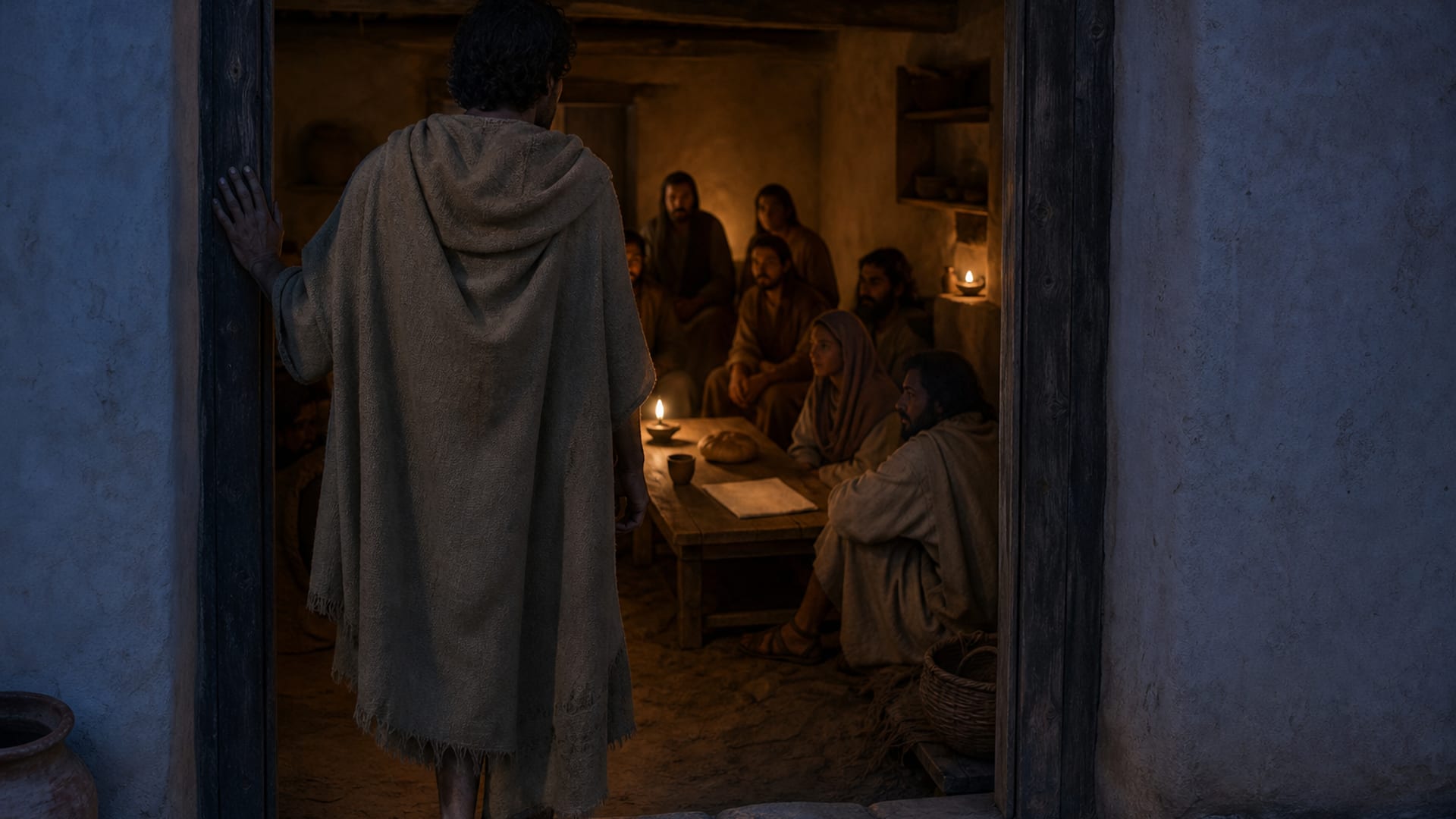
So picture the room. A household church in a small Phrygian city. The owner of the house sits among his fellow believers, some of whom are probably his own slaves. A letter from the imprisoned apostle is read aloud. And somewhere in that room, or just outside the door, stands Onesimus, listening to himself being described as “useless,” then “useful,” then “my very heart.”
That is a plausible reconstruction, not a stated fact. Heard in that setting, though, the letter stops sounding like a quiet favor between friends.
What the letter says, and what it leaves out
The popular story (a slave steals from his master, runs off to Rome, meets Paul, converts, and is sent home) is more detailed than the letter. Here is what Paul actually states. He is a prisoner (v. 1, 9). Onesimus became his “child” while Paul was in chains (v. 10). “Formerly he was useless to you,” Paul tells Philemon (v. 11). Paul is sending him back (v. 12) though he would have liked to keep him as a helper (v. 13). Onesimus “was separated from you for a while” (v. 15). Philemon should now receive him “no longer as a slave, but better than a slave, as a beloved brother” (v. 16). And:
But if he has wronged you in any way or owes you anything, charge it to my account. (Philemon 18)
Here is what Paul does not state. He never uses a word for running away. He never mentions theft. He never says where he is imprisoned; Rome, Ephesus and Caesarea all have serious defenders. He never says Onesimus repented, and he never describes what Onesimus did.
Two small grammatical facts matter. The verb in verse 15 is passive: Onesimus “was separated.” Paul could have said “he left you.” He chose a form that leaves room for God’s hand without naming anyone’s fault. And verse 18 is a conditional: if he has wronged you. Some take that as tact covering a known offense. Others take it at face value. The Greek will not settle it.
A note on the context passage: many scholars dispute whether Paul wrote Colossians, while others hold it to be his or written under his direction. Either way, Colossians 4:7–9 is very early evidence that the church remembered Onesimus as “one of you,” a Colossian, and that he went home as a “faithful and beloved brother.”
A household in the Lycus valley
Colossae sat on the Lycus River in the Roman province of Asia, a few hours’ walk from Laodicea and Hierapolis. The valley was notorious for earthquakes. Tacitus reports that in AD 60 Laodicea “was overthrown by an earthquake” and rebuilt from its own resources.
Colossae itself has barely been dug. A survey began in 2021, and full excavations under Barış Yener of Pamukkale University started only in 2025, in the northern necropolis. Nothing published touches Philemon’s household. What we know of this family comes from one page.
That page names three people. Philemon is a “beloved fellow worker” and wealthy enough to host a church and later a guest (v. 22). Apphia is called “our sister” in the critical Greek text; the later Byzantine text reads “the beloved.” Lightfoot showed long ago that Apphia is a native Phrygian name, common on inscriptions throughout the region. Most interpreters assume she was Philemon’s wife, which is reasonable but not stated. If so, her name is not decorative: the mistress of a household often oversaw its domestic slaves, and a decision about Onesimus was her business too.
Archippus is Paul’s “fellow soldier,” and Colossians 4:17 contains a pointed charge to him: “See to it that you complete the ministry you have received in the Lord.” The phrase “the church that meets at your house” uses a singular “your,” and John Knox argued that the nearest name, Archippus, was the actual owner of both house and slave. Few have followed him, but the point stands that the address alone tells us little.
What slavery was in that world
Two errors distort almost every reading of this letter.
The first is to imagine Roman slavery as a milder arrangement, closer to employment. It was not. Gaius, a Roman jurist of the second century, states flatly that masters hold the power of life and death over their slaves, and that whatever a slave acquires belongs to the master. The Lex Aelia Sentia of AD 4, as Gaius summarizes it, regulated the status of freed slaves who had been put in chains by their masters as punishment, branded, or tortured under interrogation. The law assumes such things were common enough to legislate for. Enslaved bodies were sexually available to their owners, a reality Jennifer Glancy has shown the early church had to face in its own households.
And in AD 61, within a decade of this letter on any dating, the city prefect Pedanius Secundus was murdered in Rome by one of his slaves. Under existing law every slave living under his roof was condemned. Tacitus puts their number at four hundred. A crowd gathered to save them, in what he says came close to sedition. The Senate debated it, and they were executed anyway, with soldiers lining the route.
Roman law bound Roman citizens, and a Greek city like Colossae had its own customs. But the shape of power in a provincial household was the same: a slave’s body, time, family and future belonged to someone else.
The second error runs the other way: reading the letter through the slavery of the Atlantic world. Roman slavery was not organized around race. People were enslaved through war, piracy and kidnapping, the exposure of infants, and above all birth to an enslaved mother, and they came from every people the empire touched. Manumission, especially for urban household slaves, was common enough that Augustus regulated it: under the Lex Aelia Sentia a slave freed before age thirty did not become a Roman citizen unless the manumission was approved for just cause. None of this made the system gentle. It does mean that a first-century listener would not hear “slave” and picture the auction blocks of Charleston, and that freeing Onesimus would have been a familiar legal act, not a revolutionary one.
The name itself tells you something. Onesimus means “useful” or “beneficial,” and Lightfoot collected dozens of inscriptions where it belongs to a slave or freedman. It is the kind of name an owner gives.
Three ways to reconstruct what happened
A runaway. This is the traditional reading, already fully formed in Chrysostom, who inferred theft from verse 18 and called Onesimus “a runaway, a thief, and a robber.” John Nordling defended a version of it in 1991. Its strength is that “useless,” “separated,” and “owes you anything” all fit a rupture. Its weakness is explaining why a fugitive would seek out his master’s close friend, in prison.
An appeal to the master’s friend. In 1985 Peter Lampe pointed to a Roman legal opinion preserved in Justinian’s Digest. Proculus, a leading jurist of the first century, is reported as ruling that a slave who saw that his master meant to beat him, and hurried off to a friend in order to bring that friend to plead for him, was not a fugitive. On this view Onesimus, in trouble with Philemon, deliberately went to Paul as a mediator, and was converted in the process. Brian Rapske developed the idea, and it has been widely discussed since. It explains the choice of Paul well. Albert Harrill has cautioned that the passage comes from law about the sale of slaves, and that a juristic definition cannot tell us how ordinary households actually behaved. That caution is fair.
Sent by the household. Sara Winter argued in 1987 that Onesimus had not fled at all but had been sent to Paul by the Colossian congregation to help him in prison, and that the letter is Paul’s request to keep him for ministry. Verse 13 (“I would have liked to keep him with me, so that on your behalf he could minister to me”) fits this nicely. Verse 11 and verse 18 fit it less well.
There are outliers too. Allen Callahan revived a nineteenth-century abolitionist reading in which Onesimus was Philemon’s literal brother, estranged, and not a slave at all. Most scholars find that hard to square with “no longer as a slave.”
What the letter will support is this: something had gone wrong between Philemon and Onesimus, there may have been a financial loss, and Paul thinks the situation calls for reconciliation, not merely a return.
Pliny and Sabinianus
About half a century after Paul, the Roman senator Pliny the Younger wrote a short letter often laid beside Philemon. A freedman of his friend Sabinianus had offended his patron and came to Pliny, who writes that the man, “throwing himself down before me clung to my feet, as if they had been yours” (Lightfoot’s translation). He wept, begged, and fell silent, and Pliny believed his penitence. So he asks Sabinianus to forgive, pleading the young man’s age, his tears, and Sabinianus’s own gentle nature. Then comes a line any reader of Philemon will recognize: “I am afraid lest I should appear not to ask but to compel.” Pliny adds that he rebuked the freedman severely and threatened never to intercede again. In a later letter (9.24) he thanks Sabinianus for taking the man back into his household and his favor.
The parallel shows that Paul was using a known social script. An inferior in trouble goes to a superior’s friend; the friend writes, praises the recipient’s character, disclaims pressure while applying it, and hopes for clemency.
The differences are where the letter shows its hand. Pliny’s man was a freedman; Onesimus, as far as the letter shows, was still enslaved. Pliny’s argument rests on the freedman’s repentance; Paul never mentions Onesimus’s. Pliny scolds his petitioner; Paul calls his “my child” and “my very heart.” Pliny asks Sabinianus to relent. Paul asks Philemon to receive Onesimus “as you would receive me,” which is an entirely different request. Lightfoot, who admired Pliny, judged Paul’s letter superior for its “simple dignity” and “warm personal affection.” That is a verdict of taste. The structural difference is not: Pliny stands between two men, and Paul takes the side of the weaker one and puts himself in his place.
How Paul argues without giving an order
Paul says plainly that he could give orders:
So although in Christ I am bold enough to order you to do what is proper, I prefer to appeal on the basis of love. For I, Paul, am now aged, and a prisoner of Christ Jesus as well. (Philemon 8–9)
Watch three threads through the letter.
The heart. The Greek splanchna, literally the inward parts and used for deep affection, appears three times. In verse 7 Philemon has “refreshed the hearts of the saints.” In verse 12 Onesimus is “my very heart.” In verse 20 Paul asks, “Refresh my heart in Christ.” The verb “refresh” repeats too. Paul has sent his heart to Philemon’s door, in the person of a slave.
The names. Verse 11 plays on usefulness: Onesimus was achrēstos, useless, and is now euchrēstos, useful, a joke on a name that meant “useful.” In verse 20 there is a second pun that English cannot carry: “let me have some benefit from you” uses the verb onaimēn, from the same root as Onesimus.
The books. The language turns commercial in verses 18 and 19. “Charge it to my account” uses a bookkeeping verb. “I will repay” is the language of settling a debt. And Paul marks this part as written in his own hand: “I, Paul, write this with my own hand. I will repay it.” A signed promise in the writer’s own hand functioned like a note of indebtedness. Then, in the same breath, Paul reminds Philemon “that you owe me your very self.” The ledger is real, and it is also not the whole story.
Is this manipulation? Paul disclaims compulsion (v. 14), then mentions his age and chains, writes to the whole church, expresses confidence in Philemon’s “obedience” (v. 21), and asks for a guest room because he hopes to visit (v. 22). The pressure is unmistakable. What keeps it from being coercion is that every lever Paul pulls is out in the open, and the person who pays if Philemon refuses is Paul himself, not Onesimus.
What Paul says, and does not say, about freedom
Paul never writes “set him free.” He writes that Philemon should have Onesimus back “no longer as a slave, but better than a slave, as a beloved brother,” dear to Paul, “but even more so to you, both in person and in the Lord” (v. 16). The phrase translated “in person” is literally “in the flesh,” which in Paul often means ordinary human life, including its social arrangements. And verse 21 ends: “knowing that you will do even more than I ask.”
Some conclude that Paul is asking for manumission without naming it, or for Onesimus to be released back to him for ministry, which verse 13 hints at. Others, beginning with Chrysostom, concluded the opposite: “we ought not to withdraw slaves from the service of their masters.” Chrysostom read Paul’s refusal to keep Onesimus without consent as a rule.
The disagreement is not merely modern stubbornness. Paul’s other statements pull in different directions. 1 Corinthians 7:21 says, “if you can gain your freedom, take the opportunity,” but the Greek is famously compressed, and a minority of interpreters read it as “make use of your present condition instead.” Colossians 3:11 says that in Christ there is no “slave, or free,” while Colossians 3:22 tells slaves to obey their earthly masters.
History raised the stakes. In the United States, defenders of the Fugitive Slave Act of 1850 cited Philemon as proof that Paul returned a runaway to his owner. Abolitionist readers pressed “no longer as a slave” and “beloved brother,” and African American interpreters have wrestled with the letter ever since.
The honest summary is that Philemon does not abolish slavery and does not command manumission. It does something more local and, in its way, harder. It tells one slaveholder that the man he owns is his brother “in the flesh,” in the ordinary life of the household, and asks what he will now do about that, in front of everyone.
What most readers miss
It was a public letter. The address to the house church means Philemon’s response would be seen. Grace and peace in verse 3, and the grace in verse 25, are addressed to “you” plural. The whole church is a witness.
Onesimus has no speaking part. Yet if he carried the letter, he heard every word of it said about him in front of the man who owned him.
Paul never makes Onesimus grovel. Pliny’s freedman lies at his feet. Onesimus is not described doing anything at all except becoming Paul’s child and serving him. Whatever he did wrong is covered by Paul’s signature, not by his own public abasement.
Paul invited himself over. “Prepare a guest room for me” is warm, and it is also a promise that Paul intends to see how Onesimus is being treated.
The later life of a name
Early in the second century, on the traditional dating, Ignatius of Antioch wrote to the church at Ephesus. He thanks them for sending delegates and names their bishop: “Onesimus, whose love passeth utterance.” A few lines later he writes, “May I have joy of you always,” using the same verb Paul puns with in Philemon 20.
John Knox, building on Edgar Goodspeed, argued that this bishop was Paul’s Onesimus, and that as a church leader in Asia he helped gather Paul’s letters, which would explain why a personal note about him survived. The idea is attractive and unprovable, and there are reasons for caution. Onesimus was an extremely common slave name. By Lightfoot’s reckoning some forty-four years separate the two references. Ignatius uses the same “may I have joy of you” formula in his letters to the Magnesians and to Polycarp, so the echo is weaker than it first looks. Lightfoot thought Ignatius described a man relatively young in office. We do not know, and the letter’s meaning does not depend on knowing.
What we do know is that someone kept this page. The owner of the house, or the church that met in it, or Onesimus himself, decided it was worth copying. People who were humiliated by a letter do not usually preserve it.
Reconciliation across unequal power
Most of our conflicts involve some imbalance: employer and employee, pastor and congregant, parent and adult child, the one with the lawyer and the one without. Philemon offers no technique for those situations. It does show the shape of a repair that takes the imbalance seriously.
The person with more power is asked to move first, and to do it where others can see. Paul does not go to Onesimus and ask him to earn his way back. He goes to Philemon and asks him to receive.
The debt is named. Paul does not pretend there was no loss. He puts the loss on his own account. There is a difference between forgiveness that says “it did not matter” and forgiveness that says “it mattered, and someone has paid.”
The weaker party is not required to perform. Paul spares Onesimus the tears and the clinging to feet that Pliny’s freedman offered. Whatever Onesimus felt, the letter does not make his contrition the price of his welcome.
The relationship is redefined, not simply restored. “Better than a slave” is not the same arrangement with nicer manners. It asks how the old categories can survive a new one.
And the mediator pays. If you stand between two people, Paul’s example is not neutrality. It is to put your name on the bill.
Christians will go on disagreeing about how far Paul meant Philemon to go. The letter does leave one thing settled: when Onesimus came back through that door, Paul expected him to be received the way Paul himself would be.
For reflection
- Paul puts his own credit on the line for Onesimus ("charge it to my account"). Whose account am I willing to have charged to mine, and whose have I quietly declined?
- The letter never records Onesimus apologizing, and never excuses him either. When I try to repair a relationship, do I insist on a performance of guilt from the weaker party before I will move?
- Philemon is asked to decide in front of his whole church. Where do I prefer to keep matters of power private because a public answer would cost me more?
- Paul says Onesimus is a brother "both in person and in the Lord." Is there someone I treat as a brother on Sunday and as something else the rest of the week?
- Christians once used this letter to send people back into bondage. What does that history ask of the way I read texts that seem to favor people like me?
Prayer
Lord Jesus, You paid what we owed and did not ask us to pretend we owed nothing.
Where I hold power over someone, make me the first to move, and let me count them as You count them.
Where I stand between two people, give me the courage to put my own name on the debt.
Amen.
Paul does not ask Philemon to forget what happened. He asks him to receive a brother, and he signs for the bill himself.
Sources and notes
Consulted while writing this piece. Nothing is listed here that was not used.
- Berean Standard Bible primary text
- SBL Greek New Testament (2010), Philemon, consulted alongside the Byzantine Majority Text for the verses where translations differ primary text
- Pliny the Younger, Letters 9.21 and 9.24, to Sabinianus, trans. J. B. Firth (1900) primary text
- Pliny the Younger, Letter 9.21, Latin text (the English quotations in this study follow Lightfoot's 1875 translation, listed below) primary text
- Digest of Justinian 21.1.17.4, Ulpian reporting Vivianus and Proculus on who counts as a fugitive, Latin text primary text
- Gaius, Institutes 1.13, 1.18 and 1.52 (the Lex Aelia Sentia; the master's power of life and death), Latin text primary text
- Tacitus, Annals 14.42-45, the execution of the household of Pedanius Secundus in AD 61, trans. A. S. Kline primary text
- Tacitus, Annals 14.27, the earthquake at Laodicea primary text
- Ignatius of Antioch, To the Ephesians 1-2 and 6, with To the Magnesians 12 and To Polycarp 6, trans. J. B. Lightfoot and J. R. Harmer (1891) primary text
- John Chrysostom, Homilies on Philemon, Argument, Nicene and Post-Nicene Fathers, First Series, vol. 13 primary text
- J. B. Lightfoot, Saint Paul's Epistles to the Colossians and to Philemon (Macmillan, 1875) commentary
- Joseph A. Fitzmyer, The Letter to Philemon, Anchor Bible 34C (Doubleday, 2000), for further study commentary
- James D. G. Dunn, The Epistles to the Colossians and to Philemon, NIGTC (Eerdmans, 1996) commentary
- Peter Lampe, "Keine Sklavenflucht des Onesimus," Zeitschrift für die neutestamentliche Wissenschaft 76 (1985): 135-137 historical study
- Brian M. Rapske, "The Prisoner Paul in the Eyes of Onesimus," New Testament Studies 37 (1991): 187-203 historical study
- J. Albert Harrill, "Using the Roman Jurists to Interpret Philemon: A Response to Peter Lampe," ZNW 90 (1999): 135-138 historical study
- John G. Nordling, "Onesimus Fugitivus: A Defense of the Runaway Slave Hypothesis in Philemon," Journal for the Study of the New Testament 41 (1991) historical study
- Sara C. Winter, "Paul's Letter to Philemon," New Testament Studies 33 (1987): 1-15 historical study
- John Knox, Philemon Among the Letters of Paul, revised edition (1959) historical study
- Allen Dwight Callahan, Embassy of Onesimus: The Letter of Paul to Philemon (Trinity Press International, 1997) historical study
- D. F. Tolmie, "Onesimus: a runaway slave? The origin of the Letter to Philemon," Verbum et Ecclesia 30 (2009), a survey of the competing theories historical study
- Keith Bradley, Slavery and Society at Rome (Cambridge University Press, 1994) historical study
- Jennifer A. Glancy, Slavery in Early Christianity (Oxford University Press, 2002) historical study
- Matthew V. Johnson, James A. Noel and Demetrius K. Williams, eds., Onesimus Our Brother: Reading Religion, Race, and Slavery in Philemon (Fortress, 2012) historical study
- Lauren K. McCormick, "Colossae: A Biblical City of the Classical World," Bible History Daily, Biblical Archaeology Society (July 2026), on the survey from 2021 and excavations from 2025 excavation report
Scripture in English is from the Berean Standard Bible, placed in the public domain by its publisher on 30 April 2023.