
Bible Study
Seventeen Shekels Under Siege
With Babylon's army at the walls and the prophet under arrest, God tells Jeremiah to buy a field. The chapter records the paperwork in unusual detail, because the paperwork is the message.
Scripture Jeremiah 32:1–15 · Jeremiah 32:16–44 · Leviticus 25:23–25 · Jeremiah 37:11–21 · Jeremiah 16:1–4
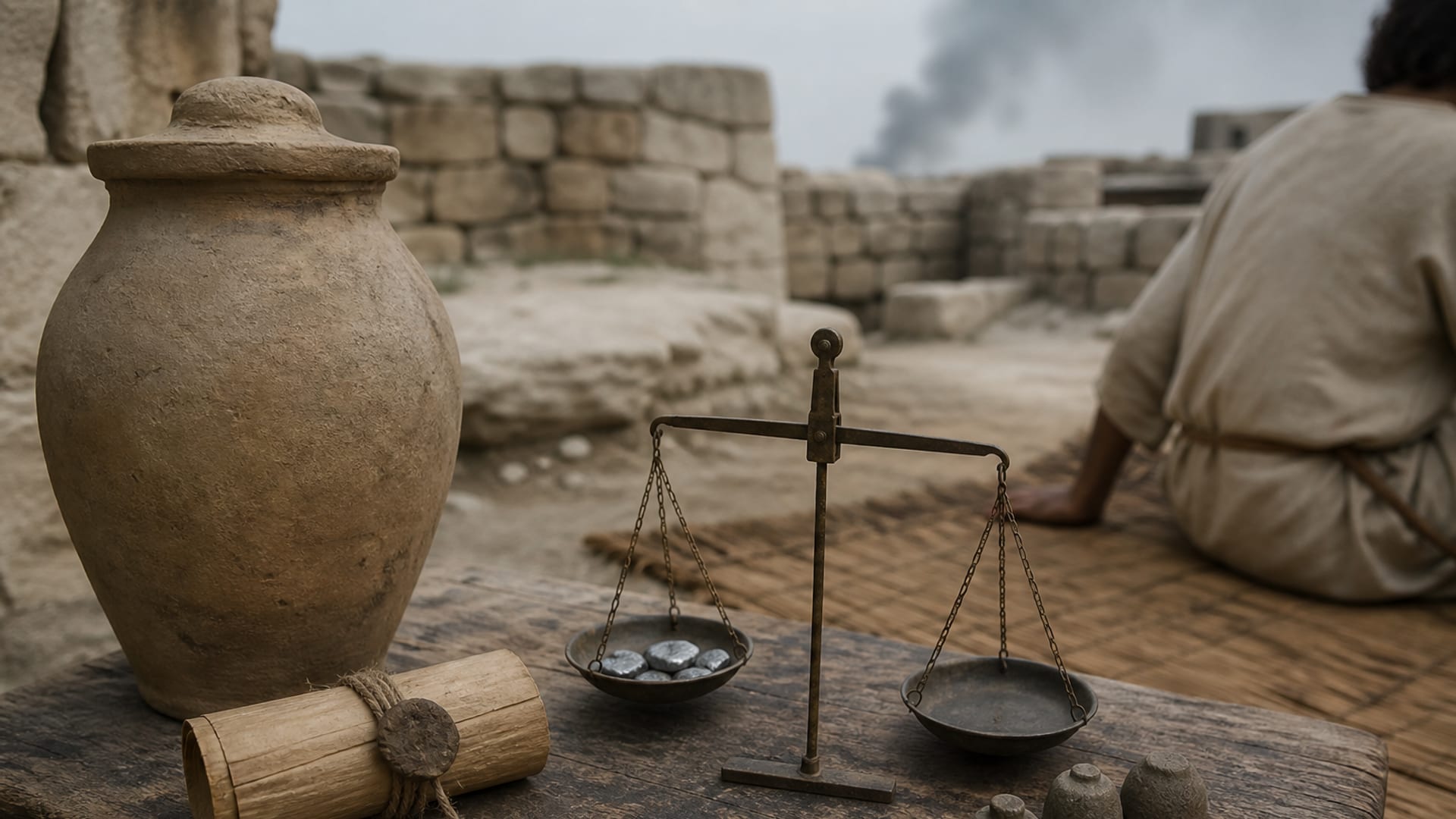
Jeremiah 32 opens with a date, an army, and a man under guard. Then, before it offers a line of prayer or promise, it records the purchase of a field, with more procedural care than almost any other sale in the Bible: the price, the scales, the deed, the seal, the witnesses, two copies, a custodian, and a clay jar.
It is a strange thing to linger over while a city starves.
Babylon’s army is dug in around Jerusalem. The prophet who has said for years that the city will fall is confined in the palace courtyard for saying it. The land he is asked to buy lies a few miles north, in country the enemy already controls. By any practical measure it is the worst investment in Judah, and that is exactly why the chapter slows down.
The Central Question
We usually picture hope as something inside a person, a mood that rises and falls. Jeremiah 32 treats it as something you can take to a notary. The passage asks whether a word from God is solid enough to act on publicly, with your own silver, when every visible fact argues against it.
Jeremiah acts. Then he prays, and the prayer shows he does not fully understand what he has done. So a study of this chapter has to hold both halves: the transaction in verses 1–15, and the bewilderment and long reply in verses 16–44.
The Historical World
The date. Verse 1 sets the word “in the tenth year of Zedekiah king of Judah, which was the eighteenth year of Nebuchadnezzar.” In our calendar that is around 588 or 587 BC. Precision is elusive because Judah and Babylon did not necessarily count royal years the same way, and the same problem surrounds the fall of the city. Rodger Young notes that scholars have long divided almost evenly between 587 and 586 BC, and in his own reconstruction Jeremiah 32:1 is one of the texts that decides between rival systems of reckoning.
What Babylon’s records say, and do not. The Babylonian Chronicle tablet in the British Museum (BM 21946) reports that in Nebuchadnezzar’s seventh year he besieged “the city of Judah,” seized it on the second of Addaru, captured its king, and appointed “a king of his own choice.” That is the capture of 597 BC, when Jehoiachin was deported and Zedekiah installed. The museum describes the tablet as a chronicle for 605 to 594 BC, and after the eleventh year it breaks off. As Young puts it, the Babylonian records describing the destruction of Jerusalem have not been found. Anyone who says Babylon’s annals confirm the scene in Jeremiah 32 has claimed more than the tablets give.
The siege and the pause. The siege began in Zedekiah’s ninth year (39:1). At one point it lifted when Pharaoh’s army came out of Egypt (37:5). During that lull Jeremiah set out “to go to the land of Benjamin to claim his portion there among the people” (37:12), was seized at the gate as a deserter, beaten, and jailed. Later Zedekiah moved him to the courtyard of the guard with “a loaf of bread daily from the street of the bakers, until all the bread in the city was gone” (37:21). Some interpreters connect that aborted trip with the field of chapter 32. The text does not, and we should not do it on the text’s behalf.
The courtyard was an open confinement. Hanamel walks in to make his offer, and verse 12 mentions “all the Jews sitting in the courtyard of the guard.” A prophet under arrest could still conduct a closing in front of a crowd.
Anathoth. Jeremiah’s hometown lay just north of Jerusalem in Benjamin, one of the towns Joshua 21:18 assigns to the priests, and Jeremiah came from its priestly families (1:1). It was also where his townspeople had threatened to kill him (11:21), and where his own brothers and his father’s household had betrayed him (12:6). Hanamel belongs to that household.
One detail from the ground is worth adding. After Jerusalem fell, the Babylonians made Mizpah, also in Benjamin, the seat of their governor Gedaliah, and Jeremiah went to live there (40:6). Jeffrey Zorn, who has worked for years on the excavated remains of Tell en-Nasbeh, the leading candidate for Mizpah, describes the Benjamin area as apparently left undamaged as a Babylonian base of operations. Jeremiah could not have known that when he paid.
Reading the Transaction Closely
The word comes before the knock. The LORD tells Jeremiah that Hanamel is coming to say, “Buy for yourself my field in Anathoth, for you have the right of redemption to buy it” (v. 7).
Then the knock, and the recognition. Hanamel arrives with nearly the same words, and Jeremiah writes: “Then I knew that this was the word of the LORD” (v. 8). He does not claim he was certain beforehand. The knowing arrives with the cousin. It is a modest account of guidance: a word received privately, confirmed by a relative with a practical request.
The payment and the procedure. “I weighed out seventeen shekels of silver. I signed and sealed the deed, called in witnesses, and weighed out the silver on the scales” (vv. 9–10). Jeremiah hands the sealed copy “with its terms and conditions” and the open copy to Baruch son of Neriah before Hanamel, the witnesses, and the detainees in the courtyard. In the Hebrew of verses 12 and 13 the phrase “in the sight of” occurs four times. The act is built to be remembered by other people.
The instruction and the reason. Baruch is to put both documents “in a clay jar to preserve them for a long time” (v. 14), because “Houses, fields, and vineyards will again be bought in this land” (v. 15).
Notice what that sentence leaves out. It never says Jeremiah will farm Anathoth or live to walk its boundaries. The deed is meant to outlast the siege, and quite possibly its buyer.
The Right of Redemption
The legal ground is Leviticus 25. “The land must not be sold permanently, because it is Mine, and you are but foreigners and residents with Me” (25:23). If a man fell into poverty and sold property, “his nearest of kin may come and redeem what his brother has sold” (25:25). That kinsman is the go’el, the redeemer, the role Boaz fills in Ruth 4.
Jeremiah’s case is close without being identical. In Leviticus the relative buys back land already sold to an outsider. Here Hanamel offers it to his kinsman first, keeping it in the clan before it can leave. We are not told why he needed to sell. A siege is reason enough to prefer silver to soil.
One puzzle stays open. Leviticus 25:34 says the pastureland around Levitical towns “may not be sold,” and Anathoth was such a town. Whether Hanamel’s field was that kind of land, or whether practice had drifted from the ideal, we simply do not know.
Language Notes
Mishpat ha-ge’ullah (v. 7). “The right of redemption.” Mishpat is the ordinary word for justice and legal claim. Before redemption is a theological image, it is a family’s enforceable duty, and when Isaiah calls the Holy One of Israel “your Redeemer” (Isaiah 41:14), he borrows from that world.
He-chatum and ha-galui (vv. 11, 14). “The sealed one” and “the open one.” Between them the Hebrew has a compressed phrase, ha-mitzvah ve-ha-chuqqim, literally “the commandment and the statutes,” which the BSB renders “terms and conditions.” It seems to refer to the contract’s stipulations, and translations handle it differently.
“So that they may stand many days” (v. 14). The documents go into a kli-cheres, an earthen vessel, lema’an ya’amdu yamim rabbim. The verb is the everyday word for standing or remaining. The BSB’s “to preserve them for a long time” is accurate; the Hebrew is simply more physical.
‘Od yiqqanu (v. 15). “Will again be bought.” The verb comes from the root q-n-h, to buy, which also forms miqnah, “purchase,” in “deed of purchase.” Counting every form, the root occurs fourteen times in the chapter. Its hope is written in the vocabulary of the market.
Too difficult (vv. 17, 27). Jeremiah prays, “Nothing is too difficult for You!” God answers, “Is anything too difficult for Me?” Both use pala’, to be extraordinary or beyond reach, the verb of Genesis 18:14 about Sarah’s son. God hands Jeremiah’s creed back to him as a question, at the moment the prophet is least sure of it.
Shevut (v. 44). The chapter ends with ashiv et-shevutam, which the BSB renders “I will restore them from captivity” and other versions “restore their fortunes.” The meaning of shevut is debated, and both senses suit a people on the edge of exile.
Archaeology: What It Illuminates and What It Cannot Prove
No excavation confirms that Jeremiah bought a field. Archaeology can show us the kinds of objects the chapter assumes its readers knew.
Weighed silver. Tzilla Eshel, who studies ancient silver hoards, describes the shekel as a weight of about 11.33 grams, calculated from the inscribed stone weights of eighth and seventh century Judah, and notes that coins reached the southern Levant only in the Persian period. Raz Kletter’s study of Judah’s weight system rests on hundreds of those weights. Seventeen shekels is a little under two hundred grams of silver. Whether that was cheap or generous we cannot tell, since the text gives neither the size of the field nor any sense of land prices under siege. Kesef, the Hebrew word, means both silver and money, and in verse 10 the scales show which was on the table.
Seals, and the fire that kept them. A sealed document in Jeremiah’s Jerusalem was usually papyrus, folded or rolled, tied, and closed with clay stamped by a seal. Papyrus rarely survives in the hill country, but fired clay can. In Yigal Shiloh’s excavations in the City of David, a building destroyed in the Babylonian burning of Jerusalem yielded a hoard of such bullae, published in the excavation’s final report, the documents themselves long since burned. One names Gemaryahu son of Shaphan, and a Gemariah son of Shaphan the scribe appears in Jeremiah 36:10, in whose chamber Baruch read Jeremiah’s scroll aloud. That find comes from a controlled excavation, and it shows the kind of archive Jeremiah’s deed belonged to.
A sealed copy and an open copy. In Mesopotamia a contract on a clay tablet could be enclosed in a clay envelope. Cécile Michel describes contract envelopes bearing the seals of the parties and witnesses with a substantial summary of the contract, and the Harvard Art Museums hold an eighteenth century BC land sale in this form, the same text on tablet and envelope with only minor variations. In the Greek legal papyri of Egypt, as W. Graham Claytor explains, the inner text of a double document could be rolled, tied and sealed, with the witnesses’ names written around the seals. Many deeds in the second century AD archive of Babatha, found in a leather purse in a cave near the Dead Sea, were double documents of this kind. The logic in every case is Jeremiah’s: one copy to consult, one sealed against tampering.
An Elephantine house deed. The Jewish community at Elephantine in Egypt left family archives of Aramaic legal papyri. One in the Brooklyn Museum records Ananiah giving a house to his daughter Yehoishema in 402 BC. According to the catalogue it arrived intact, folded, tied with linen string, and closed with a mud seal that still preserves the sealer’s fingerprints. It is not a double document and was not found in a jar. What it shares with Jeremiah 32 is the thing itself: a family’s title, written, sealed, and kept.
Clay jars. A jar keeps out damp and animals. The best-known example comes centuries later: the Leon Levy Dead Sea Scrolls Digital Library notes that the best-preserved scrolls of Qumran Cave 1 were said to have been protected by tall clay jars with lids intact. That is an illustration, not a parallel, but it shows Baruch’s instruction was practical.
The Baruch bulla. In 1978 Nahman Avigad published a clay bulla reading “Belonging to Berekhyahu son of Neriyahu the scribe,” the fuller forms of Baruch and Neriah. It came from the antiquities market with no known findspot, and a second impression of the same seal later surfaced. For years both were presented as Baruch’s own signature.
They are now seriously contested. Christopher Rollston and Heather Dana Davis Parker argued in 2005 that the Baruch bullae were modern forgeries, citing anomalies in the script. In 2014 Yuval Goren and Eran Arie compared both with more than 180 other bullae, most from Jerusalem, and concluded they were made in modern times. In 2016 Pieter van der Veen, Robert Deutsch and Gabriel Barkay replied that those arguments do not stand up to scrutiny. The object has no archaeological context, serious specialists consider it a forgery, and others defend it. A study of Jeremiah should put no weight on it.
Baruch Son of Neriah
Verse 12 is Baruch’s first appearance in the book, and he comes with a grandfather: “son of Neriah, the son of Mahseiah.” The same pair of names returns only for “Seraiah son of Neriah, the son of Mahseiah,” the officer who went to Babylon with Zedekiah (51:59), so Seraiah was very likely Baruch’s brother. Baruch writes Jeremiah’s scroll (36:4), reads it in the temple (36:10), writes it again after the king burns it (36:32), and goes with Jeremiah to Egypt (43:6). In chapter 32 he is a custodian, handed a deed whose fulfillment neither man was likely to see.
What Most Readers Miss
The promise repeats the paperwork. Verse 44: “Fields will be purchased with silver, and deeds will be signed, sealed, and witnessed in the land of Benjamin.” In Hebrew these are the verbs of verse 10: write, seal, witness. God describes the future by quoting Jeremiah’s procedure back to him. Restoration will look like ordinary conveyancing by ordinary families, and one purchase in a prison courtyard becomes the pattern.
The buyer had no heirs. In 16:2 the LORD had told him, “You must not marry or have sons or daughters in this place.” A man with no children buys a family field in a land about to be emptied. Whatever the purchase meant, it was no legacy for his descendants. It was a claim that the land itself had a future.
He bought from the family that had turned on him. The book never says whether that breach was mended. It only records that when a cousin from that house needed a buyer, Jeremiah paid in full, in front of witnesses.
The prayer has no ending. Jeremiah’s prayer (vv. 17–25) moves through creation, the exodus, the gift of the land and Israel’s disobedience, then stops almost mid-thought: “Yet You, O Lord GOD, have said to me, ‘Buy for yourself the field with silver and call in witnesses, even though the city has been delivered into the hands of the Chaldeans!’” No closing request follows. He has obeyed and is still trying to understand what he obeyed, and Scripture keeps the prayer untidied.
God does not soften the judgment first. Verses 26–35 confirm that the city will burn and list the reasons. Only then comes the promise of gathering, one heart, an everlasting covenant, and God planting them “in this land with all My heart and with all My soul” (v. 41). Verse 42 holds both in one sentence: “Just as I have brought all this great disaster on this people, so I will bring on them all the good I have promised them.”
“The field,” singular. Verse 43 in Hebrew reads ve-niqnah ha-sadeh, “and the field will be bought.” English rightly renders it “fields,” since the singular is collective. But the Hebrew quietly echoes verse 9, where Jeremiah bought “the field” at Anathoth.
Theological Meaning
The easy misreading turns Jeremiah into an optimist. He had said for decades that the city would fall, he was about to be proved right, and chapter 32 withdraws none of it.
What the chapter offers is hope on the far side of judgment, in the least sentimental form available. A feeling is private and can change overnight. A deed has a date, a price, a signature and a seal, and it can be produced before witnesses. When God wanted Judah to know there would be life in the land after Babylon, He did not begin by asking Jeremiah to feel encouraged. He asked him to sign something.
This follows the grain of Leviticus 25. The land belongs to the LORD, His people hold it as tenants, and the redeemer acts so that a family’s inheritance is not lost for good. Jeremiah’s purchase is one small act under that law. Verses 37–44 enlarge it: God Himself will gather, plant and restore, and make “an everlasting covenant” with His people (v. 40). What one kinsman did for one field becomes a picture of what God binds Himself to do.
Christian readers will hear an echo when Paul tells the Ephesians they were “sealed with the promised Holy Spirit, who is the pledge of our inheritance until the redemption of those who are God’s possession” (Ephesians 1:13–14). Paul does not cite Jeremiah 32, so this is canonical resonance and should be named as such. Still, sealing, inheritance and redemption travel together through the Bible, and the people who receive God’s promises are asked to live as though the deed will stand.
And the prayer matters. Obedience did not remove Jeremiah’s confusion, and God did not rebuke him for it. He answered at length.
Living It Now
Few of us will buy land during a siege, but the shape of the act carries over.
Hope in this passage has a cost and a date. It may mean keeping a commitment after the circumstances that made it sensible have collapsed, or planting, building or staying where others are leaving, because God has said something about the future the present does not yet show. The test is whether the act would only make sense if God keeps His word.
It is public. Jeremiah did it in front of his cousin, the witnesses and a courtyard of detainees. Christian hope was never meant to be a private mood; a community should be able to see it and hold you to it.
It does not require denial. Jeremiah bought the field and then described the siege ramps to God in detail. You can act on a promise and still name what is burning.
It does not depend on your own reward. The buyer had no one to inherit the field. Some of what we do in faith is for people we will never meet.
And it leaves room for an unfinished prayer. If your obedience has outrun your understanding, you are in Jeremiah’s company, and God answered him.
In a city about to burn, Baruch was told to put two copies of a deed into a clay jar. The jar had one purpose: to still be standing when the siege was a memory.
For reflection
- Where am I waiting to feel hopeful before I will act on something God has plainly said?
- What would a deed look like in my situation: a concrete act, with a cost and a date, that only makes sense if God keeps His word?
- Jeremiah obeyed first and prayed his confusion afterward. What would it mean to bring God a prayer that does not end neatly?
- Who are the witnesses in my life, the people who will remember what I committed to?
- Am I willing to invest in a future I may never personally enjoy?
Prayer
Lord GOD, You made the heavens and the earth, and nothing is too difficult for You.
When everything I can see says the city is lost, teach me to act on Your word anyway, in ways other people can witness.
Keep me honest when I obey before I understand.
Plant Your people in this land again, as You promised. Amen.
Jeremiah did not wait to feel hopeful. He weighed out the silver, signed the deed, and put the promise in a jar.
Sources and notes
Consulted while writing this piece. Nothing is listed here that was not used.
- Berean Standard Bible primary text
- Hebrew text of Jeremiah 32 and Genesis 18:14 (Masoretic Text), consulted through the Sefaria library primary text
- British Museum, clay tablet 21946 (reg. 1896,0409.51), Babylonian Chronicle for the years 605 to 594 BC, collection record museum record
- Livius.org, ABC 5 (Jerusalem Chronicle), translation of the chronicle with notes primary text
- Rodger C. Young, When Did Jerusalem Fall?, Journal of the Evangelical Theological Society 47/1 (2004), 21-38 historical study
- Jeffrey R. Zorn, on biblical Mizpah and Tell en-Nasbeh, Biblical Archaeology Society, 2008 historical study
- Tzilla Eshel, How Silver Was Used for Payment, TheTorah.com historical study
- Raz Kletter, Economic Keystones: The Weight System of the Kingdom of Judah (JSOT Supplement Series 276; Sheffield Academic Press, 1998) historical study
- Yair Shoham, Hebrew Bullae, in D. T. Ariel (ed.), Excavations at the City of David 1978-1985 Directed by Yigal Shiloh, vol. VI: Inscriptions (Qedem 41; Institute of Archaeology, Hebrew University of Jerusalem, 2000) excavation report
- Harvard Art Museums, 1983.107, Cuneiform Tablet and Envelope: Old Babylonian Sale Document museum record
- Cécile Michel, The Louvre looks inside sealed clay envelopes, Centre for the Study of Manuscript Cultures, University of Hamburg, 2024 historical study
- W. Graham Claytor, Rogue notaries? Two unusual double documents from the late Ptolemaic Fayum, Journal of Juristic Papyrology 44 (2014), 93-115 historical study
- Naphtali Lewis (ed.), The Documents from the Bar Kokhba Period in the Cave of Letters: Greek Papyri (Judean Desert Studies; Israel Exploration Society, 1989) primary text
- Brooklyn Museum, 47.218.88, Ananiah Gives Yehoishema a House (Elephantine, 402 BC), catalogue description museum record
- Leon Levy Dead Sea Scrolls Digital Library (Israel Antiquities Authority), Discovery Sites museum record
- Nahman Avigad, Baruch the Scribe and Jerahmeel the King's Son, Israel Exploration Journal 28 (1978), 52-56 historical study
- Yuval Goren and Eran Arie, The Authenticity of the Bullae of Berekhyahu Son of Neriyahu the Scribe, Bulletin of the American Schools of Oriental Research 372 (2014), 147-158 historical study
- Christopher A. Rollston and Heather Dana Davis Parker, Responses to the Epigraphic Forgery Crisis, The Bible and Interpretation, 2005 historical study
- Pieter G. van der Veen, Robert Deutsch and Gabriel Barkay, Reconsidering the Authenticity of the Berekhyahu Bullae: A Rejoinder, Antiguo Oriente 14 (2016) historical study
Scripture in English is from the Berean Standard Bible, placed in the public domain by its publisher on 30 April 2023.