
Bible Study
A Name at the Gate
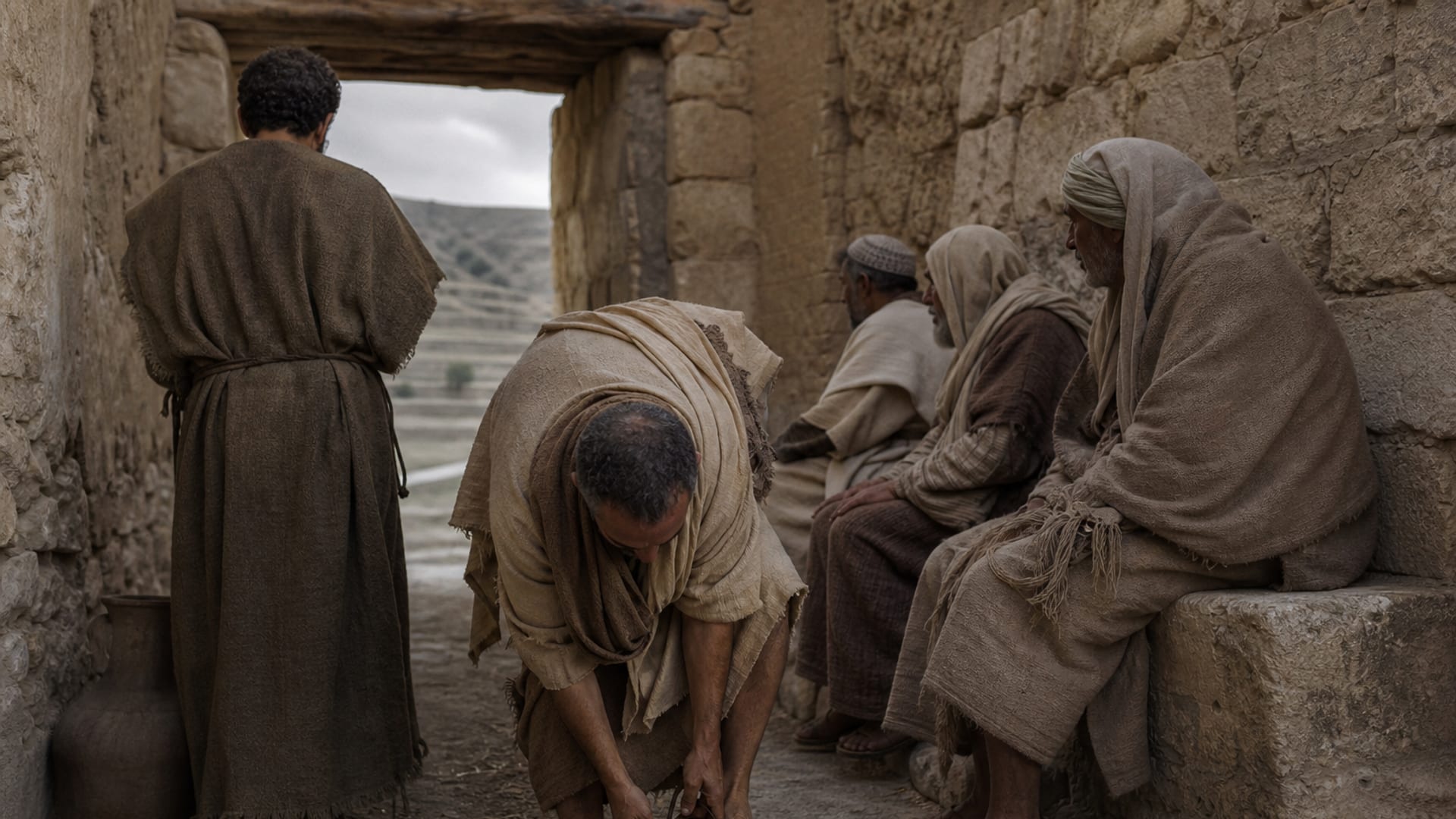
Boaz settles Ruth's future at the town gate, before ten elders and a relative who had every right to go first. The relative says no, and the narrator quietly declines to give his name.
Scripture Ruth 4:1–12 · Ruth 4:13–22 · Deuteronomy 25:5–10 · Leviticus 25:23–28 · Jeremiah 32:6–12 · Genesis 38:8–30
Ruth 4 is crowded with names. Boaz, Naomi, Elimelech, Chilion and Mahlon. Rachel and Leah, Judah and Tamar and Perez. By the last verse there is a genealogy of ten generations that closes on David.
One man in the chapter speaks, makes a legal decision, removes a sandal and walks out of the story without a name.
Boaz calls him over with a Hebrew expression, peloni almoni, that is not a name at all. It is what you say when you are deliberately not saying the name, something like “so-and-so.” The BSB, reaching for natural English, renders it “my friend.” The ancient Greek translation chose a word that its modern English edition renders “Hidden One.”
The central question
Why does a man who says “I will redeem it” in verse 4 say “I cannot redeem it” two verses later? And why does a narrator who names three dead men in the same scene refuse to name him?
From the threshing floor to the gate
Chapter 3 happens at night and in private. Naomi tells Ruth to “go down to the threshing floor,” and she “went down.” Chapter 4 opens with Boaz at the gate, and the Hebrew says he went up (ʿalah). Part of that is the lie of the land around a hill town. The movement also carries the story from darkness to daylight, from a whispered conversation to the one place in an Israelite town where matters were settled in front of everyone.
Boaz had hinted at this already. When he told Ruth that “all my fellow townspeople know that you are a woman of noble character” (3:11), the Hebrew behind “all my fellow townspeople” is literally “all the gate of my people.” Before the scene at the gate begins, Boaz has told her that the gate already knows who she is. He has also sworn an oath: “If he does not want to redeem you, as surely as the LORD lives, I will” (3:13).
The gate as a courtroom
In the Old Testament the gate is where elders sat and where law became public. A rebellious son is brought “to the elders of his city, to the gate of his hometown” (Deuteronomy 21:19). Amos sums up the demand of justice as “establish justice in the gate” (Amos 5:15). The husband of the woman of noble character in Proverbs “is known at the city gates, where he sits among the elders of the land” (Proverbs 31:23).
The opening of Ruth 4 is staged with legal care. Boaz sits. The relative “came along,” introduced with the small Hebrew word hinneh (“look”) that marked Boaz’s own well-timed arrival in the field in 2:4. Boaz tells him to sit, and he sits. Boaz takes ten of the elders and says “Sit here,” and they sit. By the time anyone mentions land, a court has been convened.
The text does not explain the number ten, and no law requires it. The Babylonian Talmud (Ketubot 7b) cites Ruth 4:2 as the source for requiring ten men at the wedding blessings. That is later interpretation, yet it shows how early readers heard the scene: as a public act that needed witnesses. Boaz says “You are witnesses today” twice, and the people answer, “We are witnesses.”
The closest biblical parallel is Jeremiah 32, where the prophet’s cousin offers him a family field, “for you have the right of redemption to buy it,” and urges, “Buy it for yourself” (Jeremiah 32:7–8). Those last words are, in Hebrew, exactly what the nearer kinsman says to Boaz in Ruth 4:8, and the BSB renders them identically. Jeremiah’s purchase uses a sealed deed and Ruth’s uses a sandal, but both happen before witnesses, and both keep family land in the family.
What the gates looked like, and what we cannot say
At Dan, in the far north, Avraham Biran’s excavations exposed an Iron Age gate complex with an outer gate, a paved courtyard and an inner gate. In the courtyard stood what the excavator called the “bench of the elders,” along with a canopied structure and an installation of five standing stones, in phases Biran dated to the ninth and eighth centuries BC. At Beersheba, in the south, Ze’ev Herzog described Iron Age gate chambers “open to the passageway and furnished with built-in benches,” beside a city square.
The caveats matter as much as the stones. The large six-chamber gates at Megiddo, Hazor and Gezer were once confidently assigned to Solomon, and that dating has been contested for decades; David Ussishkin, among others, argues that the Megiddo gate is considerably later. Dan and Beersheba were administrative centers. Bethlehem was a hill town, and no Iron Age gate has been excavated there. What the area has produced for this period is mainly funerary, a necropolis southeast of the town documented in rescue excavations by Sapienza University of Rome and Palestinian archaeologists. A tiny clay bulla of the late eighth or seventh century BC, found in soil from excavations in Jerusalem and announced in 2012, is read as naming Bethlehem as a town sending a shipment to the king.
The Bible gives Bethlehem a gate: David longs for water “from the well near the gate of Bethlehem” (2 Samuel 23:15). Still, the gate in Ruth is best imagined as a town entrance with somewhere to sit, not the gatehouse of a royal fortress.
The narrator also marks distance in time. Verse 7 explains the sandal as something done “in former times in Israel,” an aside for readers who no longer practiced it. The story is set “in the days when the judges ruled” (1:1) but was written for a later audience. How much later is disputed, with proposals running from the monarchy to the Persian period.
Close reading: how Boaz frames the case
Boaz opens with land, not with Ruth. “Naomi, who has returned from the land of Moab, is selling the piece of land that belonged to our brother Elimelech” (4:3). What exactly Naomi is selling is debated; Frederic Bush argues she is more likely disposing of her right to use and redeem the property than selling the land outright.
Then comes an echo English cannot keep. Boaz says, in the Hebrew idiom, “I said I would uncover your ear” (4:4), which the BSB sensibly renders “I thought I should inform you.” The verb is galah, “uncover,” the one used when Ruth “uncovered his feet” at the threshing floor (3:4, 3:7). The night before, Ruth uncovered Boaz. This morning Boaz uncovers the matter to the man who stands ahead of him.
The man answers with an emphatic pronoun: “I will redeem it.” It is the same emphatic “I” Boaz used when he swore to Ruth (3:13). For one sentence the nearer kinsman looks like the hero.
Verse 5 turns everything. In the BSB: “On the day you buy the land from Naomi and also from Ruth the Moabitess, you must also acquire the widow of the deceased in order to raise up the name of the deceased on his inheritance.”
The verse is notoriously difficult. The Hebrew consonants read “and from Ruth,” which the BSB keeps. Many translations adopt a one-letter correction, supported by the Latin Vulgate, that yields “also Ruth”: when you acquire the field from Naomi, you also acquire Ruth. Raanan Eichler argues that exactly such a scribal slip occurred. The verb has its own problem. The written Hebrew reads “I acquire,” while the reading tradition in the margin says “you acquire.” Most commentators, and the BSB, follow “you acquire.” A minority, including D. R. G. Beattie and more recently Gary Rendsburg, defend “I acquire,” so that Boaz is announcing his own claim on Ruth.
On any of these readings the effect on the relative is the same. The field now comes with a widow, and with a future son who would carry a dead man’s name.
Why he says no
“I cannot redeem it myself, or I would jeopardize my own inheritance” (4:6).
The text does not spell out the arithmetic. The usual modern explanation, argued by Robert Hubbard and Frederic Bush, is economic. The kinsman would pay for Elimelech’s field, support two widows, and father a son who would legally belong to Mahlon’s line and take the field with him. The cost would come out of what his own children stood to inherit.
Ancient readers offered other answers. The Aramaic Targum has him say he already has a wife and may not take another, “lest the result be quarrel in my home.” The midrash Ruth Rabbah imagines him afraid to marry a Moabite, since Deuteronomy 23:3 excludes Moabites from the assembly, and notes that he did not know the ruling, recorded in the Mishnah (Yevamot 8:3), that the exclusion applied to Moabite men and not to Moabite women. Josephus, retelling the story in Greek in the first century AD, simply merged it with Deuteronomy 25 and had Ruth loosen the man’s shoe and spit in his face. The biblical text has no spitting and does not place Ruth at the gate.
Nothing in the book calls this man wicked. He follows procedure, gives up his right in public, and makes the kind of choice careful people make every day. Yet the narrator lets one verb carry more than any comment could. The word behind “jeopardize” is shachat, to ruin or destroy. The same root appears in Genesis 38:9, where Onan, knowing “that the offspring would not belong to him,” wasted his seed on the ground rather than raise up a child for his dead brother. The BSB rightly translates the two passages differently. But three verses after the kinsman speaks, the elders bless Boaz with “the house of Perez, whom Tamar bore to Judah,” and the book itself sends us back to Genesis 38.
The kinsman is no Onan. He deceives no one. His reasoning simply has the same shape: a child who will not count as his is a loss to be avoided.
Ruth 4 and Deuteronomy 25
Many readers take Ruth 4 as a plain application of the levirate law in Deuteronomy 25:5–10. The overlap is genuine. Both scenes happen at the gate before elders, and both involve a sandal. In Deuteronomy the widow complains that her brother-in-law “refuses to preserve his brother’s name in Israel” (25:7), and the Hebrew phrase, to raise up a name, is the one Boaz uses in Ruth 4:5 and 4:10. Deuteronomy’s shaming formula speaks of the man “who will not maintain his brother’s line” (25:9), literally the man who “will not build his brother’s house,” and in Ruth the elders pray that Ruth will be like Rachel and Leah, “who together built up the house of Israel” (4:11).
The differences are larger than most sermons admit. Deuteronomy concerns brothers who “dwell together”; Boaz and the kinsman are more distant relatives. In Deuteronomy the widow herself pulls off the man’s sandal and spits in his face, and his family is called “The House of the Unsandaled.” In Ruth the man removes his own sandal, nobody spits, Ruth is absent, and no shame attaches to him beyond the narrator’s silence about his name. The verbs differ too: Deuteronomy has chalats, Ruth has shalaf. Most telling, the narrator in 4:7 does not explain the sandal by appeal to Moses. He calls it an old custom “concerning the redemption or exchange of property.”
Ruth draws on two strands of the Torah without being a simple case of either. From Leviticus 25 comes the redeemer who buys back what a poor relative has sold, because “the land must not be sold permanently, because it is Mine” (Leviticus 25:23). From Deuteronomy 25 comes the concern that a dead man’s name not be blotted out. No law requires a redeemer of land to marry a widow. Elsie Stern reads the book as reflecting the customary law of kinship rather than the letter of Deuteronomy; others think Boaz joined the two duties himself. The text does not settle it. It is clear enough what the kinsman was willing to do: redeem a field, not build a house.
The go’el
In Israel’s law the go’el, “redeemer,” bought back family land (Leviticus 25:25) and redeemed a relative sold into servitude (25:47–49). In homicide cases the same word names “the avenger of blood” (Numbers 35:19). Then prophets and poets give the word to God: “Your Redeemer is the Holy One of Israel” (Isaiah 41:14); “I know that my Redeemer lives” (Job 19:25). A go’el is the relative who steps in when someone cannot recover what they have lost.
When Boaz admits “there is a redeemer nearer than I” (3:12), he echoes Leviticus 25:25, where the one who redeems is “his nearest of kin.” And Ruth’s request at the threshing floor, “Spread the corner of your garment over me” (3:9), uses kanaf, the word Boaz had used in 2:12 for the LORD’s “wings” under which she had taken refuge. Boaz prayed for God to shelter her. Ruth asks Boaz to become part of the answer.
What most readers miss
Ruth’s husband is named for the first time at the gate. Chapter 1 says Naomi’s sons married Orpah and Ruth, but not who married whom. Only in 4:10 does Boaz announce he has acquired “Ruth the Moabitess, Mahlon’s widow.” The dead man’s name is spoken in public at the moment it is being preserved.
The last redeemer in the book is a baby. When the women say, “Blessed be the LORD, who has not left you this day without a kinsman-redeemer” (4:14), they mean the newborn Obed, the one who “will renew your life and sustain you in your old age.”
That blessing answers Naomi’s complaint. In 1:21 she said, “I went away full, but the LORD has brought me back empty.” The Hebrew behind “brought me back” is the verb shuv. In 4:15 the phrase “renew your life” uses a form of the same verb: the child will be one who brings life back.
One Hebrew word links Boaz, Ruth and the blessing. Boaz is a man of chayil (2:1, “noble character”), Ruth a woman of chayil (3:11), and the elders pray that Boaz will do chayil in Ephrathah (4:11, “be prosperous”). “A woman of chayil” also opens the poem of Proverbs 31:10. In the Leningrad Codex, the manuscript behind the standard scholarly editions of the Hebrew Bible, Ruth follows Proverbs directly, so a poem about a noble woman whose husband sits with the elders is followed by the story of a noble woman whose redeemer sits with the elders. The Talmud (Bava Batra 14b) knew another order, with Ruth first among the Writings, so the sequence is a tradition rather than either author’s design. It is a perceptive one.
The name is withheld on purpose. Peloni almoni appears elsewhere when a speaker chooses not to disclose something: the “certain place” where David’s men are to meet him (1 Samuel 21:2), the “such and such a place” where the king of Aram will camp (2 Kings 6:8). In a town the size of Bethlehem, Boaz surely used the man’s real name. The narrator did not pass it on. The NET Bible’s translators call this a kind of poetic justice, and it fits. He would not raise up a dead man’s name, and his own was not kept.
Ancient readers disagreed about whose sandal it was. The Hebrew of verse 8 says only that “he drew off his sandal,” without naming him; the BSB reasonably supplies the kinsman as the subject. The Septuagint adds “and gave it to him.” Ruth Rabbah records Rav and Levi disagreeing over whether it was the kinsman’s or Boaz’s, and the Targum turns it into a glove taken off by Boaz.
Theological meaning
The characters of Ruth invoke the LORD constantly, in blessings, oaths and complaints. In the narrator’s own voice, though, God acts only twice: at the start, when “the LORD had attended to His people by providing them with food” (1:6), and here, when “the LORD enabled her to conceive” (4:13). Everything in between happens through gleaning, a mother-in-law’s plan, a night conversation and a morning court session.
That restraint is the theology of Ruth 4. God’s faithfulness reaches Naomi and Ruth through a lawful procedure carried out by a man willing to absorb the cost. Boaz performs no miracle at the gate. He gathers witnesses, states the case honestly, gives the other man a real choice, and accepts the expense the other man declined. Hesed, the loyal love the book keeps praising, looks a great deal like integrity in public business on behalf of people who cannot act for themselves.
The ending widens the frame. A woman from Moab, a people Deuteronomy 23:3 excludes from the assembly, is blessed at the gate of Bethlehem as one who will build a house like Rachel and Leah. The book does not argue with Deuteronomy. It tells a story whose last word is David, and leaves its readers to reckon with who belongs.
Christological connection
Explicit. Matthew’s genealogy names her: “Boaz the father of Obed by Ruth” (Matthew 1:5), alongside Tamar and Rahab, and Luke traces the line through “the son of Obed, the son of Boaz” (Luke 3:32). The New Testament places the genealogy of Ruth 4:17–22 in the ancestry of Jesus, the son of David. (Matthew’s naming of Rahab as the mother of Boaz is a detail the book of Ruth does not contain.)
Canonical and typological. The Old Testament applies the redeemer’s role to God, and Paul writes that God sent His Son “to redeem those under the law” (Galatians 4:5). Seeing in Boaz a picture of a redeemer who takes on a cost another refused is a fair analogy, as long as it is named as one. The New Testament never cites Ruth 4 to explain the work of Christ.
Not warranted. An old allegorical habit makes the nameless kinsman stand for the Law, which cannot redeem. Nothing in the text supports it, and it turns a cautious, law-abiding man into a symbol he was never written to be.
For today
Most readers will recognize themselves more readily in the nearer kinsman than in Boaz. He is not cruel. He is prudent. He would help, but not at the expense of what he is building for his own children. That is a respectable position, and it is precisely the one the book declines to honor with a name.
Ruth never appears at the gate. Her future is settled in a meeting she does not attend, among men discussing a field. What protected her was a man who cared about her and was also willing to act in public, before witnesses, and to be held to what he said there. Many people who most need that kind of faithfulness are absent from the rooms where their lives are decided.
For anyone who feels like Naomi at the end of chapter 1, the book offers a quiet hope. Her restoration did not arrive as a spectacle. It arrived as a child placed on her lap, and a name that reached all the way to David.
For reflection
- The nearer kinsman broke no law. Where does ordinary prudence in my life turn into protecting what is mine at someone else's expense?
- Ruth's future was decided in a meeting she did not attend. Who depends on me to act for them in rooms they will never enter?
- Boaz made the matter public and bound himself before witnesses. Is there a commitment I keep private so that I can quietly leave it undone?
- Naomi said the LORD had brought her back empty, and the book ends with a child on her lap. How do I respond when God restores slowly and through ordinary means?
- Scripture uses the same word for Boaz and for God: redeemer. What does that suggest about how God regards what I have lost?
Prayer
Lord, You are the Redeemer of what we cannot buy back ourselves.
Where I have guarded my own inheritance at the cost of someone else's, forgive me and make me generous.
Make me faithful in public, before witnesses, for people who are not in the room.
Amen.
The man who protected his inheritance is the only person in the chapter left without a name. The man who spent his own is remembered in the line of David.
Sources and notes
Consulted while writing this piece. Nothing is listed here that was not used.
- Berean Standard Bible primary text
- Hebrew text of Ruth 4, Miqra according to the Masorah (Sefaria) primary text
- Routh, trans. Frederick W. Knobloch, in A New English Translation of the Septuagint (Oxford University Press, 2007) primary text
- Targum of Ruth 4:6-8, trans. Samson H. Levey (Sefaria) primary text
- Ruth Rabbah 7:7-12 (Sefaria Midrash Rabbah, 2022) primary text
- Babylonian Talmud, Ketubot 7b and Bava Batra 14b (William Davidson edition, Sefaria) primary text
- Mishnah Yevamot 8:3 (William Davidson edition, Sefaria) primary text
- Josephus, Jewish Antiquities 5.332-335, trans. William Whiston primary text
- NET Bible translators’ notes on Ruth 3–4 (Biblical Studies Press) commentary
- Frederic W. Bush, Ruth, Esther, Word Biblical Commentary 9 (Word, 1996) commentary
- Robert L. Hubbard Jr., The Book of Ruth, New International Commentary on the Old Testament (Eerdmans, 1988) commentary
- Raanan Eichler, Acquiring Ruth with the Land: A Text-Critical Solution for Ruth 4:5, TheTorah.com commentary
- Gary A. Rendsburg, Boaz Married Ruth at the Threshing Floor: A Grammatical Solution to Ruth 4:5, TheTorah.com commentary
- Elsie R. Stern, Kinship over Covenant: The Book of Ruth’s Traditional Challenge to Deuteronomy, TheTorah.com historical study
- Avraham Biran, Dan, in The New Encyclopedia of Archaeological Excavations in the Holy Land (Israel Exploration Society) excavation report
- Ze’ev Herzog, Israelite City Planning, Expedition 20.4 (1978), Penn Museum excavation report
- David Ussishkin, The So-Called Solomonic City-gate at Megiddo, ASOR Blog (2013) historical study
- L. Nigro et al., Protecting and rehabilitating the archaeology of Bethlehem, Antiquity (2018) excavation report
- Bible History Daily, History of Bethlehem Documented by First Temple Period Bulla from the City of David (2012) excavation report
- Biblia Hebraica Stuttgartensia (Deutsche Bibelgesellschaft, 1977), based on the Leningrad Codex primary text
Scripture in English is from the Berean Standard Bible, placed in the public domain by its publisher on 30 April 2023.