
Bible Study
Thirsty at the Sixth Hour
Jesus asks a Samaritan woman for water before he offers her anything. A close reading of John 4, with the road, the well, the mountain and the woman's story checked against what the text actually says.
Scripture John 4:1–42 · 2 Kings 17:24–41 · Deuteronomy 18:15–18 · Jeremiah 2:13 · John 7:37–39 · John 19:14 · John 19:28
Jesus asks for water before he offers any.
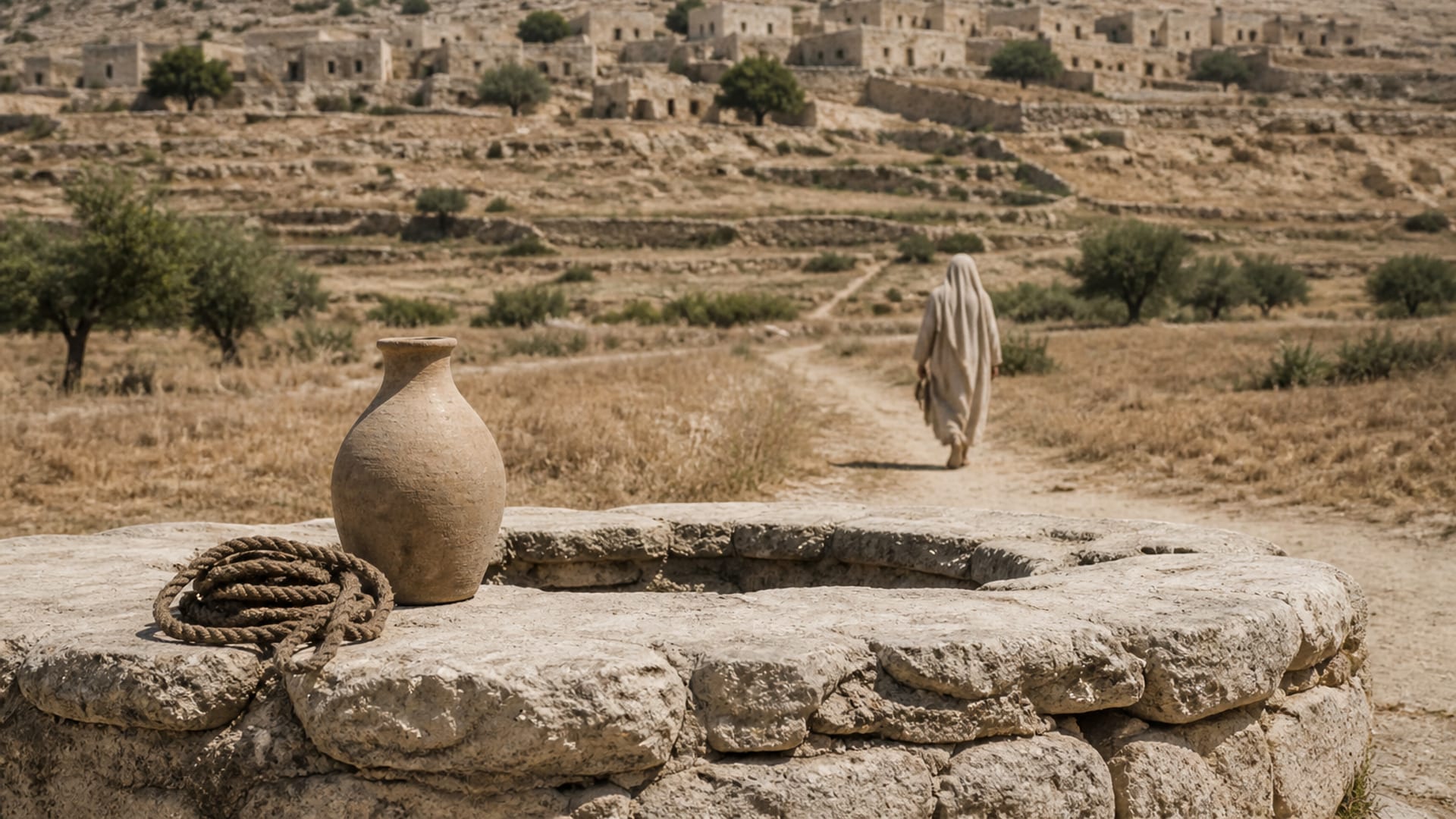
That is the order of events in John 4, and it is easy to read past. A tired traveler sits down beside a well around midday. A woman comes out to draw. The first words of one of the longest private conversations in the Gospels are a request: “Give Me a drink.”
As far as John tells us, he never gets it. By the end of the chapter a Samaritan town has walked out across the fields to meet him, and his disciples are still wondering who brought him lunch.
Most of us arrive with the story already told: a woman with a scandalous past, hiding from the other women at noon, exposed and then forgiven. Some of that is on the page. Much of it is not. The question for this study is what John actually wrote.
He had to pass through Samaria
Jesus leaves Judea for Galilee, and John adds: “Now He had to pass through Samaria” (4:4).
A familiar explanation says devout Jews always avoided Samaria by going around through the Jordan valley, so “had to” must signal a divine appointment. The conclusion may be right. The premise needs correcting. Josephus says it was “the custom of the Galileans, when they came to the holy city at the festivals, to take their journeys through the country of the Samaritans” (Antiquities 20.118), and that by that road “you may, in three days’ time, go from Galilee to Jerusalem” (Life 269). It was the normal route. It was not a safe one: the same passage of the Antiquities describes villagers on the Samaritan border killing a number of Galilean pilgrims around AD 50.
So “had to” has a plain geographic sense. It also has a Johannine one. The Greek is edei, “it was necessary,” and John uses that verb with weight. The Son of Man must be lifted up (3:14). “I have other sheep that are not of this fold. I must bring them in as well” (10:16). In this chapter it returns twice: the woman speaks of the place “where one must worship,” and Jesus answers that true worshipers “must worship Him in spirit and in truth” (4:20, 24). John never says which necessity he meant. His vocabulary suggests he would not have pulled them apart.
Neighbors with long memories
Jewish tradition traced the Samaritans to 2 Kings 17. After Assyria destroyed the northern kingdom, “the king of Assyria brought people from Babylon, Cuthah, Avva, Hamath, and Sepharvaim and settled them in the towns of Samaria to replace the Israelites” (17:24), and these settlers “worshiped the LORD, but they also served their own gods” (17:33). Josephus retells the story and sneers that the Samaritans claim kinship with the Jews “as though they were derived from Joseph” whenever the Jews happen to be prospering (Antiquities 9.291).
The Samaritans did claim descent from the northern tribes, and they held the five books of Moses as Scripture. The woman here calls Jacob “our father” (4:12). How much of their ancestry was Israelite is still debated. The hostility is not.
A sanctuary stood on Mount Gerizim, the mountain of blessing in Deuteronomy 11:29. Josephus ties its founding to the age of Alexander the Great, but Yitzhak Magen’s excavations date the first sacred precinct to the mid fifth century BC. Late in the second century BC the Jewish ruler John Hyrcanus took Shechem and Gerizim and destroyed that temple (Antiquities 13.254-256). Josephus implies a date around 128 BC; Magen argues from the coins that it fell about 110 BC. Either way, when Jesus sat at the well the Samaritan temple had been a ruin for more than a century, and a Jewish king had made it one.
The injuries ran both ways. Josephus reports Samaritans slipping into the Jerusalem temple at Passover, early in the first century, and scattering human remains in the porticoes (Antiquities 18.29-30). A Samaritan village refused Jesus “because He was heading for Jerusalem” (Luke 9:53). His opponents in John 8:48 call him “a Samaritan” with a demon. And the Mishnah, compiled around AD 200, treats Samaritan girls as ritually unclean from the cradle (Niddah 4:1). That ruling is later than the Gospels, but it shows where the attitude could lead.
A well between two mountains
Sychar appears nowhere else in the Bible. John places it “near the plot of ground that Jacob had given to his son Joseph,” recalling Genesis 33:19 and Joshua 24:32. Ancient Shechem is identified with Tell Balata, on the eastern edge of modern Nablus, in the pass between Gerizim and Ebal. Excavation there shows a Hellenistic town that ended in the late second century BC, consistent with Josephus on Hyrcanus. The Romans founded Flavia Neapolis nearby in AD 72.
Since Shechem was probably not inhabited in Jesus’ day, many identify Sychar with the village of Askar, a short walk northeast of the well. That is not certain. Askar has its own spring, which makes it harder to explain the woman’s walk. The earliest surviving Christian pilgrim itinerary, from a traveler from Bordeaux in AD 333, already distinguishes Shechem from Sychar and places Sychar a mile away.
Genesis never mentions Jacob digging a well at Shechem. The site near Tell Balata is attested by fourth-century pilgrims and fits John’s description, which makes it a reasonable identification. No excavated layer can tell us it is the patriarch’s shaft.
What the setting does give us is verse 20. When the woman says, “Our fathers worshiped on this mountain,” she has no need to describe it. Gerizim rises over the valley.
A Jew asks a Samaritan for help
“Give Me a drink” crosses several lines. He is a Jew addressing a Samaritan. He is a man alone with a woman he does not know, and it is this, not her history, that surprises the disciples: they “were surprised that He was speaking with a woman” (4:27). And he would have to drink from her vessel, since “You have nothing to draw with” (4:11).
John’s aside in verse 9 is usually rendered “Jews do not associate with Samaritans.” It cannot be fully literal, because the disciples have gone into town to buy food. In 1950 David Daube argued that the verb, synchraomai, meant “use vessels together with,” making it a purity issue. More recently Gary Manning has argued that the grammar does not allow that, and that with a person as its object the verb usually means “get help from.” A Jew is asking a Samaritan for help.
The debate is open. Every option leaves Jesus in need, asking, from someone his people kept at arm’s length.
Two words for one well
Jesus reverses the request. If she knew the gift of God and who was asking, “you would have asked Him, and He would have given you living water” (4:10).
She hears it as anyone in that valley would. Living water meant running water, from a spring or stream, rather than water that has been collected and sits. Hebrew has the same idiom, mayim ḥayyim, which the BSB renders “fresh water” in Genesis 26:19 and Leviticus 14:5. The Mishnah later ranks waters for purification and puts living water at the top (Mikvaot 1:1-8).
So she answers practically. “Sir, You have nothing to draw with and the well is deep. Where then will You get this living water? Are You greater than our father Jacob, who gave us this well?” (4:11–12).
English readers miss a detail here. John uses two words for the well. In verse 6 it is a pēgē, a spring or fountain. In the woman’s mouth, in verses 11 and 12, it is a phrear, a dug shaft. Then Jesus returns to the first word: the water he gives “will become in him a fount of water springing up to eternal life” (4:14). She is thinking of a hole you lower a jar into. He means water that rises by itself.
Jeremiah had already given the contrast its force: God’s people “have forsaken Me, the fountain of living water” for cisterns that crack (Jeremiah 2:13). And John tells us what the living water is. At the Feast of Tabernacles Jesus says, “Streams of living water will flow from within him,” and John explains, “He was speaking about the Spirit” (7:38–39).
What the text says about her
“Go, call your husband and come back.” “I have no husband.” “You are correct to say that you have no husband. In fact, you have had five husbands, and the man you now have is not your husband” (4:16–18).
From those lines, and from “about the sixth hour,” a whole biography has been built. Take it piece by piece.
The sixth hour, counted from sunrise, is about noon. John does not say why she came then or that she was avoiding anyone. Genesis 24:11 names evening as “the time when the women went out to draw water,” which may make noon unusual. Genesis 29:7 has shepherds at a well while “it is still broad daylight.” The hour may be in the text for another reason, which we will come to.
Five husbands is a great deal, and Jesus names it as true. It is not the same as five divorces for misconduct. In the Jewish legal world of the time a husband could divorce his wife, and a wife could not simply divorce her husband. Disease and childbirth ended lives early. Lynn Cohick argues that repeated bereavement is more likely than serial scandal, and that her present arrangement could reflect any of several ordinary obstacles to a formal marriage. We do not know Samaritan marriage law in detail, and we do not know her story. John does not tell us.
He does show how the conversation goes. The passage contains no rebuke and no pronouncement of forgiveness. That does not prove she was blameless; it shows where John’s attention lies. Twice Jesus says she has spoken truly. She recognizes a prophet and raises the most contested question between their peoples. Back in town people listen to her, and many believe “because of the woman’s testimony” (4:39). Shunned women rarely get that hearing.
Her own summary: “a man who told me everything I ever did” (4:29). She describes being known.
Some scholars, Craig Koester among them, also read the five husbands as Samaria’s history, the five peoples Assyria settled there. Josephus does count five nations. But 2 Kings lists more than five gods for them (17:30–31), and John gives no signal of allegory. The idea can illuminate the chapter. It should not erase a real woman.
This mountain, or Jerusalem
“Sir, I see that You are a prophet. Our fathers worshiped on this mountain, but you Jews say that the place where one must worship is in Jerusalem” (4:19–20).
This is often called a deflection. The text does not say so. It reads just as naturally as the obvious question to bring a prophet, with the ruins of her people’s temple on the ridge above.
Jesus says two things that belong together. “Salvation is from the Jews” (4:22): he does not pretend the traditions are equal. And “a time is coming and has now come when the true worshipers will worship the Father in spirit and in truth” (4:23): the question of which mountain is about to be overtaken.
“In spirit and in truth” is often reduced to “sincerely.” That is too thin for John. In this Gospel the Spirit gives new birth (3:5) and is given once Jesus is glorified (7:39). Jesus calls himself “the truth” (14:6). And when he spoke of the temple, John says, “Jesus was speaking about the temple of His body” (2:21). Worship in spirit and truth comes through the One now speaking to her, by the Spirit he will give. The new holy place is a person.
Note who is searching: “the Father is seeking such as these to worship Him” (4:23).
“I am, the one speaking to you”
“I know that Messiah” (called Christ) “is coming. When He comes, He will explain everything to us” (4:25).
The Greek Messias occurs only twice in the New Testament, here and in John 1:41. Her hope, though, likely has a Samaritan shape. With only the books of Moses as Scripture, Samaritans had no son of David to wait for. Later Samaritan writings speak of the Taheb, “the one who returns” or “the restorer,” the prophet like Moses of Deuteronomy 18:18: “he will tell them everything I command him.” Her words sit close to that verse.
A caution: the texts that use the title Taheb date from late antiquity and later, and the full doctrine cannot be assumed for the first century. There is, however, first-century evidence of a Moses-shaped hope on Gerizim. Around AD 36 a man gathered armed Samaritans with a promise to reveal sacred vessels Moses had buried on the mountain, and Pilate sent cavalry and infantry against them (Antiquities 18.85-87).
Jesus’ reply is brief. The BSB has “I who speak to you am He.” The Greek reads egō eimi, ho lalōn soi, “I am, the one speaking to you.” In context the plain sense is “I am the one you mean,” and interpretation starts there. Yet this is the first time in John that Jesus says egō eimi, and the words gather weight: “It is I; do not be afraid” on the water (6:20), “before Abraham was born, I am!” (8:58), and the arrest, where the soldiers “drew back and fell to the ground” (18:6).
One chapter earlier Nicodemus, a named teacher of Israel, came “at night” (3:2) and left without recorded response. An unnamed Samaritan woman meets Jesus at noon and hears his plainest self-disclosure so far.
Bread from town, people from town
The disciples return. She leaves her water jar, goes into town, and says, “Come, see a man who told me everything I ever did. Could this be the Christ?” The people “left the town and made their way toward Jesus” (4:29–30).
Meanwhile: “Rabbi, eat something.” “I have food to eat that you know nothing about.” “Could someone have brought Him food?” (4:31–33). It is her misunderstanding about water all over again, told with some humor. They went into Sychar and came back with bread. She went into Sychar and came back with people.
“My food is to do the will of Him who sent Me,” Jesus says, and he points to the fields, “ripe for harvest” (4:34–35). The Greek calls them white. Whether “four months until the harvest” is a proverb or a seasonal note is debated. The arrangement of the story is clear: verse 30 has just put the Samaritans on the road toward him. If the disciples lift their eyes, that is what they will see.
Then: “Others have done the hard work, and now you have taken up their labor” (4:38). The prophets, John the Baptist, Jesus, even the woman have all been proposed as those “others.” The Greek offers a hint. The verb behind “done the hard work” is kopiaō, and outside this verse John uses it only once, in verse 6, where Jesus sits down “weary.” The fatigue at the well was part of the work.
What most readers miss
The sixth hour happens twice in John. Here, where Jesus is weary and asks for water, and at his trial, “about the sixth hour” (19:14), shortly before he says from the cross, “I am thirsty” (19:28). John draws no explicit line. The echo is there.
The scene is shaped like a betrothal. Abraham’s servant finds Rebekah at a well (Genesis 24), Jacob meets Rachel at one (Genesis 29), Moses meets his future wife’s family at one (Exodus 2:15–21). Robert Alter called this a type-scene: a man in a foreign land, a woman at a well, water drawn, a rush home with the news, a marriage. John 4 has nearly every element, and the name in the woman’s mouth is Jacob. The wedding never comes. A town comes to faith instead, a chapter after John the Baptist has called Jesus the bridegroom (3:29).
The widest title comes from the most doubtful people. “We have heard for ourselves, and we know that this man truly is the Savior of the world” (4:42). In the Gospels the phrase appears only here. Koester notes that similar titles honored Roman emperors. John gives the most sweeping confession of these chapters to people whose ancestry was disputed and whose temple lay in ruins, and Jesus stays with them two days.
For readers now
Start with what was done to her. The inherited version of this woman was built largely from gaps, and the gaps were filled with the worst available explanation. Most churches have someone whose story is known only in outline. The text gives no warrant for supplying the rest.
Then notice how Jesus begins: with need. He receives from someone he had every social reason to avoid. Many of us find it easier to serve people than to be helped by them. John 4 does not let the one who gives living water skip being thirsty.
Being known and being exposed are different things, and this chapter shows the difference. Jesus tells her the truth about her life and keeps talking with her. She leaves to find her neighbors.
The worship question has not gone away; it now sounds like arguments about denominations, buildings and styles. Jesus did not call such questions meaningless. He said an hour had come that would overtake them.
And there is the jar. The disciples spent their time in Sychar on an errand and noticed no one. The woman came for water, left the jar by the well, and brought a town. It is possible to buy bread in a place for years without lifting your eyes to see who is already walking toward you across the fields.
For reflection
- When I hear someone's story in outline, what do I tend to fill the gaps with, and why?
- Jesus began by asking for help from someone his people kept at a distance. From whom have I refused to receive anything?
- What is the difference, in my own experience, between being exposed and being known?
- Which "mountain" questions about worship absorb my attention more than the One the Father sent?
- The disciples went into Sychar for bread and came back having noticed no one. Where do I run errands without lifting my eyes?
Prayer
Lord Jesus, You sat down tired and asked for water. Teach me to receive before I presume to give.
Where I have told other people's stories with less mercy than the facts allow, forgive me.
Know me all the way through, and give me the water that rises on its own.
Amen.
She did not say he had condemned her. She said he had told her everything she ever did, and then she went to find her neighbors.
Sources and notes
Consulted while writing this piece. Nothing is listed here that was not used.
- Berean Standard Bible primary text
- SBL Greek New Testament, John 4 (Society of Biblical Literature and Logos Bible Software, 2010) primary text
- Josephus, Jewish Antiquities 9.288-291; 13.254-256; 18.29-30; 18.85-87; 20.118, trans. William Whiston primary text
- Josephus, Life 269, trans. William Whiston primary text
- Mishnah Niddah 4:1 (Sefaria) primary text
- Mishnah Mikvaot 1:1-8 (Sefaria) primary text
- The Bordeaux Pilgrim (AD 333), trans. Andrew S. Jacobs primary text
- Yitzhak Magen, "Gerizim, Mount," in The New Encyclopedia of Archaeological Excavations in the Holy Land (BAS Library) excavation report
- Leiden University and the Palestinian Department of Antiquities and Cultural Heritage, Tell Balata Archaeological Park excavation report
- W. Ewing, "Sychar," International Standard Bible Encyclopedia, ed. James Orr historical study
- David Daube, "Jesus and the Samaritan Woman: The Meaning of synchraomai," Journal of Biblical Literature 69 (1950): 137-147 historical study
- Gary Manning, "Sharing Cups, Associating, or Getting Help? The Meaning of synchraomai in John 4.9," New Testament Studies 70.4 (2024): 520-530 historical study
- Lynn H. Cohick, "Was the Samaritan Woman Really an Adulteress?" Christianity Today, October 2015 historical study
- Craig R. Koester, "The Savior of the World (John 4:42)," Journal of Biblical Literature 109 (1990): 665-680 historical study
- Jona Lendering, "The Samaritan Prophet," Livius historical study
- John Macdonald, The Theology of the Samaritans (London: SCM Press, 1964) historical study
- Robert Alter, The Art of Biblical Narrative (New York: Basic Books, 1981), chapter 3, on biblical type-scenes historical study
Scripture in English is from the Berean Standard Bible, placed in the public domain by its publisher on 30 April 2023.