
Bible Study
The Easier Thing to Say
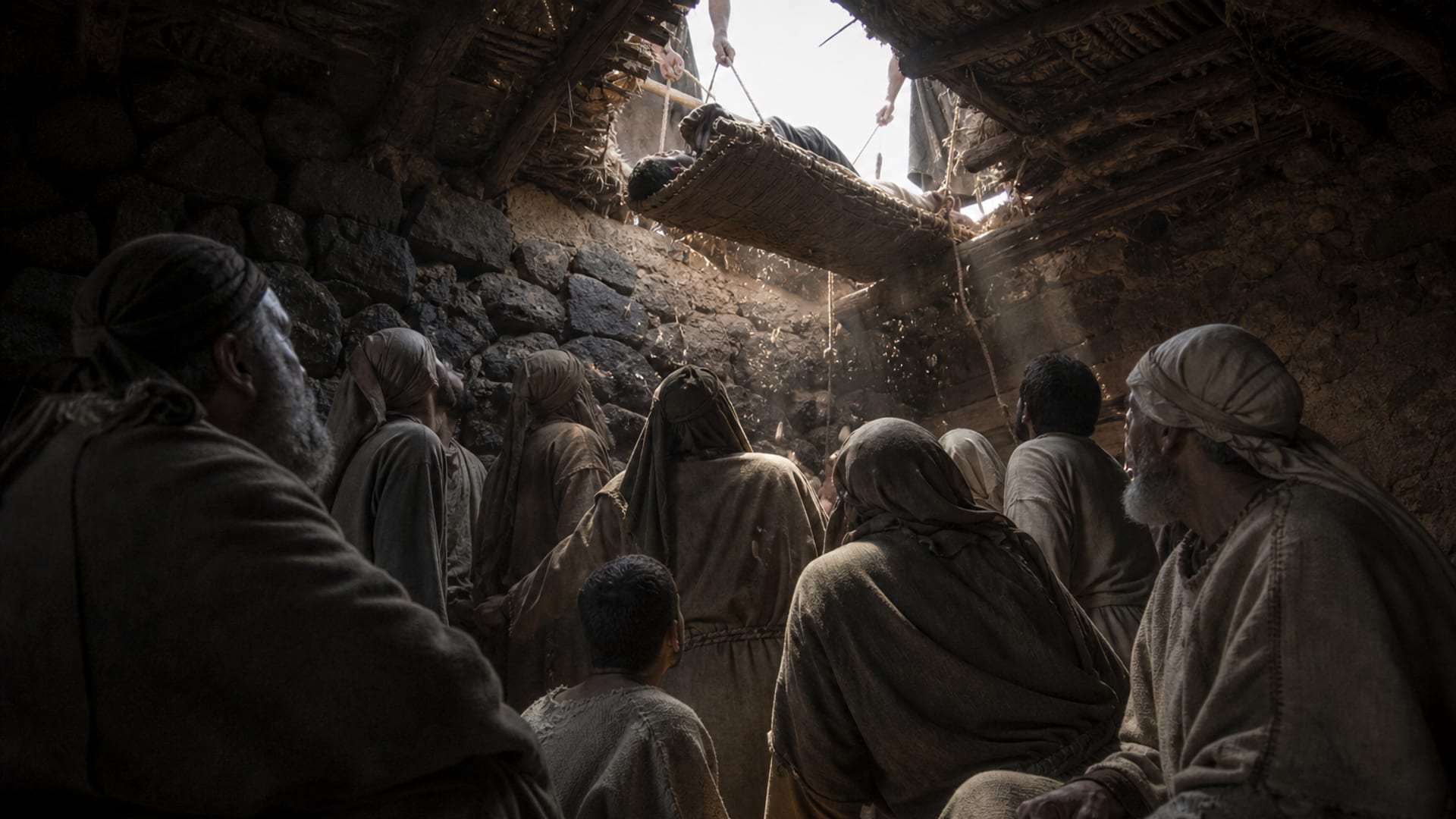
Four men dig through a roof in Capernaum to reach a healer, and the first thing Jesus gives the man they carry is something nobody in the room can see.
Scripture Mark 2:1–12 · Luke 5:17–26 · Matthew 9:1–8 · Daniel 7:13–14 · Mark 14:61–64 · John 9:1–3
Mark says they dug.
Most retellings of this story move quickly to the miracle, but the verb Mark chose is a working man’s verb, and it describes damage. Somebody owned that roof. Somebody was sitting under it when the dirt started to fall.
By the end of twelve verses Jesus has claimed an authority that belongs to God, the word “blasphemy” has entered Mark’s Gospel for the first time, and a title has been spoken that will be repeated at his trial. The roof is only how the story gets in.
A town, a house, a blocked door (Mark 2:1–2)
“A few days later Jesus went back to Capernaum. And when the people heard that He was home, they gathered in such large numbers that there was no more room, not even outside the door, as Jesus spoke the word to them.”
Capernaum sat on the northern shore of the Sea of Galilee. Matthew says Jesus left Nazareth and “lived in Capernaum, which is by the sea” (Matthew 4:13), and later calls it “His own town” (9:1). It was not a city. The historian Josephus, hurt in a skirmish nearby early in the war with Rome, says he was carried “into a village” whose name is usually identified with Capernaum (Life 403). The Franciscan custodians of the site describe a settlement along the shore that lived from fishing and farming, on a route that carried trade between Galilee and Damascus.
After the man with leprosy spread the news, Jesus “could no longer enter a town in plain view” (1:45). So the return in 2:1 is quiet, until word gets out that he is “home” and the house fills to the door.
Whose home? Mark does not say. Readers naturally think of 1:29, where Jesus goes “to the home of Simon and Andrew,” and that may be right. But the text leaves it open.
What the ground at Capernaum shows, and what it does not
The Franciscan archaeologists Virgilio Corbo and Stanislao Loffreda excavated Capernaum from 1968 to 1986, with further seasons from 2000 to 2003, and what they found helps us picture Mark 2. The houses were built of black basalt fieldstones laid without mortar, in blocks separated by lanes, with rooms clustered around open courtyards. Jerome Murphy-O’Connor, summarizing the excavations, notes that such dry-stone walls could not have carried a second story, and that the roofs were made of crisscrossed branches, sometimes sealed with earth and straw. A roof like that is not smashed. It is opened. You pull back the covering and dig through the packed layer beneath.
One house has drawn special attention. In the block the excavators called the insula sacra, one large room was plastered on floor, walls and ceiling, which appears nowhere else in the village, and at about the same time its pottery changes from cooking vessels to storage jars and lamps. The excavators read this as a private room turned to communal use, and they date the change to the second half of the first century (estimates run from about AD 50 to later in the century). In the fourth century the room was enlarged and walled off, and its replastered walls collected well over a hundred graffiti in Greek, Syriac, Aramaic and Latin, with invocations such as “Lord Jesus Christ help your servant.” In the second half of the fifth century an octagonal church was built directly over it. Around 570 a pilgrim from Piacenza wrote that he came “to Capernaum, to the house of blessed Peter, which is now a basilica.”
Here the honest sentence matters. What is securely established is early and sustained Christian veneration of one particular house in Capernaum. That it was Peter’s house is an inference, a reasonable one, drawn from that veneration and from the Gospels. The excavators believed several graffiti mention Peter by name, but many scholars now dispute those readings, and some, Joan Taylor among them, dispute the identification itself. Emmanuele Testa, who published the graffiti, dated the oldest of them to the early third century on the basis of the handwriting. And that this was the house of Mark 2 is a further step that Mark himself never takes.
What archaeology can honestly give us is the kind of house, and that is enough. It turns a stained-glass scene back into basalt, branches and mud.
Four men, a mat and a roof (2:3–4)
“Then a paralytic was brought to Him, carried by four men. Since they were unable to get to Jesus through the crowd, they uncovered the roof above Him, made an opening, and lowered the paralytic on his mat.”
First, Mark says only that the man was carried “by four.” The word “men” is supplied by translators. The word most of us use for them, friends, is not in the text at all. They may have been brothers, neighbors or hired porters. Their devotion is shown by what they did, not by a label.
Second, the verbs. They “unroofed the roof” (apestegasan tēn stegēn), and then, “having dug it out” (exoryxantes), they let the mat down. The second verb is ordinary Greek for digging earth out of a trench. Paul uses it in a figure of speech in Galatians 4:15: “you would have torn out your eyes.” It fits the kind of roof Capernaum actually had, and it is not gentle.
Getting up there was probably not the hard part. Roofs were used spaces (Deuteronomy 22:8 requires a railing around one), and Mark 13:15 pictures someone on a housetop who could leave without going back inside. The hard part was taking someone else’s roof apart in front of a crowd.
Third, the mat. Mark’s word is krabattos, a pallet or camp bed, the poor man’s mattress, a word Greek lexicons connect with the Latin grabatus. Mark uses it four times in this story (2:4, 9, 11, 12). He keeps the camera on it. The thing that had carried the man will, by the end, be carried by him.
“Through the tiles”: how Luke and Matthew tell it
Luke tells the same story in 5:17–26 and changes the roof. The men “went up on the roof and lowered him on his mat through the tiles into the middle of the crowd, right in front of Jesus” (5:19).
This detail has puzzled careful readers, because Mark’s roof is dug, and tiles are not dug. The Greek word is keramos. Its root meaning is potter’s clay, and some have tried to read Luke that way, but when the word is used of a roof, classical Greek means tiling. The simplest explanation, given for example in the notes of the New American Bible, is that Luke retold the scene in the architecture his wider Greco-Roman readers knew, where a roof meant tiles. That is not a mistake so much as a translation of setting, the thing every preacher does when an ancient detail would otherwise stop the listener.
Luke also trades Mark’s krabattos for other words for a bed, though he uses Mark’s word himself in Acts 5:15 and 9:33.
Luke raises the stakes of the audience. Before the men arrive, “the Pharisees and teachers of the law were sitting there,” and Luke adds that people had come “from Jerusalem and from every village of Galilee and Judea” (5:17). It is the first time Pharisees appear in Luke’s Gospel. And Luke ends with a different exclamation: “We have seen remarkable things today” (5:26). The word translated “remarkable” is paradoxa, things contrary to expectation, and it occurs nowhere else in the New Testament.
Matthew (9:1–8) is the shortest of the three. There is no crowd at the door and no roof at all. “Just then some men brought to Him a paralytic lying on a mat” (9:2). Jesus adds “Take courage,” and the ending moves the focus: the crowds “glorified God, who had given such authority to men” (9:8). Matthew does not explain that plural, and we should not force it.
Side by side, the three accounts differ in staging and agree on the core: Jesus sees faith, pronounces forgiveness, meets the silent charge of blasphemy with a question, claims authority for the Son of Man on earth, and proves it by a healing.
“When Jesus saw their faith” (2:5)
Faith in this scene is something you can see. It has dirt on it.
Mark writes “their faith” without saying whether the man on the mat is included; the plural most naturally points to the four, and nothing excludes him. What the story will not allow is faith as a purely private feeling. Jesus looks up at a hole in the ceiling and calls what he sees faith.
Then comes the surprise. Everyone in that room can see what the man needs. No one has mentioned his sins. And Jesus says, “Son, your sins are forgiven.” The word is teknon, “child,” a word of tenderness. The first thing the man receives is the one gift nobody can verify.
Sin and sickness, and the error Jesus rejects
Why forgiveness first? It is tempting to conclude that this man’s paralysis was punishment and that Jesus is dealing with the cause before the symptom. Mark does not say that, and the rest of Scripture will not let us assume it.
The Bible does hold a real connection between sin and suffering. Psalm 32 describes unconfessed sin in bodily terms, and Psalm 103 blesses the God “who forgives all your iniquities and heals all your diseases” (103:3). James writes that the prayer offered in faith will restore the sick, and “if he has sinned, he will be forgiven” (James 5:15), with the “if” doing real work. In John 5:14 Jesus tells a man he has healed, “Stop sinning, or something worse may happen to you.” The pairing lasted in Jewish thought as well. The Babylonian Talmud records a saying, attributed to rabbis who lived well after Jesus and citing Psalm 103:3, that a sick person does not recover until his sins are forgiven (Nedarim 41a). That is later evidence and should not be read back as a first-century rule, but it shows how natural the connection felt.
Yet Jesus refuses to turn that connection into a diagnosis. When his disciples see a man born blind and ask, “Rabbi, who sinned, this man or his parents, that he was born blind?” Jesus answers, “Neither this man nor his parents sinned” (John 9:2–3). In Luke 13 he asks whether the Galileans killed by Pilate or the eighteen crushed by the tower of Siloam were worse sinners than anyone else, and answers, “No, I tell you” (13:2–5).
So we should hold both. In Mark 2 the order of Jesus’ words shows his priorities, not the man’s medical history. The deepest need in that room was not the one lying on the mat.
“Who can forgive sins but God alone?” (2:6–7)
“But some of the scribes were sitting there and thinking in their hearts, ‘Why does this man speak like this? He is blaspheming! Who can forgive sins but God alone?’”
It is worth saying plainly: the scribes’ theology is correct. The God of Israel says, “I, yes I, am He who blots out your transgressions for My own sake” (Isaiah 43:25). Back in 1:22 the people in the Capernaum synagogue had noticed that Jesus “taught as one who had authority, and not as the scribes.” Now scribes are in the room.
Their phrase in Greek is “except one, God” (ei mē heis ho theos). Mark uses the identical wording in 10:18, “No one is good except God alone,” and “one” is the word of the great confession he quotes in 12:29: “Hear, O Israel, the Lord our God, the Lord is One.” Some readers hear an echo of that confession in the scribes’ words. Mark does not point it out.
Could Jesus’ words have been heard more innocently? “Your sins are forgiven” is passive, and a prophet could announce God’s forgiveness without claiming it as his own. Nathan told David, “The LORD has taken away your sin” (2 Samuel 12:13). A broken Aramaic fragment from Qumran, the Prayer of Nabonidus (4Q242), even links a Jewish diviner with the pardon of a king’s sins, though scholars such as Tobias Hägerland note that it is disputed whether the diviner or God forgives. The question was not as simple as a slogan.
But nothing in Mark 2 sounds like a prophet relaying a message. There is no temple, no sacrifice, no priest, no confession, no appeal to what God has said. And Jesus is about to make the claim explicit. The scribes have understood him better than many admirers do.
This is also the first time any form of the word “blasphemy” appears in Mark. Near the end of the Gospel the high priest tears his clothes over Jesus and says, “You have heard the blasphemy” (14:64).
“Which is easier to say?” (2:8–9)
Jesus answers a question nobody asked out loud. “At once Jesus knew in His spirit that they were thinking this way within themselves.” Then he asks one of his own: “Which is easier: to say to a paralytic, ‘Your sins are forgiven,’ or to say, ‘Get up, pick up your mat, and walk’?”
The question turns on the word say. Saying “your sins are forgiven” is easy, because no one can check it. Saying “get up and walk” is risky, because everyone will know within a minute whether it was empty. Doing, of course, runs the other way. Only God can forgive sins, while healing, however astonishing, is something Scripture records God doing through prophets such as Elisha.
Jesus does not answer his own question. He does the checkable thing in order to vouch for the one that cannot be checked.
The Son of Man, on earth (2:10–11)
“But so that you may know that the Son of Man has authority on earth to forgive sins…” He said to the paralytic, “I tell you, get up, pick up your mat, and go home.”
The sentence breaks off in the middle. Jesus turns from the scribes to the man before finishing, and translations mark the break with dashes or ellipses.
This is the first time the title “Son of Man” appears in Mark. On its own the phrase could simply mean “a human being,” and that ambiguity may be part of why Jesus chose it. But Mark’s readers have a particular text in view. In Daniel 7:13–14 the prophet sees “One like the Son of Man coming with the clouds of heaven.” The Aramaic phrase is kebar enash, most plainly “one like a human being,” as the Jewish Publication Society renders it. That figure is brought before the Ancient of Days: “And He was given dominion, glory, and kingship.” Both ancient Greek versions of Daniel call his “everlasting dominion” exousia, the same word Mark uses here for “authority.”
In Daniel, the authority is conferred in heaven. Jesus claims it “on earth,” in a borrowed house with a hole in the ceiling, over one man’s sins.
Whether the people in that room heard Daniel we cannot know. Mark’s readers certainly would by the end, because Jesus uses Daniel’s words at his trial: “you will see the Son of Man sitting at the right hand of Power and coming with the clouds of heaven” (14:62). The charge the high priest brings in response is the charge the scribes were thinking in Capernaum.
Out the front, carrying the mat (2:12)
“And immediately the man got up, picked up his mat, and walked out in front of them all.”
The man who came in through the roof leaves by the door, through the same crowd that had blocked his way. Mark wants us to see it. Whatever the scribes thought about the words, everyone watched the legs.
“As a result, they were all astounded and glorified God, saying, ‘We have never seen anything like this!’” Mark says “all,” and it is best not to squeeze that word for more than it holds. Amazement is not faith, and the next stories will show that.
The first of five
Mark 2:1–12 opens a carefully built section. Five conflict stories follow one another: forgiveness of sins (2:1–12), eating with tax collectors and sinners (2:13–17), fasting (2:18–22), picking grain on the Sabbath (2:23–28), and healing a withered hand on the Sabbath (3:1–6). The section ends with a sentence that should stop any reader: “At this, the Pharisees went out and began plotting with the Herodians how they might kill Jesus” (3:6).
In a 1973 article, Joanna Dewey showed how deliberately the first and last stories mirror each other. Both begin with Jesus entering “again” (2:1; 3:1). Both happen indoors, one in a house and one in a synagogue. Both place a controversy inside a healing. In both the opponents never speak their objection aloud: in the first, Jesus knows what they think “in their hearts”; in the last, he is grieved at “their hardness of heart.” These are the first uses of the word “heart” in Mark. Both use the verb “get up,” though the BSB renders it “Stand up” in 3:3. And the crowd’s praise at the end of the first story is answered by a murder plot at the end of the last.
Dewey also traced the hostility rising from silent criticism to a plot, with a saying at the center of the five stories: “the time will come when the bridegroom will be taken from them” (2:20). Not every reader finds the pattern as tight as she argues, but the parallels are on the page. Mark’s first controversy is not an isolated miracle. It is the first step toward the cross.
What most readers miss
The four are never called friends. Mark says only that the man was carried “by four.” Their love is inferred from their actions, which is exactly how Jesus inferred their faith.
The scribes are not wrong about God. Their objection is sound theology. What they failed to consider was who might be standing in front of them.
The healing is evidence offered to critics. “So that you may know” is addressed to the men who doubted him. The man’s walk home is, among other things, an argument.
Two words enter Mark’s Gospel here and return at the trial. “Blasphemy” (2:7) and “Son of Man” (2:10) are both introduced in this house, and both are spoken again before the high priest (14:62–64). The end of the story is already in the room.
Going home
Jesus’ last words to the man are ordinary: “go home.”
The forgiveness came first, and it could not be seen. The healing came second, and it could. One was given for the man; the other was given so that the room would know the first was real. He left carrying the bed that had carried him, past the people who had filled the doorway.
Mark does not say whether anyone fixed the roof. He says that a man the crowd had kept outside was sent home forgiven, and that of the two things Jesus did that day, the forgiving was the harder.
For reflection
- The four men could not reach Jesus by the door, so they made another way in. What has blocked the ordinary way for you, and have you taken that as the end of the matter?
- Jesus answered a need nobody had named before the one everyone could see. What would change if you let him set the order of your needs?
- The scribes were right that only God forgives sins. Where has a correct belief kept you from recognizing what God was actually doing?
- Scripture holds together a real link between sin and suffering and a firm refusal to read one person's illness as a verdict. Which of those two truths do you tend to forget?
- The healing was given "so that you may know." What visible evidence of forgiveness does your own life offer to people who cannot see inside it?
Prayer
Lord Jesus, You saw the faith of men who would not stop at a crowded door.
Speak to me first the word I cannot see, and teach me to trust it before anything else changes.
Give me the courage to get up, carry what I once lay on, and go home.
Amen.
Anyone can say "your sins are forgiven." Jesus said the harder, checkable thing so that the room would believe the one they could not check.
Sources and notes
Consulted while writing this piece. Nothing is listed here that was not used.
- Berean Standard Bible primary text
- Michael W. Holmes, ed., The Greek New Testament: SBL Edition (Society of Biblical Literature and Logos, 2010), MorphGNT digital text primary text
- Maurice A. Robinson and William G. Pierpont, The New Testament in the Original Greek: Byzantine Textform (2005), digital text primary text
- H. B. Swete, ed., The Old Testament in Greek according to the Septuagint, vol. 3 (Cambridge University Press), Daniel 7:13–14 in the Old Greek and Theodotion, digital text primary text
- Daniel 7:13, Aramaic text with the JPS Tanakh translation, Sefaria primary text
- Josephus, Life 403 (section 72 in Whiston), trans. William Whiston primary text
- Babylonian Talmud, Nedarim 41a, William Davidson Edition, Sefaria primary text
- 4Q242, Prayer of Nabonidus, translation at Livius primary text
- Piacenza Pilgrim, Itinerarium 7 (c. 570), record E00416, The Cult of Saints in Late Antiquity, University of Oxford primary text
- Jerome Murphy-O'Connor, "Peter's House," Bible Odyssey, Society of Biblical Literature historical study
- Custody of the Holy Land, "Capernaum" (history of the site and of the Franciscan excavations, 1968 to 1986 and 2000 to 2003) excavation report
- Biblical Archaeology Society, "The House of Peter: The Home of Jesus in Capernaum?" Bible History Daily (2011) historical study
- James R. Wicker, "Pre-Constantinian Nomina Sacra in a Mosaic and Church Graffiti," Southwestern Journal of Theology 52.1 (2009), on the Capernaum graffiti as published by E. Testa historical study
- Joanna Dewey, "The Literary Structure of the Controversy Stories in Mark 2:1–3:6," Journal of Biblical Literature 92.3 (1973): 394-401 historical study
- Tobias Hägerland, Jesus and the Forgiveness of Sins: An Aspect of His Prophetic Mission, SNTS Monograph Series 150 (Cambridge University Press, 2012) historical study
- New American Bible Revised Edition, note on Luke 5:19, United States Conference of Catholic Bishops commentary
- G. Abbott-Smith, A Manual Greek Lexicon of the New Testament (T. & T. Clark, 1922), and Liddell, Scott and Jones, A Greek-English Lexicon, entries for κράβαττος, κέραμος, ἐξορύσσω, ἀποστεγάζω, via Logeion (University of Chicago) lexicon
Scripture in English is from the Berean Standard Bible, placed in the public domain by its publisher on 30 April 2023.