
Bible Study
The Question at the King's Gate
Esther 4 is the chapter everyone quotes and the chapter that never mentions God. A study of Mordecai's sackcloth, the law about the inner court, Persian Susa as far as we can know it, and a famous line that was never meant to be a slogan.
Scripture Esther 4:1–17 · Esther 3:7–15 · Esther 5:1–3 · Esther 2:5–10 · Deuteronomy 31:18 · Genesis 43:14 · Joel 2:14 · Jonah 3:9 · 2 Samuel 12:22 · Hebrews 4:16
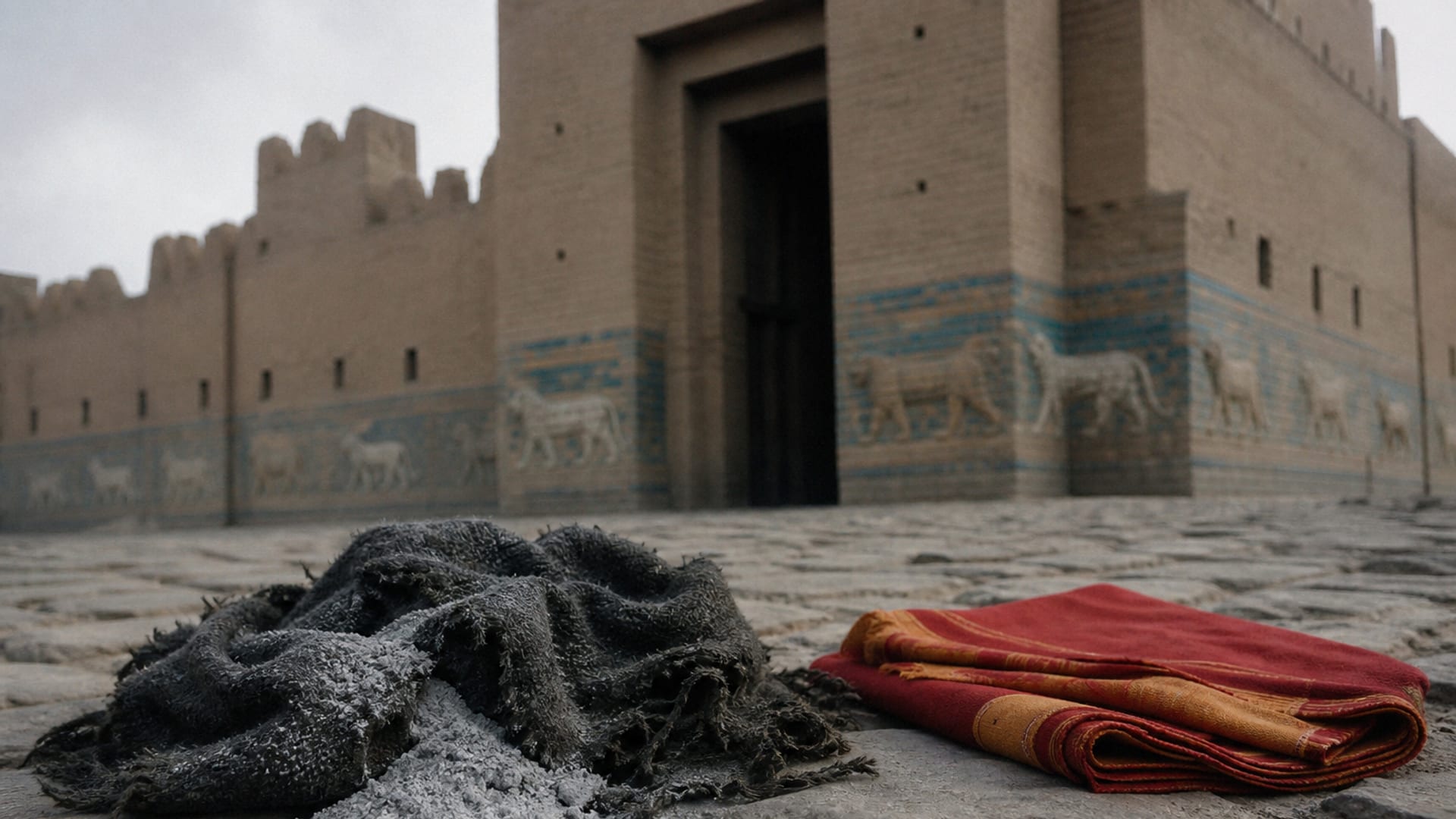
Two sets of clothes lie at the center of Esther 4.
One is sackcloth. When Mordecai learns what Haman has arranged, he “tore his clothes, put on sackcloth and ashes, and went out into the middle of the city, wailing loudly and bitterly.” He walks as far as the palace allows and stops, “because the law prohibited anyone wearing sackcloth from entering that gate.”
The other set comes from inside. Esther’s maids and eunuchs tell her about Mordecai, and “the queen was overcome with distress. She sent clothes for Mordecai to wear instead of his sackcloth, but he would not accept them.”
It is easy to be hard on Esther here, and I think that would be unfair. She does not yet know what has happened; she lives behind walls and learns the news from servants. What she sees is a man who raised her as his own daughter standing in mourning cloth at a gate he cannot pass through, and she does what love often does first. She tries to make the grief stop.
Mordecai will not let it stop. The whole chapter hangs on that refusal. Before Esther can decide anything, she has to hear the reason for the sackcloth.
A book that never says God
Anyone who reads Hebrew Esther carefully notices what is missing. In ten chapters God is never named. There is no prayer, no mention of the covenant, the Law of Moses or the temple. Jerusalem appears only as the place Mordecai’s family was deported from (2:6). People fast in this book (4:3, 4:16, 9:31), and in Israel fasting and prayer belonged together, but the narrator never says anyone prayed.
This has troubled readers for a long time. Esther is the only book of the Hebrew Bible of which no fragment has been found among the Dead Sea Scrolls. That could be an accident of preservation, and it should not be pushed further than that. The Babylonian Talmud records the view of the sage Shmuel that the scroll of Esther “does not render the hands ritually impure,” the technical formula for a sacred book, though the discussion that follows argues he still considered it inspired (Megillah 7a). Martin Luther, arguing against Erasmus in 1525, said that Esther deserved more than any other book to be held outside the canon.
The earliest translators felt the absence too, and filled it. The Greek version of Esther, preserved in the Septuagint, is a different book in several places. It calls the king Artaxerxes. It opens with a dream given to Mordecai. In our chapter, Mordecai’s message to Esther adds a line the Hebrew does not have: “Do thou call upon the Lord, and speak to the king concerning us.” After Esther agrees to go, the Greek inserts two long prayers, one by Mordecai and one by Esther, and when she finally stands before the king, it says outright: “God changed the spirit of the king to gentleness.” The Hebrew says only that “she found favor in his sight” (5:2).
Those Greek Additions are in Catholic and Orthodox Bibles, and many readers know them from there. The BSB, like most Protestant translations, follows the Hebrew and leaves them out, so the version most of us read is the stranger one: a story of rescue in which the rescuer is never mentioned.
The rabbis did not treat that silence as an embarrassment. They treated it as a clue. When the Talmud asks where Esther is hinted at in the Torah, the answer comes from Deuteronomy 31:18, where God warns what will happen when His people turn away: “And on that day I will surely hide My face.” In Hebrew, “I will surely hide” is haster astir, and the sages heard the name Esther in it (Chullin 139b). It is a pun, and they knew it was a pun. But it names something true about the book. Esther is a story set in the time of the hidden face.
Susa, and a king called Xerxes
The story is placed in Susa, in what is now southwestern Iran, one of the royal residences of the Achaemenid Persian kings. Darius I built a palace there late in the sixth century BC, and French excavators in the 1880s recovered from it the glazed-brick panels of marching archers that now stand in the Louvre. Esther calls it “the citadel of Susa,” and the book knows the vocabulary of that world. Several of its administrative words are borrowed from Persian: dat for law, patshegen for a copy of a document, the word for satraps.
The king is Ahasuerus in Hebrew, ‘Aḥashwerosh. The name corresponds to the Old Persian Xšayāršā, which the Greeks wrote as Xerxes, and that identification is the broad consensus of scholarship. The BSB is confident enough to print “Xerxes” in the text itself. That would place the story in the reign of Xerxes I, 486 to 465 BC, the king who invaded Greece and lost at Salamis.
Care is needed beyond that point. Esther’s position as queen has no confirmation outside the Bible. Herodotus names Xerxes’ wife as Amestris, daughter of Otanes (7.61), and he tells a grim story of her jealousy and cruelty at the king’s birthday feast (9.109-112). He also reports that the seven noble conspirators who put Darius on the throne agreed the king should marry only from their families (3.84). Attempts to identify Amestris with Vashti or with Esther do not fit well, and it is possible that Greek writers simply recorded one wife among several. Many scholars read Esther as a historical novella, a story told with real knowledge of the Persian court but shaped for its own purposes. Others defend its historical core. What can be said honestly is that the book’s setting is authentic in texture and its central events have no outside witness.
Conversation through a go-between
Esther never speaks to Mordecai in this chapter. She summons Hathach, “one of the king’s eunuchs appointed to her,” and everything passes through him, across the square in front of the king’s gate and back again. The narrator marks each crossing.
Mordecai hands over two things. One is information: “the exact amount of money that Haman had promised to pay into the royal treasury in order to destroy the Jews.” Haman had offered ten thousand talents of silver (3:9), a sum so large that many readers take it as deliberate exaggeration. Mordecai knows the figure precisely. He has been listening at the gate, as he did when he uncovered the plot against the king’s life (2:21–22).
The other is a document. Mordecai “gave Hathach a copy of the written decree issued in Susa for the destruction of the Jews, to show and explain to Esther, urging her to approach the king, implore his favor, and plead before him for her people.” The word for copy is patshegen, the same Persian loanword used for the decree in 3:14. Esther is shown the text itself. And the phrase “her people” returns for the first time since chapter 2, where Mordecai told her to keep them secret (2:10, 2:20). Now he tells her to use what she has hidden.
The go-between shows how far apart the two cousins now live: Mordecai at a gate that sackcloth cannot pass, Esther in a place where even the queen does not see the king unless she is sent for.
What we know about approaching a Persian king
Esther’s first answer is not cowardice. It is a report of the law.
“All the royal officials and the people of the king’s provinces know that one law applies to every man or woman who approaches the king in the inner court without being summoned …”
The penalty is “that he be put to death,” with a single exception: “Only if the king extends the gold scepter may that person live.” Then she adds the detail that makes it personal: “But I have not been summoned to appear before the king for the past thirty days.”
How much of this can we check? Some, not all. Greek writers were fascinated by the inaccessibility of the Persian king, and Herodotus is our best early witness. He says that Deioces, the first king of the Medes, established the rule “that none should enter into the presence of the king, but that they deal with him always through messengers” (1.99). He reports that after Darius came to power, his six fellow conspirators were given a special privilege: they might “pass in to the royal palaces without any to bear in a message,” unless the king was in bed with his wife (3.84). And he tells what happened to one of them, Intaphrenes, who tried to use that privilege. The gatekeeper and the bearer of messages stopped him, saying the king was with his wife. Intaphrenes cut off their ears and noses. Darius, suspecting a conspiracy, had him and most of his family put to death (3.118-119).
That is a picture of a court where doorkeepers and messengers controlled access, and even the highest nobles needed a special grant to walk in unannounced. The audience reliefs excavated at Persepolis show the same world in stone: the king enthroned, holding a long staff, an official leaning toward him with his hand raised to his mouth.
What we do not have is any Persian or Greek source that states the law Esther describes: death for unsummoned entry, lifted by a golden scepter. It fits the world Herodotus describes, but he does not confirm it. The law may be exactly as Esther says; we know it only from Esther.
What the text does tell us is how Esther saw her own position. The king had not called for her in a month. The previous queen had lost her place by refusing a summons (1:12, 1:19). Esther would be risking hers, and her life, by answering a summons nobody had given.
Mordecai’s reply
Mordecai’s answer is the most quoted passage in the book, and it is harsher than its reputation.
“Do not imagine that because you are in the king’s palace you alone will escape the fate of all the Jews. For if you remain silent at this time, relief and deliverance for the Jews will arise from another place, but you and your father’s house will perish. And who knows if perhaps you have come to the kingdom for such a time as this?”
It begins with a warning. The palace will not protect her. The decree says “all the Jews,” and Haman has already proven that he would rather kill a whole people than one man (3:6).
Then comes a conditional with an emphatic Hebrew verb: im-haḥaresh taḥarishi, “if you keep utterly silent.” Mordecai is not afraid she will say the wrong thing. He is afraid she will say nothing.
Then the famous phrase: relief and deliverance “from another place,” mimmaqom aḥer. Readers have long wondered whether this is the book’s one veiled reference to God, and with some reason. In later rabbinic Hebrew, HaMakom, “the Place,” became a common way to speak of God. Genesis Rabbah explains that God is called the Place because “He is the place of the world, and His world is not His place.” But that usage is attested later than Esther, and the grammar makes the reading awkward: “another place” implies that Esther herself is one place deliverance might come from, and it would be strange to call God “another” alternative to the queen. Many commentators therefore take the words as meaning some other human source of help. Mordecai expresses confidence that the Jews will not be destroyed, without saying where that confidence comes from. The Greek version keeps the same vague phrase, “from another quarter,” even though it names God freely elsewhere.
Then the threat: “you and your father’s house will perish.” Mordecai does not explain how. Some read it as divine judgment, others as the obvious consequence that the queen’s identity would come out when the killing began. The text leaves it unexplained, and the threat is sharper for it.
“Who knows” is a question
The line on church banners is the last sentence, usually trimmed to “for such a time as this.” In Hebrew it begins umi yodea, “and who knows.”
The phrase has a history in the Old Testament. When David fasted for his dying child, he explained: “I said, ‘Who knows? The LORD may be gracious to me and let him live’” (2 Samuel 12:22). The child died. In Joel, the prophet calls Israel to return to the LORD and adds, “Who knows? He may turn and relent” (Joel 2:14). In Jonah, the king of Nineveh orders his city to fast and says, “Who knows? God may turn and relent; He may turn from His fierce anger, so that we will not perish” (Jonah 3:9).
In each case “who knows” is spoken by someone who is fasting and does not know the outcome. It is humble hope, not a promise. Jonah 3:9 is especially close to our chapter: a fast, a threat of destruction, and the Hebrew verb ‘avad, “perish,” which is the very verb Mordecai uses of Esther’s father’s house and Esther will use of herself.
So Mordecai does not tell Esther that she was placed on the throne for this purpose. He asks whether she might have been, and the difference matters. A slogan tells me that my position proves my calling. Mordecai’s question does something harder. It asks a frightened young woman to act without a guarantee, on the chance that her strange history had a purpose she could not yet see.
And her history was strange. She had been taken into a king’s harem, not called by a prophet. She had hidden her people on Mordecai’s instruction. The phrase “come to the kingdom” (higa’at lammalkhut) looks back over that whole compromised path and asks whether even that could have been for something. It is a question about providence asked by someone who cannot see it, which is the only way most of us ever ask it.
Notice, too, that the Hebrew uses the word “time” twice in the verse: silent “at this time” (ba’et hazzot), come to the kingdom “for such a time” (le’et kazot). The moment when keeping quiet would be easiest is the moment the question is about.
“If I perish, I perish”
Esther’s reply is short, and it changes who gives the orders.
“Go and assemble all the Jews who can be found in Susa, and fast for me. Do not eat or drink for three days, night or day, and I and my maidens will fast as you do. After that, I will go to the king, even though it is against the law. And if I perish, I perish!”
Until now, Mordecai has instructed and Esther has obeyed (2:10, 2:20). The chapter closes: “So Mordecai went and did all that Esther had instructed him.” The queen has begun to act as one.
Her last words, ka’asher ‘avadti ‘avadti, have an echo. When Jacob finally lets Benjamin go down to Egypt, he says: “As for me, if I am bereaved, I am bereaved” (Genesis 43:14). The Hebrew construction is the same. Commentators have noticed the parallel, and it may be deliberate, since Mordecai is introduced as a Benjaminite (2:5) and the book has other echoes of the Joseph story. Whether or not the author intended it, the tone is alike. Neither speaker is heroic in the loud sense. Both have run out of better options and accept a loss they cannot prevent.
The verb matters too. The decree ordered officials “to destroy, kill, and annihilate all the Jews” (3:13), and the last of those verbs is ‘abbed, from the same root as “perish.” Mordecai has warned that she will perish if she stays silent. She answers that she may perish if she speaks. Either way she stands under the same word as her people, and she chooses to stand there with them.
Then there is the fast. It is total, food and water, for three days, “night or day,” and it is communal: the Jews of Susa on one side of the wall, Esther and her maidens on the other, all fasting together. No prayer is mentioned. But no reader who knew Israel’s Scriptures would imagine a three-day fast before a life-or-death appeal as a mere diet. The narrator leaves the prayer unwritten, and the reader supplies it.
The timing may add weight. The decree was written “on the thirteenth day of the first month” (3:12), and Passover falls on the fourteenth. If the fast followed at once, it would have run over the feast. The Talmud noticed this: the verse says Mordecai “went” (vaya’avor, literally “passed”), and Rav took it to mean that Mordecai let the first day of Passover pass as a fast day (Megillah 15a). The text does not give dates for the fast, so this is an inference. It is a reasonable one, and it would mean that the festival of deliverance from Egypt was kept that year in sackcloth.
What the silence teaches
Why would a biblical book leave God out of a story of deliverance? Scholars do not agree, but many, Michael Fox among them, read the silence as deliberate: the reader is placed where the characters stand, able to see a pattern but never told for certain who drew it.
The pattern is hard to miss once you look. The night after Esther’s first banquet, “sleep escaped the king” (6:1), and the pages read to him happen to be the ones about Mordecai (6:2). Haman’s own wife and advisers tell him that if Mordecai is Jewish, “you will not prevail against him” (6:13). The month chosen by lot for the destruction of the Jews becomes “the month in which their sorrow turned to joy” (9:22). Nobody in the story announces that God did these things. The book lets the reader see them line up.
The Greek Additions make the book more obviously religious and, I think, a little smaller. When the Greek says God changed the king’s heart, the question is answered. The Hebrew leaves it open, and so it can speak to people whose lives also contain no voices, no visions and no angels: exiles who have to decide what to do inside someone else’s empire, with no prophet to tell them.
A throne you may approach
No New Testament passage quotes Esther, so any connection to Christ here is theological and should be offered as that.
The law in 4:11 describes a throne that means death to anyone who comes near uninvited. Esther went in anyway, dressed in her royal robes, and lived only because the king extended his scepter. The letter to the Hebrews describes another throne, and the instruction is the opposite: “Let us then approach the throne of grace with confidence, so that we may receive mercy and find grace to help us in our time of need” (Hebrews 4:16). The reason given in the verses before is a high priest who has passed through the heavens and can sympathize with our weaknesses.
It is also fair, as analogy, to notice the shape of Esther’s act: one person, with access others lacked, risking death to plead for a people already under sentence. Christian readers have heard in that a faint outline of the gospel, but the differences matter as much as the likeness. Esther did not know whether she would survive. And the king she approached was the one whose seal was on the decree.
Living in chapter 4
Most of us do not live in the chapters where God speaks from a burning bush. We live in Esther 4: a decree has been posted, the news arrives secondhand, and the choices in front of us are real and risky and come without a voice from heaven.
The chapter has some counsel for that kind of life. Hear what grief is about before you try to quiet it. Tell the truth about the danger, as Esther did, without letting an accurate account of the risk end the conversation. Hold any position you have, especially one you did not seek, as something that may have been given for other people. Ask others to fast and pray with you before you move. And walk into the inner court without assuming you know how it will turn out.
The famous line is best kept as Mordecai said it, as a question put to someone in a safe place while others are in danger. It can still be asked.
Who knows?
For reflection
- Mordecai refused the clothes Esther sent. Where have I tried to quiet someone's grief with comfort when what they needed was for me to hear the reason for it?
- Esther's first answer was a true account of the danger. Which of my reasons for staying silent are accurate, and still not enough?
- "Who knows?" is a question without a guarantee. Am I waiting for certainty about God's purpose before I will do what is plainly right in front of me?
- Esther asked for others to fast with her before she moved. Whom do I ask to carry a decision with me, and whom do I leave out because I would rather appear strong?
- The book never says God acted, and never says He was absent. Where in my own life have I seen only coincidence, and what would it mean to read it again?
Prayer
Lord, You are not named in this chapter, and You were not absent from it. Teach me to trust You in the pages of my life where I cannot find Your name.
Where I have been placed near power, keep me from thinking I will escape what happens to others.
When the right thing costs more than I want to pay, give me Esther's plain courage, and friends who will fast with me.
Amen.
Mordecai did not tell Esther that God had put her there. He asked her who knew, and let the question do its work.
Sources and notes
Consulted while writing this piece. Nothing is listed here that was not used.
- Berean Standard Bible primary text
- The Hebrew text of Esther (Miqra according to the Masorah), with Genesis 43, Deuteronomy 31, 2 Samuel 12, Joel 2 and Jonah 3, via Sefaria primary text
- Greek Esther with the Additions, in L. C. L. Brenton, The Septuagint with Apocrypha: Greek and English (1851), Esther 1, 4 and 5 primary text
- Herodotus, Histories 1.99, 3.84, 3.118-119, 7.61 and 9.109-112, trans. G. C. Macaulay (1890), Project Gutenberg primary text
- Babylonian Talmud Chullin 139b, on where Esther is hinted at in the Torah (William Davidson edition) primary text
- Babylonian Talmud Megillah 7a, on whether the book of Esther renders the hands impure (William Davidson edition) primary text
- Babylonian Talmud Megillah 15a, on Esther 4:17 and a fast during Passover (William Davidson edition) primary text
- Genesis Rabbah 68:9, on HaMakom, "the Place," as a name for God (Sefaria Community Translation) primary text
- Jon D. Levenson, Esther: A Commentary, Old Testament Library (Westminster John Knox, 1997) commentary
- Karen H. Jobes, Esther, NIV Application Commentary (Zondervan, 1999) commentary
- Frederic W. Bush, Ruth, Esther, Word Biblical Commentary 9 (Word, 1996) commentary
- Michael V. Fox, Character and Ideology in the Book of Esther, 2nd edition (Eerdmans, 2001) commentary
- Carey A. Moore, Daniel, Esther and Jeremiah: The Additions, Anchor Bible 44 (Doubleday, 1977), for the Greek Additions commentary
- Pierre Briant, From Cyrus to Alexander: A History of the Persian Empire (Eisenbrauns, 2002), for the Achaemenid court historical study
- Erich F. Schmidt, Persepolis I: Structures, Reliefs, Inscriptions, Oriental Institute Publications 68 (University of Chicago Press, 1953) excavation report
Scripture in English is from the Berean Standard Bible, placed in the public domain by its publisher on 30 April 2023.