
Bible Study
The Mercy Jonah Could Not Forgive
Jonah finally explains why he ran, and his reason is a line of praise. A study of Jonah 4, the Assyria he had every reason to fear, and a book that ends by handing God's question to the reader.
Scripture Jonah 4:1–11 · Jonah 3:1–10 · Exodus 34:6–7 · Exodus 32:12–14 · Joel 2:13–14 · Nahum 1:3 · Nahum 3:19 · Matthew 12:38–41 · Luke 11:29–32
Jonah does not tell anyone why he ran until the story is nearly over.
In chapter 1 the sailors fire a string of questions at him: his work, his country, his people. He answers with a confession about the God who made the sea and the dry land, and admits he is running from that God. He never says why.
He says why in chapter 4, after Nineveh has repented and God has spared it. And the reason turns out to be a creed.
Jonah, however, was greatly displeased, and he became angry. So he prayed to the LORD, saying, “O LORD, is this not what I said while I was still in my own country? This is why I was so quick to flee toward Tarshish. I knew that You are a gracious and compassionate God, slow to anger, abounding in loving devotion …”
The sentence ends with one more description, “One who relents from sending disaster,” and then Jonah asks to die: “And now, O LORD, please take my life from me, for it is better for me to die than to live.”
The prophet is not confused about God. He is furious because he was right about Him.
The word that keeps changing address
Verse 1 in Hebrew reads, very roughly, it was evil to Jonah, a great evil, and it burned to him. The noun is ra’ah, and it has been walking through the whole story. It is the “wickedness” of Nineveh that comes up before God in 1:2. It is the “calamity” the sailors ask about in 1:7 and 1:8. It is the “evil ways” the king of Nineveh orders everyone to turn from in 3:8. In 3:10 it appears twice: the Ninevites turn from their evil ways, and God relents from the disaster He had threatened. Jonah uses it again in 4:2, “One who relents from sending disaster.” And in 4:6 God grows a plant to ease Jonah’s “discomfort,” which is ra’ah once more.
The BSB is not wrong to use six different English words. Ra’ah covers moral evil and misfortune alike, and English needs different words for them. But the Hebrew reader hears one word moving through the book. Nineveh’s evil rises to heaven. The city turns from it. God turns from the evil He had spoken. And at that precise moment, the evil lands on Jonah.
It has not left the story. It has moved house, from the Assyrian capital into the heart of the Hebrew prophet.
A creed with the ending cut off
Jonah’s description of God is a quotation, and every Israelite reader would have recognized its source. After the golden calf, the LORD passes before Moses and proclaims His own name:
The LORD, the LORD God, is compassionate and gracious, slow to anger, abounding in loving devotion and faithfulness, maintaining loving devotion to a thousand generations, forgiving iniquity, transgression, and sin. Yet He will by no means leave the guilty unpunished … (Exodus 34:6–7)
Set Jonah’s version beside it. He keeps the heart of the confession, drops “and faithfulness,” and drops the whole second half, including the guilty going unpunished. In its place he puts something Exodus 34 does not say: God “relents from sending disaster.”
Jonah did not invent that wording. Joel 2:13 has it word for word in Hebrew, in a call for Israel to rend their hearts and return to the LORD. In his study of the passages that reuse Exodus 34:6–7, Nathan Lane notes that Joel 2:13 and Jonah 4:2 are the only two to use the phrase “relents from disaster,” and that they are exact parallels. Whether one book drew on the other, or both on a formula already at home in Israel’s worship, we cannot say; the dating of both books is disputed.
What we can see is the contrast. In Joel the words are an invitation to Israel. In Jonah they are an accusation, because God has applied them to Assyria.
The book goes further, and this is what most readers miss. When the king of Nineveh says “He may turn from His fierce anger” (3:9), he is using the words Moses prayed on Sinai, “Turn from Your fierce anger and relent from doing harm to Your people” (Exodus 32:12). And the narrator’s report in 3:10, that God “relented from the disaster He had threatened to bring upon them,” is almost letter for letter Exodus 32:14, where “the LORD relented from the calamity He had threatened to bring on His people.” In Hebrew the two sentences differ by little more than the divine name and “His people” against “them.”
The mercy that spared Israel after the golden calf is the mercy that spares Nineveh. The narrator tells both rescues in the same sentence.
Nahum’s half of the creed
There is a second prophet in the Book of the Twelve who quotes Exodus 34 about Nineveh, and he quotes the other half.
The LORD is slow to anger and great in power; the LORD will by no means leave the guilty unpunished. (Nahum 1:3)
Nahum keeps “slow to anger.” Where Exodus says “abounding in loving devotion,” he says “great in power.” And he keeps the very clause Jonah cut: by no means leave the guilty unpunished. Lane describes Nahum’s use as the one place where the formula is turned entirely toward wrath, and against another nation.
Two prophets, one city, one confession. Jonah takes the mercy and complains about it. Nahum takes the judgment and announces it. Scripture keeps both.
Why Jonah had a case
It is easy to read Jonah as a nationalist sulking because foreigners were forgiven. That reading is too comfortable.
Nineveh had been a royal city in Assyria since the thirteenth century BC. Ashurnasirpal II, who reigned from 883 to 859 BC, and his successors renewed it with palaces and temples, and in 704 BC Sennacherib made it his imperial capital, with around twelve kilometers of walls around the main city. So the British Museum’s Ashurbanipal Library Project summarizes the evidence.
Assyrian kings told the world what they did to those who resisted them. Ashurnasirpal II’s annals, preserved on stone and now edited online from A. K. Grayson’s translation, record cutting off the hands, noses and ears of captives, gouging out eyes, building piles of heads, impaling soldiers on stakes around conquered cities, and burning adolescent boys and girls. After one revolt he writes: “I brought Aḫi-iababa to Nineveh, flayed him, (and) draped his skin over the wall of Nineveh.”
Royal inscriptions are propaganda, and a careful reader should say so. They record what a king wanted remembered and feared. But that is the point: terror was the message.
About a century and a half later, Sennacherib decorated a room of his new palace at Nineveh with the siege of Lachish, a Judean city he took in 701 BC. The panels are now in the British Museum. The museum’s own descriptions list what they show: Judean families walking into exile with their belongings and animals; officials “regarded as responsible for the rebellion” being flayed alive; the king on his throne watching prisoners brought before him and executed. Whoever was admitted to that room looked at the destruction of a Judean town as wall decoration.
Chronology needs honesty. According to 2 Kings 14:25, Jonah son of Amittai prophesied under Jeroboam II in the eighth century, before Sennacherib’s Nineveh and before Lachish. The book names no Assyrian king and gives no date, and scholars disagree about when it was written. But no Israelite reader, in any century we can propose, heard the name Nineveh neutrally. Assyria took Samaria and deported the northern tribes (2 Kings 17:6). The same prophet whose word had extended Israel’s borders was being sent to offer mercy to the empire that would erase his kingdom. Nahum calls it simply “the city of blood” (Nahum 3:1).
Jonah’s anger is about justice. The book does not ridicule that. It asks him a question.
Three days, forty days, and five words
Verse 3 of chapter 3 says Nineveh was “an exceedingly great city, requiring a three-day journey,” literally a great city to God, a walk of three days. Taken as a distance across, that fits nothing we know. Charles Halton’s survey of the evidence notes that the walls ran about twelve kilometers around, and that Sennacherib’s own inscription gives a circumference of 21,815 great cubits, roughly seven and a half miles.
Halton lays out the proposed solutions. Donald Wiseman suggested a formal visit, with a day to arrive, a day for business and a day to leave (the NIV’s “a visit required three days”), or else a “Nineveh” that meant the whole administrative district. Luther took it as the time needed to walk every street. Halton argues that each requires assumptions the text does not supply, and reads the phrase as a figure of speech for a vast city, the way Aristotle said part of Babylon did not learn of its capture for three days. That seems the least strained reading, though none of the options changes what the passage is doing.
Then Jonah walks one day into the city and says five Hebrew words: ‘od arba’im yom veNinveh nehpakhet. “Forty more days and Nineveh will be overturned!” The verb hafakh is the one Genesis 19:25 uses for what God did to Sodom. It is also the verb used when “God changed Saul’s heart” in 1 Samuel 10:9. Forty days later Nineveh had indeed been overturned, in the second sense. The text does not point this out. It does not need to.
A shelter, a plant, a worm, a wind
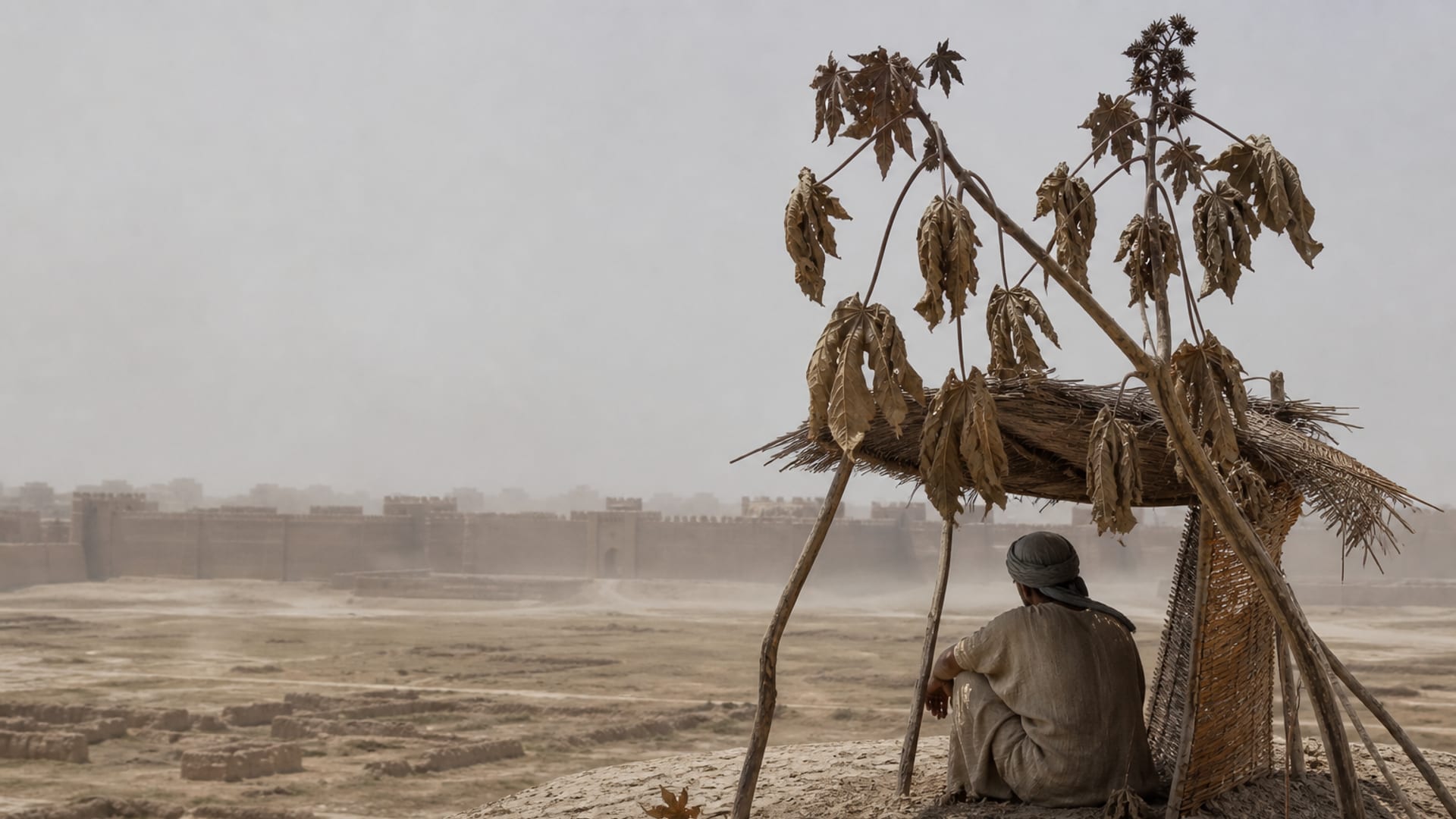
Jonah leaves the city, sits down east of it, builds himself a shelter, and waits “to see what would happen to the city.” The reader already knows what has happened. Jonah is still hoping.
Now God begins to “appoint” things, manah, the verb the BSB consistently renders “appointed.” He appointed a great fish in 1:17. Here He appoints a plant, a worm and a wind. The fish saved Jonah’s life. These will teach him.
The plant. The Hebrew word is qiqayon, and it appears nowhere else in the Bible. The oldest identification is the castor oil plant. The Mishnah forbids lighting the Sabbath lamp with “kik oil,” and in the Talmud (Shabbat 21a) Resh Lakish links that oil to “the qiqayon of Jonah,” while another sage says he has seen the plant set at shop doors for shade, with oil pressed from its seeds. Herodotus describes Egyptians making a lamp oil called kiki from the castor berry. The horticulturists Jules Janick and Harry Paris conclude that qiqayon is castor.
Translation went another way. The Septuagint rendered it kolokynthē, the colocynth, a bitter ground vine that makes poor shade; Latin followed with cucurbita, “gourd,” which the King James Version inherited. Jerome, translating from the Hebrew, chose hedera, “ivy.”
That word caused a riot. In 403 Augustine wrote to Jerome that a bishop at Oea, on the North African coast, had introduced the new translation, and when the reading reached a word in Jonah unlike what the people had always heard, the congregation erupted, the Greek speakers loudest. The bishop consulted the local Jews, who said the old version was right, and he corrected Jerome’s text rather than lose his flock.
Augustine never named the word. Jerome guessed it anyway. The Hebrew, he replied, has ciceion, a shrub with large vine-like leaves that quickly grows to the size of a small tree on its own stem. “Gourd” was simply not in the Hebrew, and he had put “ivy” to agree with Aquila and the other translators. The Jewish witnesses, he added, either did not know Hebrew or were making sport of the gourd party.
The BSB says “vine,” and we cannot be certain of the species. The text says enough: it grew over Jonah to give shade over his head, “to ease his discomfort,” and “Jonah was greatly pleased with the plant.” That is the first time in four chapters that Jonah is glad of anything. The Hebrew plays on the sound: the plant gives tsel, shade, lehatsil, to deliver him.
The worm. “When dawn came the next day, God appointed a worm that attacked the plant so that it withered.” The dawn, which should bring relief, brings the loss. The Hebrew word, tola’at, is the ordinary word for a worm or grub, and it undoes the plant in a morning.
The wind. “As the sun was rising, God appointed a scorching east wind.” The adjective, harishit, occurs only here, and no one is sure what it means. The Targum uses a word for silence. In the Talmud (Gittin 31b) Rav Yehuda proposes a wind that plows furrows in the sea; Rabba answers that the verse is about heat, and explains it as a wind that silences every other wind, and so turns hot. Ibn Ezra reports a view that it was loud enough to deafen. “Scorching” follows the context, which is clear.
For a reader in Israel, the east wind was the desert wind. It scorches grain in Pharaoh’s dream (Genesis 41:6) and in Hosea 13:15 comes “rising up from the desert” to dry up springs. Israel’s Meteorological Service today calls such spells sharav, defined by heat well above the seasonal average with very low humidity. The word is biblical. Isaiah 49:10 promises that “scorching heat or sun” will not beat down on God’s returning people, “for He who has compassion on them will guide them.” Jonah gets the heat and the sun, and has not yet understood the compassion.
There is one more echo. The worm “attacked” the plant in verse 7, and the sun “beat down” on Jonah’s head in verse 8. In Hebrew both verbs are the same, vattakh, it struck. The plant was struck, and then the man it sheltered.
Jonah grows faint, and the narrator says literally that he asked his life to die. The same Hebrew phrase is used of Elijah, sitting under a broom tree in the wilderness (1 Kings 19:4). Elijah wanted to die because he believed evil had won. Jonah wants to die because mercy has.
The argument from a plant
Twice God asks Jonah the same question. The Hebrew is short: Is it good that it burns in you? The first time (4:4) Jonah does not answer. He walks out of the city instead. The second time God narrows the question to the plant, and now Jonah answers at once: “I do. I am angry enough to die!”
Then God speaks the book’s last words.
But the LORD said, “You cared about the plant, which you neither tended nor made grow. It sprang up in a night and perished in a night. So should I not care about the great city of Nineveh, which has more than 120,000 people who cannot tell their right hand from their left, and many cattle as well?”
“Cared” and “care” are one Hebrew verb, hus, to pity, to be moved to spare. God grants that Jonah felt it, and points out where he spent it: on something he did not plant or tend and had for one day. “Sprang up in a night” is, in Hebrew, a son of a night.
The argument runs from lesser to greater, and notice what God leaves out. He does not call Nineveh innocent or Assyria’s crimes exaggerated. He argues from His own relation to the city, as one who did labor over it and make it grow.
Who are the 120,000 “who cannot tell their right hand from their left”? The medieval Jewish commentator Rashi says small children. Others take the phrase to describe the moral confusion of the whole population. The text does not settle it. Either way, God points to what the people of Nineveh do not know, not to any merit they have.
And then the cattle. The animals have already appeared in chapter 3, where the king ordered that “man and beast, herd and flock” should fast and be covered in sackcloth. Readers smile at cows in sackcloth. God counts them. The creed Jonah quoted appears again in Psalm 145:8, and the next verse reads: “The LORD is good to all; His compassion rests on all He has made.”
The book that stops
Here the book ends. Jonah does not reply, and we never learn whether he changed his mind.
Of the twelve short prophetic books, only two end with a question, and both questions are about Nineveh. Jonah ends with God asking, “Should I not care about the great city of Nineveh?” Nahum ends: “for who has not experienced your constant cruelty?” In Hebrew, the word behind “cruelty” is ra’ah. Nahum’s last word on Nineveh is its evil. The book of Jonah’s last word is God’s pity.
History did not leave Nahum’s question abstract. Nineveh was ravaged in 612 BC as Assyria collapsed, and at its Halzi Gate excavators found the bodies of people who died trying to flee. The canon does not resolve the tension by removing either prophet. It lets both questions stand.
A book that stops on an unanswered question makes its reader answer it. Jewish communities have long read the book of Jonah on the afternoon of the Day of Atonement; the Talmud already records the custom (Megillah 31a). On the day devoted to asking God to relent, the synagogue reads a story about a prophet who could not bear that He does.
The sign of Jonah
Asked for a sign, Jesus says none will be given “except the sign of the prophet Jonah” (Matthew 12:39). Matthew and Luke draw it out differently. In Matthew, Jonah’s three days and nights in the fish point to the Son of Man “in the heart of the earth.” In Luke, “as Jonah was a sign to the Ninevites, so the Son of Man will be a sign to this generation” (Luke 11:30). The prophet himself, arriving with a message, is the sign.
Both Gospels then say the same startling thing: “The men of Nineveh will stand at the judgment with this generation and condemn it; for they repented at the preaching of Jonah, and now One greater than Jonah is here.”
Consider what that preaching was: five words, from a man who did not want them to work. Jesus holds up the people who repented at that as the measure for His own hearers.
One further connection is not stated in the text, so hold it as reflection rather than claim. Jonah went out of a city, sat down to watch it, and hoped to see it destroyed. Luke tells us that as Jesus approached Jerusalem “and saw the city, He wept over it” (Luke 19:41).
Sitting in Jonah’s shelter
The book never tells Jonah he was wrong about God. His creed is correct, taken straight from Sinai. He had sung “Salvation is from the LORD!” from inside the fish (2:9), and he meant it. What he could not accept was the same God being the same God to people who had done what Assyria did.
Most of us have no Assyria. We have something smaller: someone who wronged us and never paid, a repentance we do not trust, a person we would be quietly disappointed to see forgiven. Jonah’s book takes that anger seriously enough to give it a chapter, and never answers it by pretending the evil did not happen.
It answers with a plant, a worm, a hot morning, and a question God asks and does not answer for us.
Should He not care about that great city?
For reflection
- Jonah's description of God is accurate. What made it unbearable to him was who it applied to. Is there a person or group I quietly exclude from Exodus 34:6?
- Nineveh's cruelty was real, and the book never denies it. How do I hold together a hunger for justice and a God who relents?
- Jonah grieved over a plant he did not plant. What small comforts do I care about more than I care about people?
- God points to people who cannot tell their right hand from their left, and to animals. What does it change to see a city the way God counts it?
- The book ends before Jonah answers. If the question were put to me, what would I say, and would I mean it?
Prayer
Lord, You are gracious and compassionate, slow to anger, abounding in loving devotion. I am glad of it when it covers me.
Where I have wanted that mercy kept for my own side, show me the city the way You see it.
Do not leave me sitting in the shade waiting for someone else's ruin.
Amen.
Jonah did not misunderstand God. He understood Him exactly, and could not forgive Him for being the same God to Nineveh.
Sources and notes
Consulted while writing this piece. Nothing is listed here that was not used.
- Berean Standard Bible primary text
- The Hebrew text of Jonah (Miqra according to the Masorah), with Exodus 34, Exodus 32, Joel 2, Nahum 1 and 3, 1 Kings 19 and Isaiah 49, via Sefaria primary text
- Ashurnasirpal II 001 (the Annals, RIMA 2 A.0.101.1), edition and translation after A. K. Grayson, Royal Inscriptions of Assyria online (RIAo), Oracc primary text
- British Museum, wall panel from the South West Palace, Nineveh, Room XXXVI: prisoners from Lachish, officials flayed (BM 124909) museum record
- British Museum, wall panel from the South West Palace, Nineveh, Room XXXVI: Sennacherib enthroned before Lachish (BM 124911) museum record
- British Museum, wall panel from the South West Palace, Nineveh: Judaean prisoners going into exile (BM 124907) museum record
- Jonathan Taylor, Areas of Nineveh, Ashurbanipal Library Project, The British Museum (2022) historical study
- Charles Halton, How Big Was Nineveh? Literal versus Figurative Interpretation of City Size, Bulletin for Biblical Research 18.2 (2008) 193-207 historical study
- Nathan C. Lane II, Exodus 34:6-7: A Canonical Analysis (PhD dissertation, Baylor University, 2007) commentary
- Jules Janick and Harry S. Paris, Jonah and the Gourd at Nineveh: Consequences of a Classic Mistranslation, Cucurbitaceae 2006, 349-357 historical study
- Augustine, Letter 71 to Jerome (AD 403), in Nicene and Post-Nicene Fathers, First Series, vol. 1 primary text
- Jerome to Augustine, Letter 75 in the Augustinian collection (Jerome, Letter 112), in Nicene and Post-Nicene Fathers, First Series, vol. 1 primary text
- Mishnah Shabbat 2:1 and Babylonian Talmud Shabbat 21a, on kik oil and the qiqayon of Jonah (William Davidson edition) primary text
- Babylonian Talmud Gittin 31b, on the meaning of harishit in Jonah 4:8 (William Davidson edition) primary text
- Rashi on Jonah 4:8 and 4:11; Ibn Ezra on Jonah 4:8 commentary
- Babylonian Talmud Megillah 31a, on the reading of Jonah on the Day of Atonement primary text
- Herodotus, Histories 2.94, trans. A. D. Godley (Harvard University Press, 1920) primary text
- Amos Porat, Between Khamsin and Sharav, Israel Meteorological Service (2021) historical study
Scripture in English is from the Berean Standard Bible, placed in the public domain by its publisher on 30 April 2023.