
Devotional
The Fourth Watch
Jesus himself sent his disciples out on the night crossing, stayed behind to pray, and did not come to them until the last hours before dawn. Matthew 14 tells it without apology.
Scripture Matthew 14:22–33 · Matthew 14:13 · John 6:15 · Mark 6:48 · Matthew 28:17
Immediately Jesus made the disciples get into the boat and go on ahead of Him to the other side, while He dismissed the crowds.
The storm in this story is easy to misread as a detour. The disciples were on that lake at night because Jesus put them there, and the verb Matthew uses is strong. “Made” is a fair translation; “compelled” is closer. He did not suggest the crossing. He insisted on it.
Why the hurry? Matthew does not say. John’s account of the same evening adds that the crowd was about to seize Jesus and make him king by force, which may explain why he wanted the disciples, of all people, out of there quickly. That is John’s detail, and it fits. What Matthew wants us to notice is simpler. They went where he sent them, and the wind was against them.
He went up to pray
This had been a long day for Jesus. As Matthew tells it, the day turned on the news that John the Baptist had been executed. “When Jesus heard about John, He withdrew by boat privately to a solitary place.” The crowds found him anyway, and he spent the day healing their sick and then feeding thousands of them with five loaves and two fish.
Only now does he get the solitude he went looking for when the news came. He sends the disciples off, dismisses the crowd, and goes up the mountain alone to pray. “When evening came, He was there alone.”
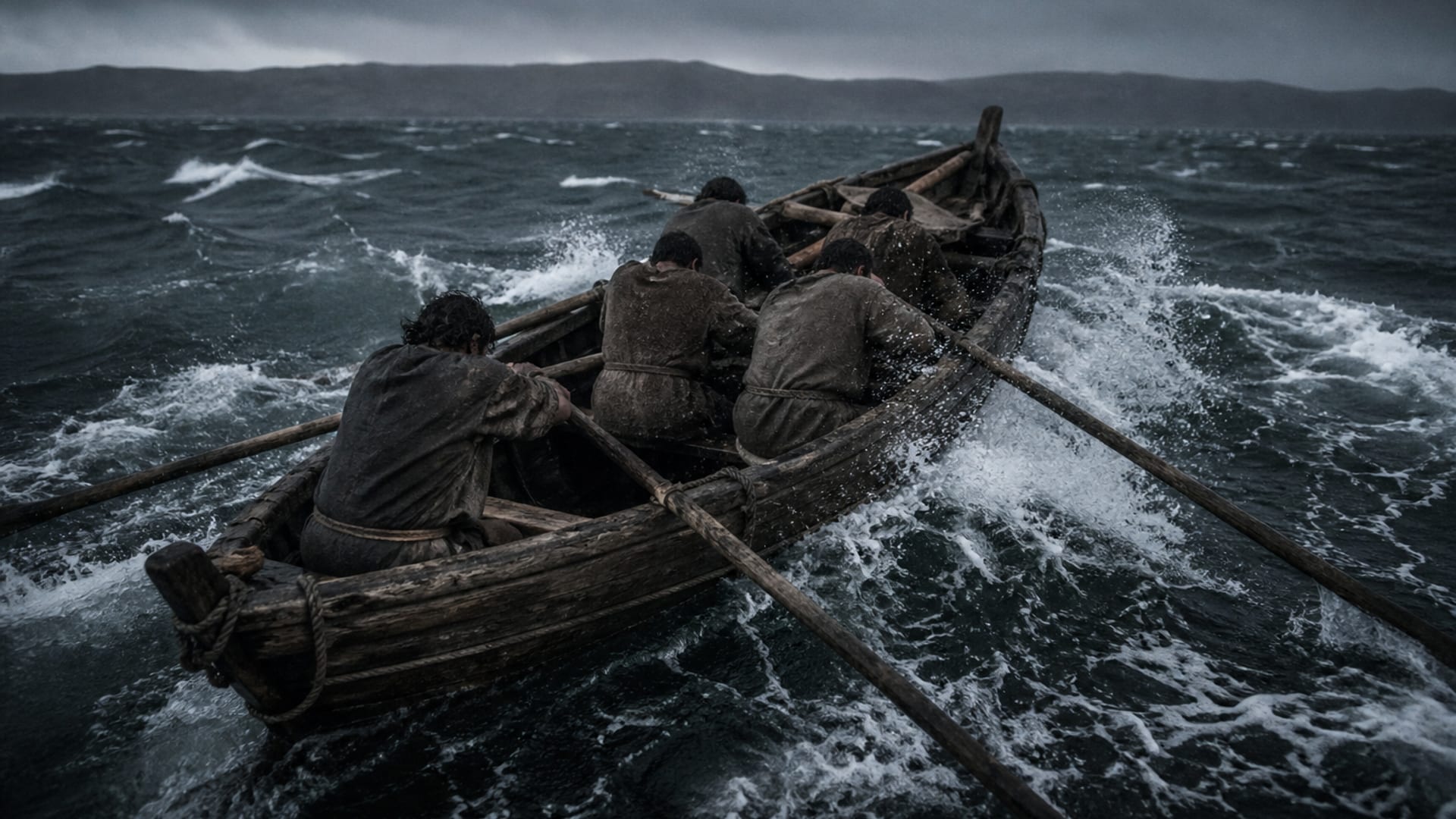
Meanwhile the boat was out on the water, “buffeted by the waves because the wind was against it.” The two scenes run side by side. He is praying on the mountain. They are pulling at the oars. Mark adds that Jesus could see them straining. Matthew only puts the two pictures next to each other and lets us draw the line between them.
The fourth watch
“During the fourth watch of the night, Jesus went out to them.”
The night was divided into watches, and the fourth was the last, the hours before dawn. It was already evening when he was alone on the mountain. So the disciples had been fighting that wind for most of the night.
I will not pretend that is easy to read. They were obedient, and they rowed for hours, and he did not come until the last watch. The text does not soften it. But it also refuses to let the delay mean abandonment. He was praying the whole time, and he came before morning, walking on the very water that had been beating them.
They did not recognize him. “It’s a ghost!” Then, at once: “Take courage! It is I. Do not be afraid.”
Little faith
Peter’s request is bold and a little strange. “Lord, if it is You, command me to come to You on the water.” Jesus says one word. “Come.” And Peter actually does it. He gets out of the boat and walks.
Then he sees the wind. The wind had been blowing the whole time he was walking. What changed was where he was looking. He begins to sink and gets out three words: “Lord, save me!”
“Immediately Jesus reached out His hand and took hold of Peter.” Before any lesson, the hand.
Then comes the question. “You of little faith, why did you doubt?” Matthew uses “little faith” several times, and each time Jesus is speaking to people who already listen to him. It is the gentle rebuke of a teacher to students who have faith and keep letting go of it. The verb for “doubt” is rare in the New Testament; it appears only here and in Matthew 28:17, where some of the disciples doubt even as they worship the risen Jesus. It carries the sense of hesitating or wavering, and it is often connected with the Greek word for “twice,” which is why some describe it as being of two minds. That is a fair picture of Peter, halfway between the boat and Jesus, trusting and afraid in the same moment. Notice that he was out on the water when he doubted. Doubt of this kind happens to people who have already stepped out.
For today
If you are in a hard crossing, it is worth asking whether you got there by disobedience. Sometimes we did. But this story allows for another answer. You may be exactly where he sent you, with the wind against you, while he prays.
And if you are sinking, Peter’s prayer is short enough to say underwater. The hand came first. The question came after, and even the question was an invitation to look up again.
They climbed back into the boat, the wind died down, and the men who had called him a ghost worshiped him.
For reflection
- Is there a hard place in my life that I have assumed means I went the wrong way, when I may be exactly where I was sent?
- When I start to sink, is my first word a prayer, or an explanation?
Prayer
Lord Jesus, you sent me here, and the wind is against me. Keep praying for me on the mountain.
When I look at the wind and start to go down, let "Lord, save me" be the first thing I say.
Amen.
The disciples were not in the storm because they had disobeyed. They were in it because he sent them, and he came before morning.
Sources and notes
Consulted while writing this piece. Nothing is listed here that was not used.
Scripture in English is from the Berean Standard Bible, placed in the public domain by its publisher on 30 April 2023.