
Bible Study
Here I Am, Three Times
Genesis 22 tells the reader it is a test before Abraham hears a word, and then tells almost nothing else. A study of the binding of Isaac, the mountain called Moriah, and a story that refuses to make Abraham either a hero or a monster.
Scripture Genesis 22:1–19 · Genesis 21:9–21 · Genesis 12:1 · Genesis 23:1–2 · 2 Chronicles 3:1 · Jeremiah 7:31 · Jeremiah 19:5 · Micah 6:6–8 · Hebrews 11:17–19 · James 2:21–23 · Romans 8:32
Most stories let you find out what is happening along with the characters. This one tells you first.
Some time later God tested Abraham and said to him, “Abraham!” “Here I am,” he answered. (Genesis 22:1)
Abraham does not hear the word “tested.” We do. From the first line the reader stands in a place Abraham never stands, knowing that what follows is a trial and not God’s last word about Isaac. Abraham has only the command.
That arrangement spares us nothing, since we still have to watch a father take a knife to his son. But it tells us how to watch. The narrator has not lost control of the story, and neither has God. What the narrator will not do is tell us what Abraham felt. For nineteen verses we get actions, a few short sentences, and one question from a boy.
Jewish tradition calls this passage the Aqedah, “the binding,” from the verb in verse 9: “He bound his son Isaac.” The verb occurs nowhere else in the Hebrew Bible. Christians often call the story “the sacrifice of Isaac,” but Isaac was not sacrificed. He was bound, and then unbound.
Your son, your only son
The command tightens with every phrase:
“Take your son,” God said, “your only son Isaac, whom you love, and go to the land of Moriah. Offer him there as a burnt offering on one of the mountains, which I will show you.” (Genesis 22:2)
“Your only son” is a strange thing to say to a man who has two. The reader has just watched the other one leave. In chapter 21, at Sarah’s demand and with God’s consent, Abraham “got up early in the morning,” put bread and a skin of water on Hagar’s shoulders, and sent her away with Ishmael into the wilderness of Beersheba (21:14). The chapter tells us plainly that the matter “distressed Abraham greatly because it concerned his son Ishmael” (21:11).
So God is not pretending Ishmael does not exist. He is naming what Abraham has left: the son of whom God said, “through Isaac your offspring will be reckoned” (21:12).
The two chapters are built to be read together. Abraham rises early in both. A child’s life is at risk in open country. A messenger calls “from heaven” at the last moment (21:17; 22:11). Eyes are opened or lifted to see what saves the child, a well for Hagar and a ram for Abraham. The reader carries chapter 21 into chapter 22, and the word “only” hurts more for it.
The rabbis heard the sequence as a conversation. Rashi, drawing on older midrash (Bereshit Rabbah 55:7), imagines Abraham answering each phrase: “I have two sons.” Your only one. “Each is the only one of his mother.” Whom you love. “I love them both.” Isaac. The dialogue is interpretation, and Rashi offers it as such. But it catches what the Hebrew really does: the name comes last.
The Greek translators of the Septuagint rendered “your only son” as “your beloved son,” ton agapēton, a choice that will matter when we reach the New Testament.
One more echo. “Go to the land of Moriah” uses the same unusual Hebrew expression, lekh-lekha, that opened Abraham’s story in Genesis 12:1: “go to the land I will show you.” At the beginning Abraham was asked to give up his past. Now he is asked to give up his future.
Three days and no conversation
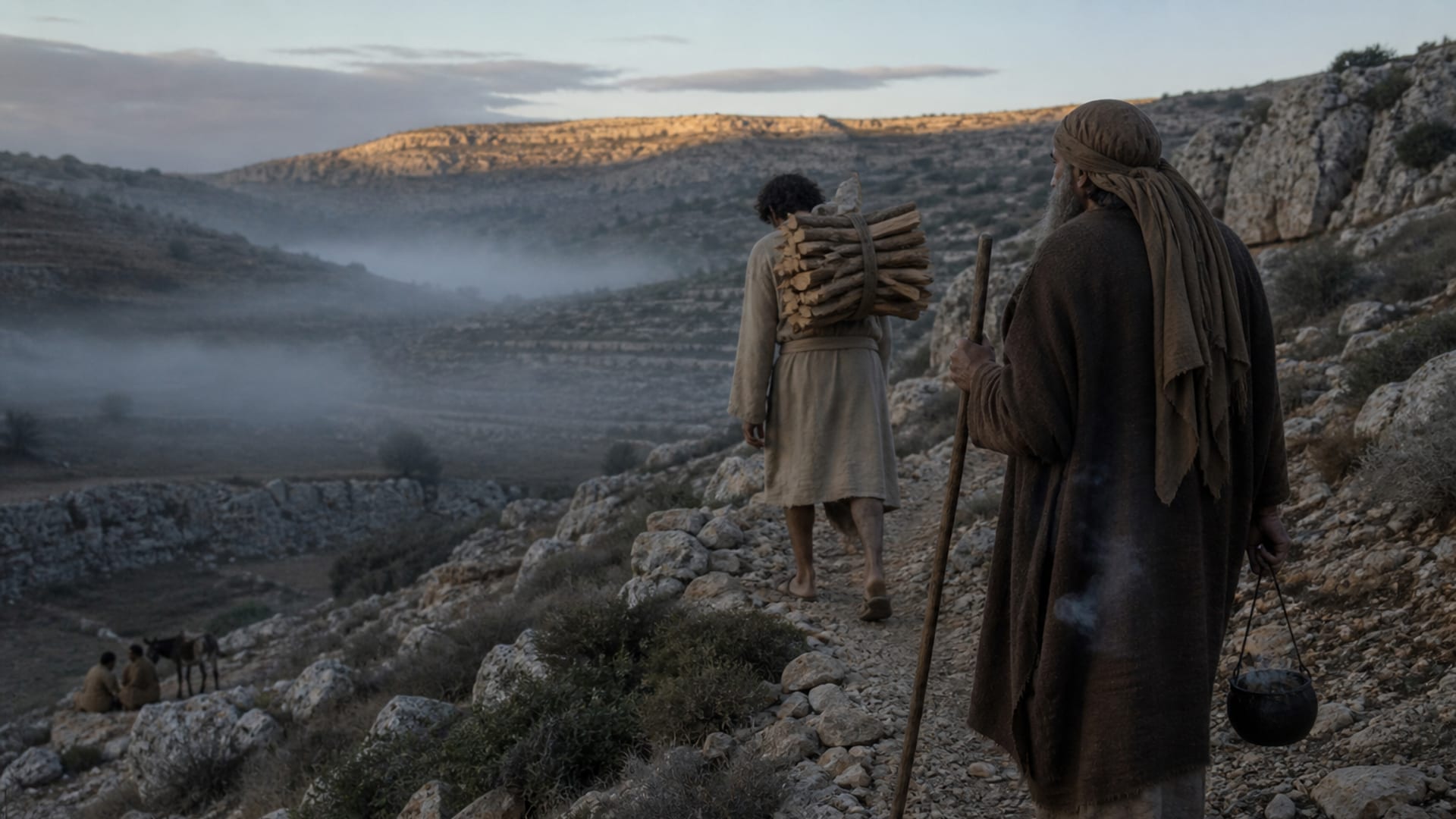
So Abraham got up early the next morning, saddled his donkey, and took along two of his servants and his son Isaac. He split the wood for a burnt offering and set out for the place God had designated. (Genesis 22:3)
Five verbs of preparation, and no speech. Then: “On the third day Abraham looked up and saw the place in the distance.” Three days pass in a single verse. We hear nothing about the nights, the meals, or what Isaac asked on the road.
The literary critic Erich Auerbach made this silence famous. In the first chapter of Mimesis, “Odysseus’ Scar,” he sets Genesis 22 beside the scene in the Odyssey where an old nurse recognizes Odysseus by a scar, and Homer pauses to tell how he got it. Homer lights everything evenly. Genesis, Auerbach argued, shows only what the story needs and leaves the rest dark; in Willard Trask’s translation, the biblical story is “fraught with background.” Something enormous is happening inside Abraham for three days, and we are not allowed in.
“Stay here with the donkey,” Abraham told his servants. “The boy and I will go over there to worship, and then we will return to you.” (Genesis 22:5)
“We will return.” The verb is plural. Readers have argued for centuries about what Abraham meant: a kindness that kept the worst unsaid, a hope against what he had been told, or faith that God would give Isaac back. The text does not say. Hebrews will later write that Abraham “reasoned that God could raise the dead,” but it does not cite this verse, and Genesis should not be made to say more than it says.
“Here I am,” three times
Abraham says the Hebrew word hinneni, “Here I am,” three times in this chapter, each time to a different voice. The first is to God (v. 1), before the command, when he does not yet know what he is answering. The second is to Isaac (v. 7):
Then Isaac said to his father Abraham, “My father!” “Here I am, my son,” he replied.
The third is to the angel of the LORD (v. 11), when the knife is already in his hand.
Put them side by side and Abraham stands between two calls, one from above asking for his son, one from beside him saying “My father.” He answers both with the same word. Whatever else is true of him on this road, he does not stop being Isaac’s father in order to obey God.
Twice the narrator adds a small refrain: “the two of them walked on together” (vv. 6, 8). Isaac carries the wood. Abraham carries the fire and the knife, the two things that could hurt a child. After Isaac’s question and Abraham’s answer, the refrain comes again, word for word. They are still together. Nothing has been explained.
The lamb and the knife
“The fire and the wood are here,” said Isaac, “but where is the lamb for the burnt offering?” Abraham answered, “God Himself will provide the lamb for the burnt offering, my son.” (Genesis 22:7–8)
“Provide” translates the Hebrew verb ra’ah, “to see.” Literally Abraham says, “God will see for Himself the lamb.” As in English, “to see to” something can mean to take care of it, hence “provide.” But seeing runs through the whole chapter. Abraham “looked up and saw the place” (v. 4). He will look up again and see a ram (v. 13). And he will name the mountain after what God sees (v. 14).
The Hebrew word order leaves one more possibility. Read without punctuation, the sentence can be heard as “God will see to the lamb for the burnt offering: my son.” An early midrash hears it that way, and has Abraham mean, “And if not, you are the lamb” (Bereshit Rabbah 56:4). We cannot know whether the narrator intended the double sense, but the Hebrew allows it.
When they arrived at the place God had designated, Abraham built the altar there and arranged the wood. He bound his son Isaac and placed him on the altar, atop the wood. Then Abraham reached out his hand and took the knife to slaughter his son. (Genesis 22:9–10)
The verbs come one at a time. Built, arranged, bound, placed, reached out, took. No one speaks.
How old was Isaac? The text does not say. He is called na’ar (vv. 5, 12), a word that covers everything from an infant to a young man; Joseph is a na’ar at seventeen. He is old enough to carry a load of wood uphill and to ask a pointed question. That is all we know.
Later interpreters filled the gap. Josephus, in the first century AD, makes Isaac twenty-five and willing. Bereshit Rabbah 56:8 makes him thirty-seven (one reading says twenty-six) and reasons that an old man could not bind a grown man without his consent. These traditions shaped how Jews remembered the Aqedah, as the devotion of two people. But they are later interpretation, not the text of Genesis. Genesis gives Isaac one question and then silence.
The voice from heaven
Just then the angel of the LORD called out to him from heaven, “Abraham, Abraham!” “Here I am,” he replied. “Do not lay a hand on the boy or do anything to him,” said the angel, “for now I know that you fear God, since you have not withheld your only son from me.” (Genesis 22:11–12)
“Now I know” is a hard phrase. Did God not know before? Some interpreters speak of knowledge by experience rather than foresight; others say the words are for Abraham’s sake and ours. The text does not resolve it. It does make clear what the test was about: whether Abraham feared God more than he held on to the gift God had given him.
Then Abraham looked up and saw behind him a ram in a thicket, caught by its horns. So he went and took the ram and offered it as a burnt offering in place of his son. And Abraham called that place The LORD Will Provide. So to this day it is said, “On the mountain of the LORD it will be provided.” (Genesis 22:13–14)
The ram dies “in place of his son.” Abraham names the place YHWH yir’eh, “the LORD will see,” and the saying that follows can be read “on the mountain of the LORD He will be seen” or “it will be seen.” The Greek translators took it that way: “the Lord saw,” and “on the mountain the Lord was seen.” God sees, and on that mountain He is seen.
Abraham does not name the place after his obedience. He names it after what God saw to.
The land of Moriah
Where was it? Genesis gives only “the land of Moriah” and “one of the mountains.” The name appears once more in the entire Old Testament:
Then Solomon began to build the house of the LORD in Jerusalem on Mount Moriah, where the LORD had appeared to his father David. This was the place that David had prepared on the threshing floor of Ornan the Jebusite. (2 Chronicles 3:1)
Chronicles does not mention Abraham. It ties Moriah to David’s threshing floor. But it uses a name found otherwise only in Genesis 22, and readers have heard the connection ever since. Josephus says it was the mountain “upon which king David afterwards built the temple.” Rashi, on Genesis 22:2, says simply, “This is Jerusalem.” And “the mountain of the LORD” in verse 14 is the language Israel later used for Zion (Isaiah 2:3).
Two cautions. This is a canonical identification, made by later Scripture and tradition, not an archaeological one. And the Septuagint did not read “Moriah” as a name at all, translating “the land of Moriah” as “the high land.” What the name means is uncertain, and the proposed links (to teaching, to myrrh, to seeing) are plays on sound, not ground for theology.
Abraham lived at Beersheba (22:19), roughly seventy kilometers, about forty-five miles, from Jerusalem in a straight line. That fits three days on foot with a loaded donkey. Fitting is not proof, but the canonical reading is geographically possible.
A God who asked for a son
What did it mean to the first hearers that a god would ask for a child? The Bible itself says that Israel’s neighbors, and at times Israel, gave children to their gods. The king of Moab, losing a war, “took his firstborn son, who was to succeed him, and offered him as a burnt offering on the city wall” (2 Kings 3:27). Leviticus forbids giving children “to be sacrificed to Molech” (18:21). Outside the Bible the evidence is harder to read. At Carthage, excavators found urns holding the burned bones of infants and young animals; whether these precincts show sacrifice or were children’s cemeteries is still argued among specialists.
Israel’s own law claimed the firstborn, “You are to give Me the firstborn of your sons” (Exodus 22:29), and then required their ransom: “You must redeem all the firstborn of your sons” (Exodus 34:20).
The prophets put it without qualification. Jeremiah condemns the people of Judah who burned their sons and daughters at Topheth, “something I never commanded, nor did it even enter My mind” (Jeremiah 7:31; see 19:5). Micah imagines a worshiper asking, “Shall I present my firstborn for my transgression, the fruit of my body for the sin of my soul?” and answers with justice, mercy and humility (Micah 6:7–8).
So how does Genesis 22 sit next to Jeremiah? A common modern answer is that the story exists to reject child sacrifice: God stops the knife and asks for a ram. There is truth in that. But Jon Levenson, in The Death and Resurrection of the Beloved Son, argues that the reading is too easy. God does ask, and Abraham is blessed precisely because he did not withhold his son (vv. 16–18). Levenson traces instead how the old idea that the beloved son belongs to God was transformed, through substitution and redemption, in Judaism and Christianity alike.
The rabbis felt the tension. On Jeremiah’s words “nor did it even enter My mind,” a reading preserved in Bereshit Rabbah 56:8 says: this refers to Isaac. God said “bring him up,” it argues, and never said “slaughter him.”
I would not resolve this too quickly. Genesis 22 does not teach that God wants children killed; the whole Bible, and the story’s own ending, stand against that. Nor does it let us pretend God never asked. It shows a God who asks for everything and then provides what He asked for.
Coming down alone
Abraham went back to his servants, and they got up and set out together for Beersheba. And Abraham settled in Beersheba. (Genesis 22:19)
Abraham went back. Isaac is not mentioned. The word “together,” which twice described father and son on the way up, now describes Abraham and the servants. The midrash asks, “And where was Isaac?” and guesses gently that he had been sent to study with Shem (Bereshit Rabbah 56:11). The text does not say.
Sarah’s death follows, at Hebron (23:2). Rashi, drawing on older tradition, says the news of the binding killed her; Genesis does not say so. What the text does show is that God never speaks to Abraham again after this chapter, and Abraham and Isaac are never again shown speaking to each other. The last words between them in Scripture are “My father” and “God Himself will provide the lamb, my son.”
A story that ends in blessing still has costs, and the text lets us see them without comment.
How Israel and the church remembered it
The Mishnah counts the Aqedah among the ten trials of Abraham (Avot 5:3), and in its prayers for fast days it asks God to answer “He Who answered Abraham on Mount Moriah” (Taanit 2:4). The Talmud explains the ram’s horn blown at the New Year this way: God says, “Sound a blast before Me with a shofar made from a ram’s horn, so that I will remember for you the binding of Isaac” (Rosh Hashanah 16a). The chapter is still read in the synagogue at the New Year. Medieval Jewish poets, after the Crusade massacres, turned to Isaac as the image of their murdered children, a tradition Shalom Spiegel traced in The Last Trial.
The New Testament reads the story in several ways, and it helps to name the kind of connection each makes.
Hebrews 11:17–19 is an explicit interpretation. “By faith Abraham, when he was tested, offered up Isaac on the altar. He who had received the promises was ready to offer his one and only son.” Abraham held command and promise together because he “reasoned that God could raise the dead, and in a sense, he did receive Isaac back from death.” “In a sense” is literally “in a figure”: Hebrews itself calls Isaac’s return a figure.
James 2:21–23 is also explicit, with a different purpose: “Was not our father Abraham justified by what he did when he offered his son Isaac on the altar?” James says that on the mountain the earlier Scripture, “Abraham believed God,” “was fulfilled.” The mountain showed that the trust was real.
Romans 8:32 is an echo, not a quotation: “He who did not spare His own Son but gave Him up for us all.” The Greek verb “spare” is the one the Septuagint uses when the angel says Abraham “did not spare” his beloved son (vv. 12, 16). Paul never names Abraham, but a reader of the Greek Genesis hears it, and the comparison turns around. On Moriah God stopped a father from giving up his son. At the cross God did not stop Himself.
Beyond these, Christian readers have long seen a typological pattern. Tertullian, early in the third century, wrote that Isaac “himself carried the wood for his own death,” setting forth Christ, who “carried the cross whereon He suffered” (Against Marcion 3.18; compare John 19:17). The voice at Jesus’ baptism, “You are My beloved Son” (Mark 1:11), may echo the Septuagint’s “beloved son.” These are typological and canonical connections, made by reading the whole Bible as one story, not claims that the author of Genesis had Jesus in view. Held with that honesty, they are rich. And notice where the pattern bends. In Genesis the son is spared and a ram dies in his place. In the Gospels no ram appears. The Son is not spared.
Neither hero nor monster
It is easy to make Abraham simpler than the text does. One kind of sermon makes him a spiritual athlete passing a test. Another reader, understandably, sees a man willing to kill his child because a voice told him to. In 1843 Søren Kierkegaard wrote Fear and Trembling against people who praise Abraham without feeling any dread at what he did.
Genesis does neither. It gives no speech of triumph and no cry of anguish. It gives us a man who gets up early, says “Here I am” to God and to his son, walks for three days, and names the mountain after what God saw. The restraint reads to me as reverence, and perhaps mercy, toward something too heavy to narrate.
None of us should believe anyone who claims God is asking them to harm another person; Jeremiah and Micah stand guard at that door. What the chapter asks of an ordinary reader is quieter. Have God’s gifts taken His place? Can I say “Here I am” to God without ceasing to say it to the people beside me? And can I walk into what I do not understand with nothing to say except that God will see to it?
Abraham said that before he knew how it would end. We say it knowing more than he did. We know it was a test. We know about the ram. And Christians know about a hill outside Jerusalem where God did not spare His own Son.
On the mountain of the LORD, it will be seen.
For reflection
- The reader is told "God tested Abraham" before Abraham knows anything. What changes when I read a hard season in my own life knowing that God sees more of it than I do, and what does that knowledge not explain?
- Abraham says "Here I am" to God, to his son, and to the angel. Whose voice am I slowest to answer, the one above me or the one walking beside me?
- The text gives three days of walking and not one recorded word. What do I do with silences that Scripture leaves unfilled: do I rush to fill them, or can I let them stand?
- Jeremiah says child sacrifice never entered God's mind. How do I hold that together with Genesis 22 without flattening either text?
- Abraham names the place for what God would see, not for what he himself did. Where have I told a story of my faith as though I were its hero?
Prayer
God of Abraham and of Isaac, You saw the mountain before either of them did. See me in the places where I cannot see the end.
Keep me from asking of others what You never asked, and from offering You what You never wanted.
When I say "Here I am," let me mean it to You and to the people You have put beside me.
Thank You that You did not spare Your own Son. Teach me to trust You with what I love.
Amen.
The story tells us it is a test and then refuses to tell us how it felt. Everything Abraham says in it is either "Here I am" or a sentence about what God will see.
Sources and notes
Consulted while writing this piece. Nothing is listed here that was not used.
- Berean Standard Bible primary text
- The Hebrew text of Genesis 21-23 (Miqra according to the Masorah), via Sefaria primary text
- Septuagint, Genesis 22 (Rahlfs text), with Brenton's English translation, for "beloved," "the high land" and "you did not spare" primary text
- SBL Greek New Testament (2010), Romans 8:32 and Hebrews 11:17-19 primary text
- Bereshit Rabbah 55:7, 56:4, 56:8 and 56:11, The Sefaria Midrash Rabbah (2022) primary text
- Rashi on Genesis 22:2 and 23:2, trans. M. Rosenbaum and A. M. Silbermann (1929-1934) commentary
- Mishnah Avot 5:3 and Mishnah Taanit 2:4; Babylonian Talmud Rosh Hashanah 16a (William Davidson edition) primary text
- Flavius Josephus, Antiquities of the Jews 1.13.1-4, trans. William Whiston primary text
- Tertullian, Against Marcion 3.18, in Ante-Nicene Fathers, vol. 3 primary text
- Erich Auerbach, Mimesis: The Representation of Reality in Western Literature, trans. Willard R. Trask (Princeton University Press, 1953), chapter 1, "Odysseus' Scar" literary study
- Jon D. Levenson, The Death and Resurrection of the Beloved Son: The Transformation of Child Sacrifice in Judaism and Christianity (Yale University Press, 1993) historical study
- Shalom Spiegel, The Last Trial, trans. Judah Goldin (1967) historical study
- Gordon J. Wenham, Genesis 16-50, Word Biblical Commentary 2 (Word, 1994), for further study commentary
- Victor P. Hamilton, The Book of Genesis: Chapters 18-50, New International Commentary on the Old Testament (Eerdmans, 1995), for further study commentary
- Søren Kierkegaard, Fear and Trembling (1843) literary study
Scripture in English is from the Berean Standard Bible, placed in the public domain by its publisher on 30 April 2023.