
Devotional
By the Arms
In Hosea 11 God remembers teaching a toddler to walk. Nobody remembers being taught to walk, and that is exactly the grief of the passage.
Scripture Hosea 11:1–4 · Hosea 11:8 · Hosea 2:8 · Exodus 15:26 · Matthew 2:15
When Israel was a child, I loved him, and out of Egypt I called My son.
Most of Hosea is hard to read. The prophet spoke to the northern kingdom of Israel in the eighth century before Christ, a generation or so before Assyria swept it away, and his book is full of betrayal, courtroom language and a marriage that breaks. Chapter 11 does not leave that behind. But for a few verses God stops speaking as a judge and starts speaking as a parent looking through old memories.
The child walks away
“But the more I called Israel, the farther they departed from Me. They sacrificed to the Baals and burned incense to carved images.”
Any parent of a grown child who has gone cold will recognize the shape of that sentence. The calling and the leaving happen together. The louder the voice, the farther the steps.
Taking them by the arms
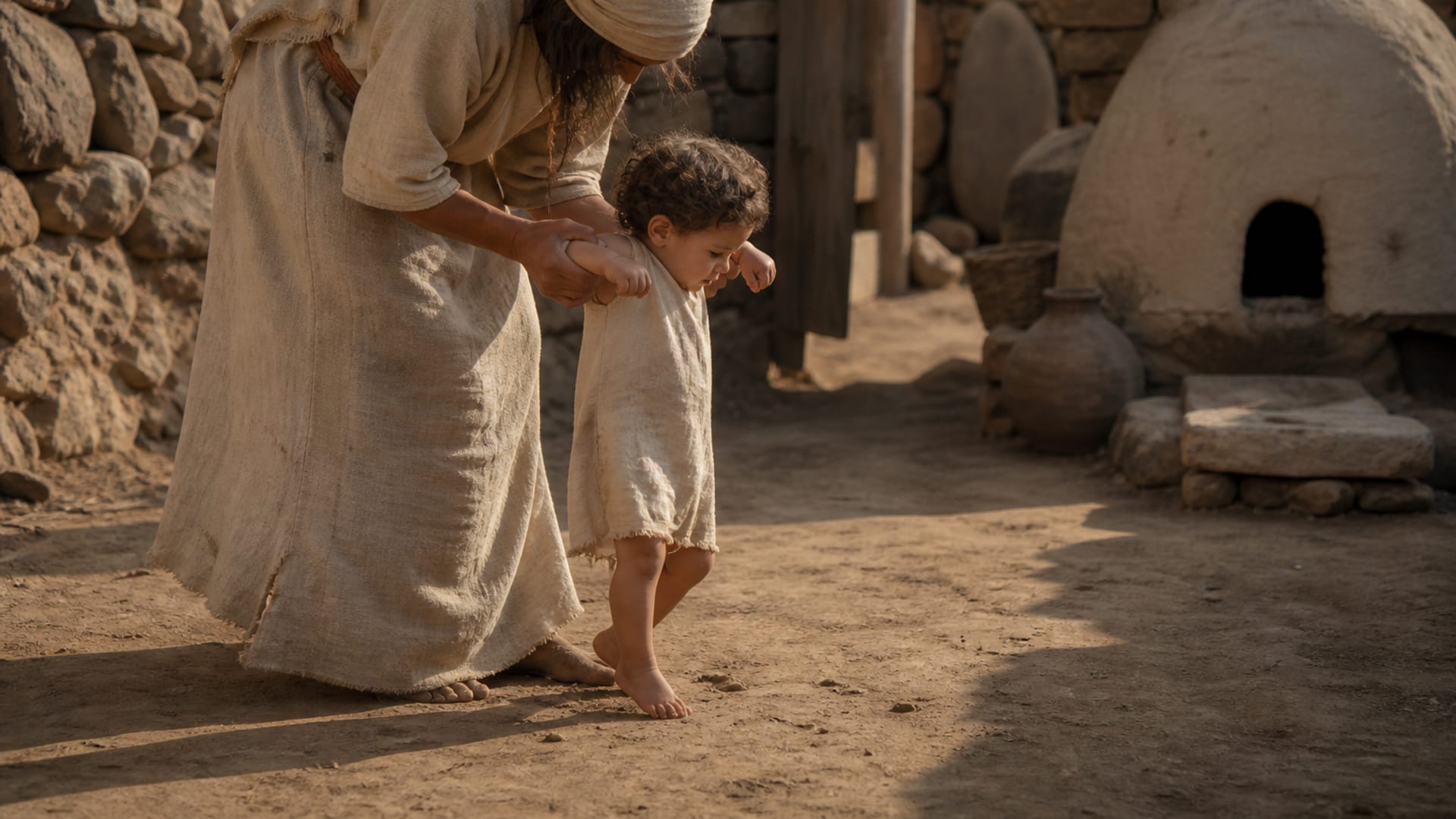
Then the memory. “It was I who taught Ephraim to walk, taking them by the arms.”
Ephraim was the leading tribe of the north, and Hosea often uses its name for the whole kingdom. Here it is the name of a toddler. The picture is plain and domestic: an adult bent over behind a small child, holding it up by the arms, taking the weight while the legs figure out what they are for. Anyone who has done it knows the ache in the back and the way you let go just a little, and then catch.
The next line is the one that stays with me. “But they never realized that it was I who healed them.”
Nobody remembers learning to walk. Nobody remembers the fevers they were nursed through at two, or who sat up with them. We walk as if we always could. That is not a failing in a child; it is simply what childhood is. Hosea’s grief is that Israel grew up and kept that same forgetfulness. Earlier in the book God had said the same thing in harvest terms: “she does not acknowledge that it was I who gave her grain, new wine, and oil.” They credited other gods with what they had, and never knew whose hands had been under their arms.
The word for “healed” is the same Hebrew root God used at the beginning of the wilderness journey: “I am the LORD who heals you.” Hosea may well be reaching back to it. Either way, the healing went unnoticed.
Cords, a yoke, a bowl
“I led them with cords of kindness, with ropes of love; I lifted the yoke from their necks and bent down to feed them.”
The Hebrew of this verse is difficult, and translations differ. Some, the New Revised Standard Version among them, read it as a parent lifting a small child up to the cheek. The BSB keeps the picture of a farmer easing the yoke off an animal so it can eat. Both readings end in the same posture: someone stronger bending down to a creature that cannot feed itself.
It is worth sitting with that. The God of Hosea does not stand at a distance waiting for his people to climb up to him. He bends. And he does it for people who, the previous verse says, did not know he was doing it.
“How could I give you up?”
Hosea does not pretend the story is sweet. Verses 5 to 7 speak of the sword and of Assyria. Then comes one of the most startling lines in the prophets: “How could I give you up, O Ephraim? How could I surrender you, O Israel? … My heart is turned within Me; My compassion is stirred!”
God argues with himself, and compassion wins.
Matthew later quotes the first line of this chapter about Jesus, carried to Egypt as a child and brought back: “Out of Egypt I called My Son.” Matthew sees in him the Son who walks Israel’s road and does not walk away.
For today
Most of the grace in your life has probably come to you the way it came to Ephraim, below the level of memory. Someone fed you before you could say thank you. Someone held you up before you knew you were falling. Some of that was God, working through people, and some of it was God in ways you will never trace.
You will not be able to remember it all, and you are not asked to. But you can stop crediting the wrong things. Today, name one good thing you have assumed was simply yours, and say out loud who you think taught you to walk.
For reflection
- What in my life that I take for granted might have come from hands I never noticed?
- Where have I been walking away from the one who taught me to walk?
Prayer
Father, you held me up before I knew there were hands under my arms. I have not always known who healed me.
Thank you for what I cannot remember. Do not give me up, and turn me back toward you.
Amen.
Hosea 11 is God remembering what his child cannot: the arms, the healing, the bending down to feed. Grace is often the care we were too small to notice.
Sources and notes
Consulted while writing this piece. Nothing is listed here that was not used.
- Berean Standard Bible (public domain) primary text
- Bible Hub Hebrew interlinear, Hosea 11:3 (rapha, Strong's 7495, "healed"), compare Exodus 15:26 interlinear
- Bible Hub parallel translations, Hosea 11:4 (renderings of the yoke line, including the NRSV "like those who lift infants to their cheeks") translation comparison
Scripture in English is from the Berean Standard Bible, placed in the public domain by its publisher on 30 April 2023.