
Devotional
The Mercy That Stops Us
David has been insulted, and he is riding toward revenge. Abigail’s courage helps him receive restraint as the LORD’s mercy before guilt is added to injury.
Scripture 1 Samuel 25:23–35 · 1 Samuel 25:13 · 1 Samuel 25:14–17 · 1 Samuel 25:21–22 · 1 Samuel 25:36–39
David is not merely angry when Abigail meets him on the road. He is armed, offended, and moving with men who have accepted his command. After Nabal humiliates David’s messengers, David says, “Strap on your swords!” The wilderness kindness David had shown Nabal’s shepherds has been repaid with contempt.
His grievance is not imaginary. Nabal’s own servants know David’s men had protected them in the fields. David’s summary has the bitter clarity of a wounded man: “Nothing that belongs to him has gone missing, yet he has paid me back evil for good.” The danger is what David decides to do with a real wrong. His next sentence takes aim at a massacre: “May God punish David, and ever so severely, if I let one male belonging to Nabal survive until morning.”
That is the road Abigail steps onto.
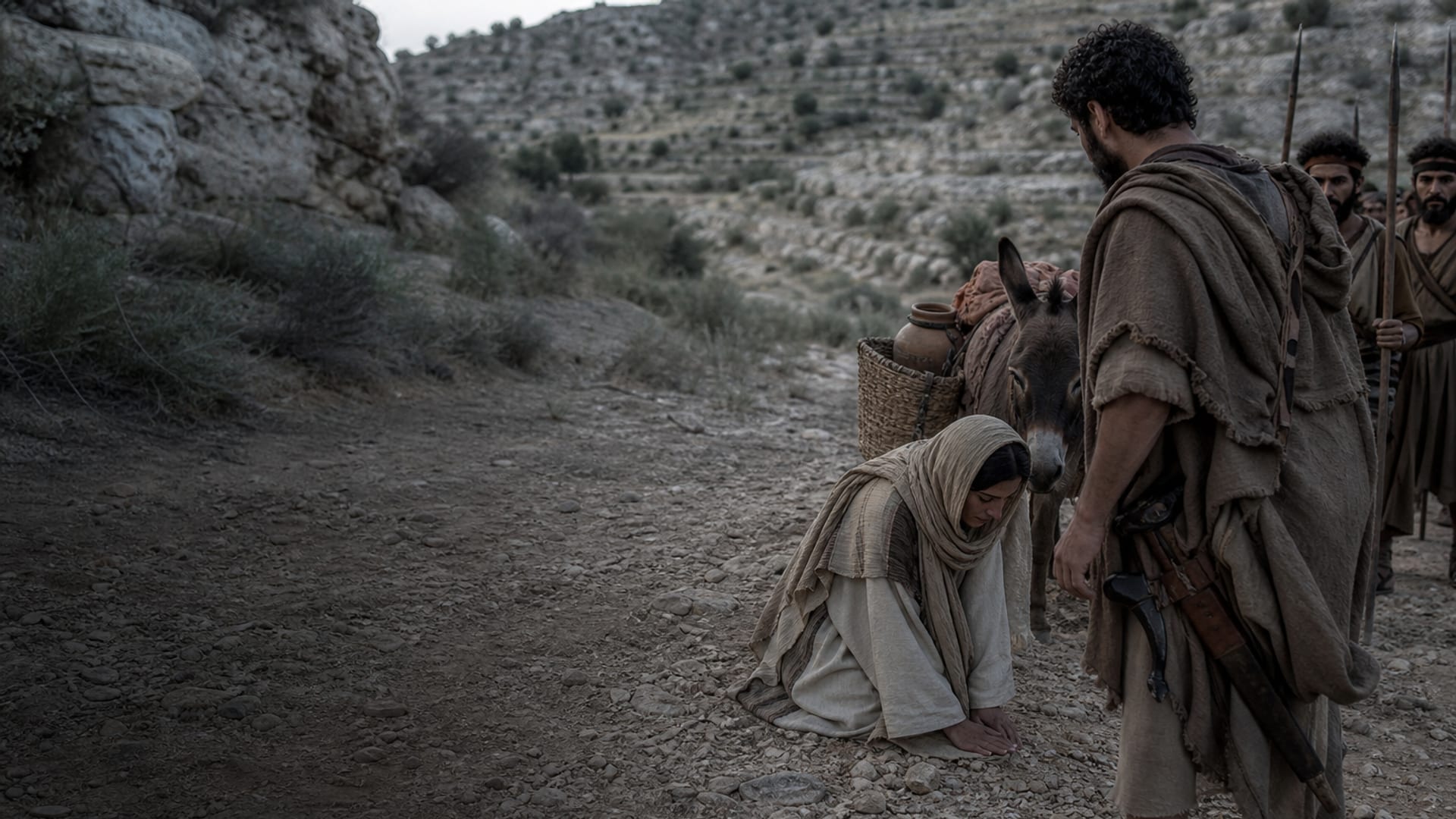
The focal passage begins with posture before speech. “When Abigail saw David, she quickly got off the donkey, fell facedown, and bowed before him.” She cannot overpower David. She can only meet him with urgency, humility, and truth. Her first words are a plea for a hearing: “My lord, may the blame be on me alone, but please let your servant speak to you; hear the words of your servant.” It is a courageous approach, because David is already in motion and armed men rarely enjoy being interrupted.
Abigail does not excuse her husband. She says, “My lord should pay no attention to this scoundrel Nabal, for he lives up to his name: His name means Fool, and folly accompanies him. I, your servant, did not see my lord’s young men whom you sent.” That sentence matters. Restraint is not denial. Abigail names foolishness as foolishness. She does not ask David to pretend Nabal acted honorably. She asks him to refuse the sin that Nabal’s sin is drawing out of him.
Her most daring line treats this interruption as God’s own mercy: “Now, my lord, as surely as the LORD lives and you yourself live, since the LORD has held you back from bloodshed and from avenging yourself with your own hand, may your enemies and those who seek harm for my lord be like Nabal.” David has not yet turned around. His men are still there. The threat is still close enough to hear. Yet Abigail speaks as if the LORD’s restraint is already happening through her presence in the ravine. The gift on the donkeys, the bowed body, and the careful words become means of mercy.
She is also thinking past the heat of the moment. Abigail has David’s future in view. The man who will receive good from the LORD should not be marked by a revenge he did not need to take. She wants him to reach that future cleanly: “then my lord will have no remorse or guilt of conscience over needless bloodshed and revenge. And when the LORD has dealt well with my lord, may you remember your servant.” The larger chapter will show that Nabal’s evil is not overlooked. Abigail’s plea is concerned with what vengeance will do to David.
David receives it. That may be the most surprising grace in the scene. He blesses God before he thanks Abigail: “Blessed be the LORD, the God of Israel, who sent you to meet me this day!” Then he names her discernment: “Blessed is your discernment, and blessed are you, because today you kept me from bloodshed and from avenging myself by my own hand.” Holy restraint has entered David through another person’s courage. He still has soldiers. He still has a sword. The sword no longer has him.
This is hard to receive while anger is fresh. When someone asks us to slow down, reconsider a message, or leave room for God to judge, it can feel like they are minimizing the wrong. Abigail shows another possibility. A person who interrupts our revenge may be taking our wound seriously enough to care what kind of soul we will have after we act.
The scene ends quietly. David says to Abigail, “Go home in peace. See, I have heeded your voice and granted your request.” No blood is shed on that road. David is spared more than a battle. He is spared the guilt that would have followed him into the future Abigail had just placed before him.
For reflection
- Where am I treating a real wrong against me as permission to do something I would later have to carry?
- Who has recently slowed me down, and have I dismissed that interruption too quickly?
Prayer
Lord, when I am offended, help me recognize the mercy that interrupts me.
Keep my hands from answering wrong with wrong, and give me humility to listen.
Amen.
Holy restraint may feel like interruption, but in David’s story it is the LORD’s mercy keeping future guilt from being born.
Sources and notes
Consulted while writing this piece. Nothing is listed here that was not used.
- Berean Standard Bible, 1 Samuel 25:23–35 primary text
Scripture in English is from the Berean Standard Bible, placed in the public domain by its publisher on 30 April 2023.