
Devotional
Lame in Both Feet
Mephibosheth called himself a dead dog and was given a permanent seat at the king's table. The chapter's last line is about his feet, and it is there on purpose.
Scripture 2 Samuel 9:1–13 · 2 Samuel 4:4 · 1 Samuel 20:14–15 · 1 Samuel 24:14 · Luke 14:13
Then David asked, “Is there anyone left from the house of Saul to whom I can show kindness for the sake of Jonathan?”
The question comes after the wars are over and the throne is secure. Saul is dead, Jonathan is dead, and David is king in Jerusalem. He asks it as though he has been thinking about it for a while.
He had reason to. Years earlier, when Saul was hunting David, Jonathan had asked him for a promise: “do not ever cut off your loving devotion from my household.” The BSB says “kindness” in 2 Samuel 9 and “loving devotion” in 1 Samuel 20, but it is the same Hebrew word, the word for loyal, covenant love. David is keeping a promise to a dead friend.
The boy who fell
The answer comes from Ziba, an old servant of Saul’s house. “There is still Jonathan’s son, who is lame in both feet.”
It is interesting that this is the first thing Ziba says about him. Perhaps he meant that the young man was no threat. Perhaps he meant he was not worth much. Either way, the disability arrives before the name.
The narrator had already told us how it happened, back in 2 Samuel 4. Mephibosheth was five years old when the news came that Saul and Jonathan had died. His nurse picked him up and ran, “but as she was hurrying to escape, he fell and became lame.” A child who fell in the panic of a collapsing royal house. He had lived with it ever since.
Now he is a grown man with a young son of his own, living east of the Jordan in Lo-debar, in the house of a man named Machir. Not his own house.
A dead dog like me
David sends for him. Mephibosheth comes in and falls on his face. David says one word, his name. “Mephibosheth!” And the answer is the careful answer of a man who does not know what is about to happen to him: “I am your servant.”
He had good reason to be afraid. He was the grandson of the king David replaced, and the new king had just asked who was left of the old one’s family. David’s next words to him are “Do not be afraid.”
Then comes more than he could have imagined: all of Saul’s land returned to him, and a seat at the king’s table, always. Mephibosheth bows again and says, “What is your servant, that you should show regard for a dead dog like me?”
There is a strange echo here. Years before, David had used the same picture about himself, calling out to Saul, who was hunting him, just outside a cave near En-gedi: “Whom are you pursuing? A dead dog? A flea?” The two men have traded places. The one who once called himself a dead dog before Saul now hears Saul’s grandson say it to him. David had once stood where Mephibosheth was standing.
Always
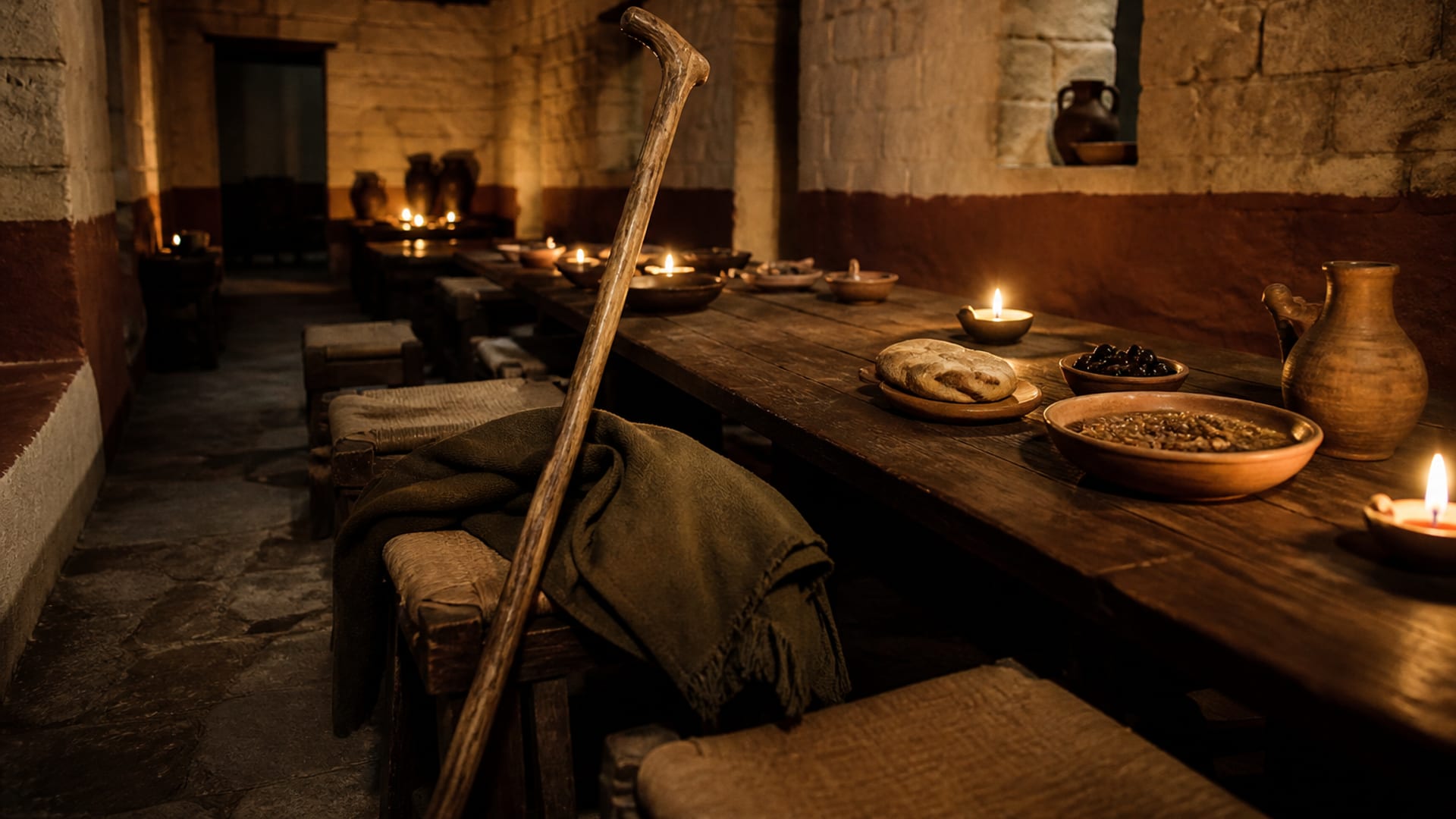
Count how often the table comes up. David promises it in verse 7. He repeats it to Ziba in verse 10: “Mephibosheth, your master’s grandson, is always to eat at my table.” Verse 11 says he ate there “like one of the king’s own sons.” Verse 13 says it once more. The chapter will not let the point go. This was not a single honorary dinner. It was where he ate, day after day.
The last line
Then the chapter ends. “So Mephibosheth lived in Jerusalem, because he always ate at the king’s table, and he was lame in both feet.”
Preachers sometimes say that once he sat down, the table hid his feet. It is a lovely picture, and the text does not say it. The narrator does the opposite. He puts the feet in the very last line, where we cannot miss them.
Nothing in 2 Samuel 9 heals Mephibosheth. The kindness does not wait for him to walk, and it does not require him to pretend he can. He is brought in lame and he stays lame, and he eats with the king’s sons every day anyway. The grace of the chapter and the limp of the chapter share one sentence.
By analogy, and it is only an analogy, this is close to how many believers experience the gospel. We are brought in for someone else’s sake, and for now we keep our limp. Jesus once told a host to invite “the poor, the crippled, the lame, and the blind,” and that is the kind of guest list David kept.
For today
If you have been waiting to be whole before you feel welcome, look at the end of 2 Samuel 9 again. The man at the table is still lame, and he is still at the table.
And if you have a table of your own, someone may be living in a Lo-debar of their own, in somebody else’s house. You might be the one who sends for them.
For reflection
- What do I think I would need to fix in myself before I could sit comfortably at God's table?
- Is there someone I could bring to my own table for someone else's sake, the way David did for Jonathan?
Prayer
Lord, you know what I cannot fix, and you have called me to your table anyway.
When I say "a dead dog like me," say my name again, and seat me.
Amen.
The table did not heal his feet, and the narrator makes sure we know it. He ate there always, lame in both feet.
Sources and notes
Consulted while writing this piece. Nothing is listed here that was not used.
Scripture in English is from the Berean Standard Bible, placed in the public domain by its publisher on 30 April 2023.