
Sermon Outline
When the Answer Is Worse Than the Question
Habakkuk asks God why the wicked go unpunished. God replies that he is raising up the Babylonians, and the prophet is left holding a larger problem than the one he brought.
Scripture Habakkuk 1:1–2:4 · Habakkuk 2:4 · Exodus 17:12 · Romans 1:17
Preaching brief
- Central truth
- God answers Habakkuk, and the answer enlarges the problem before it resolves anything. What God gives the prophet to stand on is not an explanation but an appointed time and a call to steadiness.
- Exegetical idea
- Habakkuk complained that God was doing nothing about the violence inside Judah. God answered that he was raising up the Chaldeans, which made the problem larger rather than smaller. The prophet argued back from God's own character, took up his post, and was given an appointed time and a word about steadiness in place of an explanation.
- Theological idea
- God's silence is not indifference, and his answers are not always relief. He gives the righteous a horizon he has fixed and has not disclosed, and the steadiness to keep standing until it arrives.
- Big idea
- When God's answer is harder than the question, the righteous keep standing by holding on to a God who has fixed a time he has not disclosed.
- Purpose
- To help a congregation carrying unanswered questions stay with God, rather than settle for despair on one side or a manufactured explanation on the other.
- Estimated length
- 35 to 40 minutes
The setting, and how much of it we actually know
Habakkuk gives no date. That is worth noticing, because it is unusual. Isaiah, Jeremiah, Hosea and Amos all open by naming the kings they served under. Habakkuk opens with “the oracle that Habakkuk the prophet saw” and stops there.
So everything said from the pulpit about when he wrote is an inference, and it rests on one line. In 1:6 God announces that he is raising up the Chaldeans, which is to say the Neo-Babylonians. Nineveh had fallen in 612. At Carchemish in 605 the Babylonian army broke Egypt, under a crown prince named Nebuchadnezzar who became king a few weeks later when his father died. Most scholars place Habakkuk somewhere in the reign of Jehoiakim, roughly 609 to 598, and many narrow it to the years around Carchemish.
Tell the congregation the truth about this: we are reading a man who wrote while a new empire was arriving and nobody yet knew how bad it would get. That is enough. A specific year adds nothing the sermon needs and commits you to more than the book says.
Literary context
The book runs as a dialogue. The prophet complains, God answers, the prophet complains again, God answers again. Then come the woe oracles of 2:6 to 2:20, and then a psalm in chapter 3 with its own superscription, its own musical notations, and its own closing line about stringed instruments.
Habakkuk is often described as the prophet who talks to God instead of to the people, and in chapters 1 and 2 that is largely true. Keep two qualifications. The woes in 2:6 and following are a taunt-song aimed at the oppressor, not a prayer. And Jeremiah does something similar in his confessions, where Jeremiah 12:1 raises almost the same complaint. Habakkuk is unusual. He is not alone.
Historical world: who was paying for what
Habakkuk’s complaint about injustice inside Judah is not abstract. It is a complaint about a specific and documentable regime, made by a man living under it.
Jehoiakim did not inherit the throne. He was installed on it by a foreign power. After Josiah died at Megiddo in 609 the people of the land made Jehoahaz king; Pharaoh Necho II removed him after three months, deported him to Egypt where he died, and put his brother Eliakim on the throne in his place, renaming him Jehoiakim (2 Kings 23:34). The renaming is not a decorative detail. To rename a king is to state who owns him.
Then the bill. Necho imposed a hundred talents of silver and a talent of gold, and 2 Kings 23:35 is unusually specific about how it was paid: Jehoiakim “taxed the land,” exacting the silver and gold “of the people of the land, from everyone according to his assessment.” The crown did not pay. The crown assessed households. There was a valuation, a register and a man at the door.
Carchemish changed the address on that bill without cancelling it. 2 Kings 24:1 has Jehoiakim becoming Nebuchadnezzar’s servant for three years. A household squeezed to pay Egypt was now squeezed to pay Babylon, and the treasury already drained into Egypt had bought nothing.
On top of the tax there was unpaid labour. Jeremiah’s charge against Jehoiakim in 22:13-19 is not vague wickedness but a specific accusation: a house built by unrighteousness, upper rooms by injustice, a neighbour made to serve “for nothing” without wages, cedar panelling and vermilion paint. Unpaid labour was a direct violation of Torah in Leviticus 19:13 and Deuteronomy 24:14-15, and not even a king had the right to it. Jeremiah’s sentence is that Jehoiakim will have “the burial of a donkey,” which in that culture means no burial at all.
Set 1:2-4 against that background and the complaint sharpens considerably. Grain going out as tribute, sons going out as unpaid labour, and courts in which “the wicked surround the righteous, so justice goes forth perverted.”
Peoples and culture: who the Chaldeans actually were
The word in 1:6 is kasdim, and it needs one careful paragraph before it can be preached.
The Chaldeans were West Semitic tribal groups settled in the far south of Babylonia, the marshland toward the head of the Persian Gulf that Babylonians called the Land of the Sea. They appear in Assyrian records from the early ninth century, organised in tribal houses. The most famous Chaldean before this period is Merodach-baladan of Bit-Yakin, the man who sends envoys to Hezekiah in 2 Kings 20. For two centuries they were Assyria’s most persistent southern problem.
They are not simply “the Babylonians.” Babylonian was in the first instance a civic and cultural identity, belonging to the ancient cities with their temples and scribal schools. Chaldean was a tribal identity from the southern edge. By Habakkuk’s day the two had largely merged, and glossing kasdim as “the Neo-Babylonian empire” for a congregation is fair. Worth knowing, though not worth preaching: the ruling dynasty’s own Chaldean descent is not actually documented anywhere. “Chaldean dynasty” is a modern convention rather than a title Nabopolassar used.
The trap to avoid is Daniel. In Daniel 2:2 the same word means something else entirely, a professional class of astrologers and diviners at the Babylonian court, and that is the sense Greek writers use. Habakkuk’s Chaldeans are not stargazers. They are cavalry, siege ramps and deportation, as 1:8-10 makes plain.
Which sets up the force of 1:5. Judah had known of these people for a century. The shock is not “who are they?” It is that in barely a dozen years the tribal southerners had destroyed Nineveh, broken Assyria, and then broken Egypt. God says he is doing something they would not believe if they were told. The astonishment is not curiosity. It is them?
Geography: why a battle four hundred miles away mattered
Carchemish sits on the west bank of the Euphrates, at the modern Turkish town of Karkamis, immediately north of Jarabulus in Syria. The modern border runs directly through the site, which is one reason it has been difficult to excavate; the British Museum dug there from 1911, with T. E. Lawrence assisting Leonard Woolley for three seasons.
Its importance is entirely about the river. Carchemish commanded one of the very few points where an army could get across the Euphrates. Upstream the river runs through gorges, downstream it swings east away from the roads. Hold Carchemish and you hold the hinge between Mesopotamia and the Mediterranean. The Babylonian record of the battle makes the geography audible in two words: Nebuchadnezzar “crossed the river.”
Jerusalem lies roughly 620 km away in a straight line, and nobody travelled in a straight line. The real road ran south through Aleppo, Hamath, Riblah and Damascus, closer to 900 km of marching.
This is the sentence to give a congregation. No Judean fought at Carchemish and no Judean died there. But Judah was a client state, and Carchemish decided whose client. Before 605 the taxes went to Egypt and the king had been installed by Pharaoh. After 605 the same taxes went to Babylon. A farmer outside Bethlehem woke up under a new empire without a single soldier appearing on his horizon.
Exegetical observations
1:2. “How long” translates ʿad-ʾānâ. Inside the Psalter that exact phrase turns up only in Psalm 13, where it lands four times in two verses, and once in Psalm 62. The commoner “how long” of the Psalms is a different Hebrew phrase. Habakkuk is not improvising a way of speaking to God. He is using the vocabulary of lament that Israel already sang.
1:2–4. Notice who is named as the problem. Not the wicked. God. You do not hear. You do not save. Why do you make me see wrong? The complaint is theological before it is social.
1:5–11. God’s answer. It is worth pointing out that God turns here to a plural audience, “look among the nations,” where the complaint had been one man’s. And the answer does not address the injustice Habakkuk raised. It announces something larger and more frightening.
1:12–17. The second complaint follows from the first answer. If God is too pure to look on evil, how can he watch while the treacherous swallow those more righteous than themselves? The prophet is now arguing from God’s character against God’s stated plan.
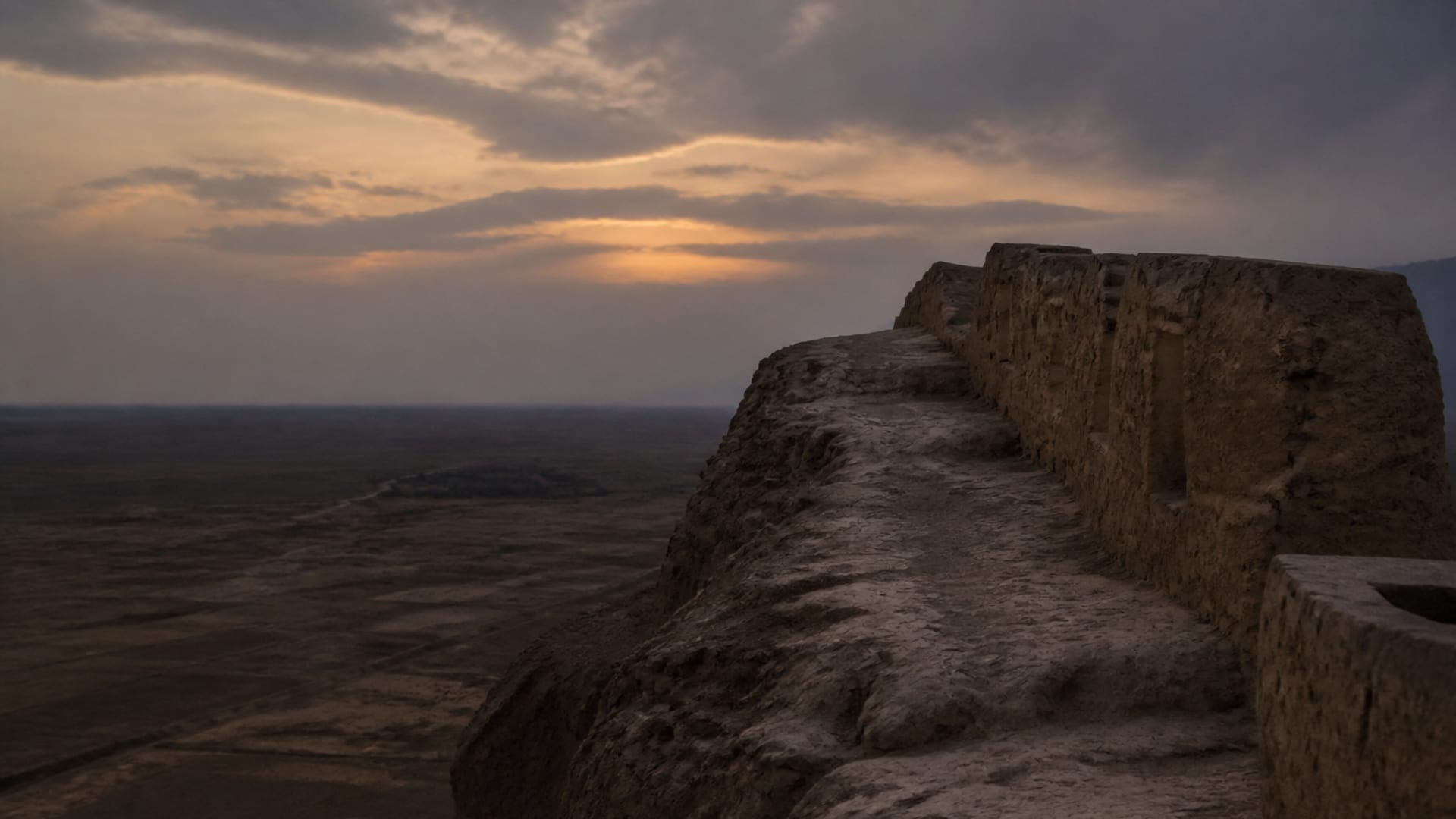
2:1. The prophet takes up a post. The two nouns are ordinary and slightly awkward. Mišmeret usually means a charge or a duty, often a priestly one, and māṣôr usually means siege-works. Most translations render the pair as watchpost and rampart, which fits the context and fits a real prophetic image: the prophet as sentinel appears in Isaiah 21, Ezekiel 3 and Ezekiel 33. What the verse does not give you is architecture. He takes a position and waits, and he expects to be answered.
2:2. “Write the vision, make it plain on tablets, so that…” and then the clause divides interpreters. It reads literally “so that he may run, one reading it.” One reading has a herald running with the message. The other has a tablet cut so plainly that a reader takes it in at speed. The verb rendered “make plain” appears only three times in the Hebrew Bible, and one of them is Deuteronomy 27:8, where the law is written on plastered stones “very plainly.” That parallel favours legibility.
2:3. There is an appointed time. It waits. It will not lie. This is the actual answer to “how long,” and notice what kind of answer it is. God confirms that there is a schedule. He does not share it.
The word this sermon turns on
Habakkuk 2:4b is four words in Hebrew: wəṣaddîq beʾĕmûnātô yiḥyeh.
ʾĔmûnâ is usually translated faith, and English readers hear belief. The Hebrew is nearer to firmness, steadiness, reliability. The clearest demonstration is Exodus 17:12. Moses’ hands grew heavy, so Aaron and Hur held them up, and his hands were ʾĕmûnâ until sunset. Steady. Not believing something. Held firm.
The same word describes workmen who handled temple silver honestly in 2 Kings 12 and 22, where no mental content is involved at all, only trustworthiness. And it describes God in Deuteronomy 32:4.
So the line is about staying power before it is about conviction. The pronoun is third masculine singular, his faithfulness, most naturally the righteous person’s own steadiness. Do not overcorrect, though. The word can shade toward trusting reliance on God, and the New Testament’s development of it is a legitimate reading rather than a mistranslation.
One honest note, if your congregation can carry it. The Greek translation of Habakkuk reads “by my faithfulness,” God’s rather than the believer’s, most likely because a scribe read one Hebrew letter for another that looked nearly identical. Paul quotes the line in Romans 1:17 and Galatians 3:11 with no possessive at all, and Hebrews 10:38 attaches “my” to the righteous one instead. The commentary on Habakkuk found at Qumran applies the same line to those who keep the law and stay loyal to their teacher. This half-verse was being argued over long before it reached a Reformation debate.
Archaeology and material culture
Three objects are worth knowing about here. Two of them are genuinely useful in a sermon, and all three need their limits stated.
The Babylonian Chronicle, British Museum 21946. A clay tablet covering the years 605 to 594, on display in Room 55. It records that in Nabopolassar’s twenty-first year the king stayed home while “Nebuchadnezzar his eldest son, the crown-prince” mustered the army, marched to Carchemish, crossed the river and broke the Egyptian force. It then records the father’s death and the son’s accession about three weeks later. A battle won, a father dead, a ride home across the desert and a throne taken, inside a single month.
For 597 it records that the king of Akkad besieged “the city of Judah,” took it on the second day of Adar, captured the king and appointed a king of his own choosing. That date converts to 16 March 597, which makes it one of the most precisely dated events in Israel’s history. Some scholars say 15 March, depending on how the Babylonian day is handled; say “March 597” and you are safe.
Now the limits, because this tablet gets oversold. It never says Jerusalem; the Akkadian is “the city of Judah,” and the identification, though universally accepted, is an inference. It names no Judean king at all. It does not record a siege of Jerusalem in 605. It does not reach the destruction of 587. And the tablet itself is dated by the museum to somewhere between 550 and 400 BC, which makes it a later scribal copy rather than a dispatch from the field. It is also small, about the size of a bar of soap. The honest claim is strong enough on its own: a Babylonian government record, entirely independent of the Bible, says the Babylonian army took a city in Judah and changed its king on a day we can name.
The Lachish ostraca. Potsherds carrying Hebrew military letters in ink, found by James Starkey in 1935 in a guardroom of the Lachish city gate, lying in the ash of the city’s destruction. Be honest about the date: they belong to the Babylonian siege of about 589, which is fifteen to twenty years after Habakkuk. That does not weaken them. It sharpens them. Habakkuk was told to write the vision and wait; these are the handwriting of men who were still alive when it arrived.
The line worth reading aloud is from Letter IV: the writer tells his commander that they are watching for the fire-signals of Lachish, “because we cannot see Azekah.” Two fortresses signalled each other by fire, and one night the signal stopped. Note what the officer does and does not say. He does not report that Azekah has fallen. He reports that he cannot see it. Jeremiah 34:7 names Lachish and Azekah as the last two fortified cities still holding out. The traditional reading is that Azekah had fallen, and many scholars reject that inference, since the letter says only that the signals are not visible. Preach the silence rather than the conclusion. The silence is the better image anyway.
The Habakkuk commentary from Qumran, 1QpHab. Found in Cave 1 in 1947, among the first scrolls recovered, and written in a script that dates it to the second half of the first century BC. It runs to thirteen columns and comments on chapters 1 and 2 only, verse by verse, applying each line to the community’s own situation.
On 2:4 it says the verse concerns “all those who observe the Law in the House of Judah, whom God will deliver from the House of Judgement because of their suffering and because of their faith in the Teacher of Righteousness.” On 2:1-3 it says God told Habakkuk to write what would happen to the final generation “but He did not make known to him when time would come to an end,” which is a remarkably close reading of what the text actually does.
Do not say the scrolls confirm Paul. They do something more interesting. Two Jewish communities within about a century of each other both built their identity on this one half-verse and drew different conclusions about what it required: fidelity to the Law and loyalty to a teacher in one case, a righteousness received by trust in the other. Habakkuk 2:4 was a contested, load-bearing sentence long before the New Testament quoted it, and long before the Reformation argued about it.
What most readers miss
The prophet never gets an answer to the question he asked. Read 1:2-4 and then 1:5-11 without a pause. He asks why God tolerates violence inside Judah. God replies by announcing an invasion. The mismatch is not a gap in the text. It is the text.
The complaint is singular and the answer is plural. Habakkuk speaks for himself, “how long shall I cry”. God’s reply in 1:5 opens by addressing a group and pointing them outward, look among the nations. A private grievance is answered with something aimed at everyone, which is part of why it does not comfort him.
He names God as the problem, not the wicked. You do not hear. You do not save. Why do you make me look at wrong? Congregations trained to bring God only settled feelings have usually never noticed that a canonical prophet opens this way and is not rebuked for it.
“How long” is borrowed, not invented. The particular Hebrew phrase behind it is rare and sits in the Psalms of lament. He is not finding words for something Israel had never said. He is using the words Israel already sang.
The book refuses to date itself. Isaiah, Jeremiah, Hosea and Amos all open by naming kings. Habakkuk opens with the oracle he saw and stops. Every historical reconstruction of this book, including the one below, is built from a single line in 1:6.
Why this matters: the missing date
It is tempting to treat the absent superscription as an inconvenience, something a good commentary can work around. It is worth preaching instead.
Every other prophet in that neighbourhood tells you whose reign you are standing in. Habakkuk withholds it, and the effect on a reader is precise: you are put inside the situation without being told how it turns out or how long it lasts. That is exactly the position the prophet is in, and exactly the position the congregation is in. The form of the book is doing the same work as its content.
From study to pulpit
Most of what is above will not survive contact with a pulpit in the shape it is in. Here is what some of it can sound like out loud.
On the answer that enlarges the problem. Possible way to explain this to the congregation: “He asks God why the violence in his own country goes unpunished. God answers him. And the answer is that a bigger army is coming. Whatever you think prayer is for, notice that this man prayed, got a real answer, and walked away with something heavier than he came with.”
On emunah. Possible way to explain this to the congregation: “The word we translate as faith here is not mainly about what you believe. It is the word used when Moses’ arms were held up until sunset, and they were steady. It is used of workmen who could be trusted with money. So the line is closer to ‘the righteous will live by staying put’ than to ‘the righteous will live by believing hard enough.’”
On the appointed time. Possible way to explain this to the congregation: “God tells him there is a set time, and then does not tell him when it is. That is the whole answer. If you have been waiting on something and what you have is a promise without a date, you are not outside the Bible. You are in Habakkuk chapter two.”
Movements
The passage supplies its own shape. Four movements, following the dialogue.
1. The complaint that names God as the problem (1:2–4). Establish that Scripture contains this. The prophet is not rebuked for it. A congregation that has been taught to bring God only settled feelings needs to hear a canonical prophet say “you do not save.”
2. The answer that makes it worse (1:5–11). This is the movement most sermons skip. God answers, and the answer enlarges the problem. Anyone in the room who prayed about a difficulty and watched a harder one arrive is already sitting inside this text.
3. The second question, and the decision to wait for one (1:12–2:1). Habakkuk does not walk away and he does not pretend to be satisfied. He argues, and then he takes up a post. Both halves matter pastorally. Honest argument and continued waiting are the same act here.
4. What the righteous are actually given (2:2–4). Not the timetable. An appointed time, a command to write it down, and a word about steadiness. The sermon should feel the weight of what is withheld before it preaches what is given.
Theological implications
God’s silence in this book is never indifference, but neither is it explained. Habakkuk is given a horizon rather than a reason. That is a hard thing to preach in a culture that treats an unexplained hardship as a problem of information.
Second, the righteous live. The verb is future and durative. Whatever ʾĕmûnâ costs, it is the way life continues rather than a condition for earning it.
Christological connection, where it is warranted
This one is warranted, because the New Testament makes it. Hebrews 10:37 takes up Habakkuk 2:3 and reads the coming appointed time as the coming of a person. Paul takes 2:4 in Romans and Galatians as the ground of a righteousness received rather than achieved.
Preach the connection as the New Testament makes it, which is by extension rather than by hidden prediction. Habakkuk was not writing about Jesus without knowing it. The New Testament writers found in his sentence a shape that fit what they had seen, and they said so.
Contemporary application
Aim at the person who prayed about something specific and received either silence or a harder season. That is most rooms.
The pastoral work here is to keep two things from collapsing into each other: the question, which stays open, and the standing, which continues anyway. Habakkuk models a third option beside despair and forced cheerfulness. He keeps talking and he keeps his post.
Be careful not to resolve the sermon too kindly. The book itself does not resolve until chapter 3, and even there the resolution is a decision to rejoice while the fig tree does not blossom, which is not the same as relief arriving.
Illustration possibilities
Use the text’s own images before reaching outside it. The sentinel on a wall. Moses’ arms held steady until sunset, which is both an illustration and an exegetical argument. A tablet cut plainly enough to be read at a glance.
If you go outside Scripture, use something verifiable and shared rather than a story about an unnamed man in your congregation. Any long project whose completion date nobody could name will do: cathedral building, a medical trial, a translation that outlives its translator.
Sermon dynamics
Use at most one of these. The passage is heavy enough that stacking devices on it will feel like decoration.
Intentional silence. After reading 1:2-4 aloud, stop for ten to fifteen seconds before reading God’s answer. The silence is the sermon’s argument in miniature, and a congregation feels the length of it in a way no sentence about waiting can reproduce.
Object lesson. Hold something up at shoulder height and keep it there while you speak for a minute or two. Do not explain it at first. When your arm begins to shake, name Exodus 17:12, where Moses’ hands were held steady until sunset by two other men. That verse is both the illustration and the exegetical argument for what emunah means.
Congregational reading. Have the room read 1:2-4 aloud together. Hearing a hundred people say “you do not save” in unison gives permission that a sermon about permission cannot.
Congregational question. “What have you stopped asking God for, because the last time you asked, it got worse?” Ask it, leave it, and do not answer it from the front.
Closing direction
End at the watchpost rather than at the answer. Habakkuk 2:1 is the posture the congregation has to take home, because most of them will leave without the explanation they came for.
If an evangelistic call fits your setting, the door is Habakkuk 2:4 read through Romans 1:17: the life offered here is received by trust, and it is offered to people whose questions are still open. Do not promise that the questions close on the way in.
Where this text is commonly mishandled
- Preaching "that he who runs may read it" as a call to keep the message simple. The Hebrew makes the reader the one who runs, so the sentence has been turned around. The two defensible readings are a herald carrying the message and a tablet legible at a glance, and Deuteronomy 27:8 leans toward the second.
- Dating the book to a specific year. Habakkuk carries no regnal date, unlike Isaiah, Jeremiah, Hosea and Amos. Everything we say about the setting is inferred from a single line in 1:6.
- Calling Nebuchadnezzar king of Babylon at Carchemish. He commanded there as crown prince. His father died weeks later.
- Flattening emunah into belief and then preaching Romans instead of Habakkuk. The Hebrew word carries steadiness and reliability, and the pronoun points to the righteous person's own.
- Telling the congregation the three New Testament citations of 2:4 agree. They differ from each other and from the Greek of Habakkuk.
- Sending Habakkuk up a literal tower on the city wall. The text says he takes up a post and waits. It does not describe the architecture.
Questions for the preacher
- Is there a question you have quietly stopped bringing to God because the last answer made things harder rather than better?
- Can you preach an unresolved text without hurrying the room toward a resolution you have not reached yourself?
- Habakkuk argues with God and keeps his post. Which of those two comes more easily to you, and what has neglecting the other one cost you?
- Are you asking this congregation to wait for something you are privately trying to find a way around?
Sources and notes
Consulted while writing this piece. Nothing is listed here that was not used.
- Berean Standard Bible (public domain) primary text
- Babylonian Chronicle for 605 to 594 BC, tablet BM 21946, British Museum primary source, object record
- A. K. Grayson, Assyrian and Babylonian Chronicles, Chronicle 5 edition and translation
- Lachish Ostracon VIII, BM 125704, British Museum primary source, object record
- Biblical Archaeology Society, The Lachish Letters excavation background
- Commentary on Habakkuk from Qumran (1QpHab), translated by Geza Vermes primary source, translation
- Biblical Archaeology Society, Carchemish site background
- Timothy H. Lim, Why did Paul cite Habakkuk 2:4b?, Expository Times (2022) journal article