
Bible Study
Small Beginnings, Steady Light
Zechariah’s vision of the lampstand and olive trees speaks to a returned community whose temple work looked fragile. The word to Zerubbabel grounds completion in the Spirit of the LORD without excusing idle hands.
Scripture Zechariah 4:1–14 · Zechariah 3:1–10 · Ezra 3:8–13 · Ezra 4:24–5:2 · Haggai 1:1–15 · Haggai 2:1–9 · Exodus 25:31–40 · Revelation 11:3–4
The temple did not look like the future of the world.
The returned community in Jerusalem was no longer a kingdom with a throne, an army, and a secure border. It lived under Persian rule. Its people had come back from exile to a city still marked by ruin, and the house of the LORD, once associated with Solomon’s wealth and the old kingdom’s stability, was being rebuilt by a small and vulnerable people.
Zechariah 4 speaks into that hour. Its encouragement is not vague optimism. The prophet does not tell the people to think bigger thoughts about themselves. He is shown a lampstand fed by oil. He also sees a mountain made level, a capstone brought out with a shout, and a plumb line in a governor’s hand. The vision teaches confidence in the Spirit of the LORD, and it keeps human hands in the frame.
That is a mercy. A community can despise its work because it looks unimpressive. It can also use spiritual language to excuse its neglect. Zechariah 4 refuses both errors.
Woken to see the work differently
The fifth vision begins with a small human detail: “Then the angel who was speaking with me returned and woke me, as a man is awakened from his sleep.”
The night visions in the early chapters of Zechariah are not loose private impressions. They form a sequence of divine messages for a people who have returned to Zion, resumed temple work, and still need assurance that the LORD has not abandoned His purpose. The prophet is not inventing courage out of his own resolve. He is awakened by the messenger and made to look.
The previous vision centered on Joshua the high priest. Joshua stood accused, clothed in filth, until the LORD’s word overruled the accusation and restored him. The angel said, “See, I have removed your iniquity, and I will clothe you with splendid robes.” The temple cannot be rebuilt as a mere civic project. Its priesthood must be cleansed. Its worship must rest on mercy.
That same scene also opened toward hope beyond the immediate priest: “For behold, I am going to bring My servant, the Branch.” The language of the Branch belongs to Israel’s royal and messianic hope. Still, Zechariah 4 first speaks to the work in front of the returned community. Joshua has been addressed as high priest. Now Zerubbabel, the Davidic governor under Persian authority, receives a word.
The order matters. Priest and governor stand together in the restoration of worship. Cleansing comes before construction can be understood rightly. The house being rebuilt is not only a building. It is the visible center of a restored life with God.
A lampstand fed from beyond itself
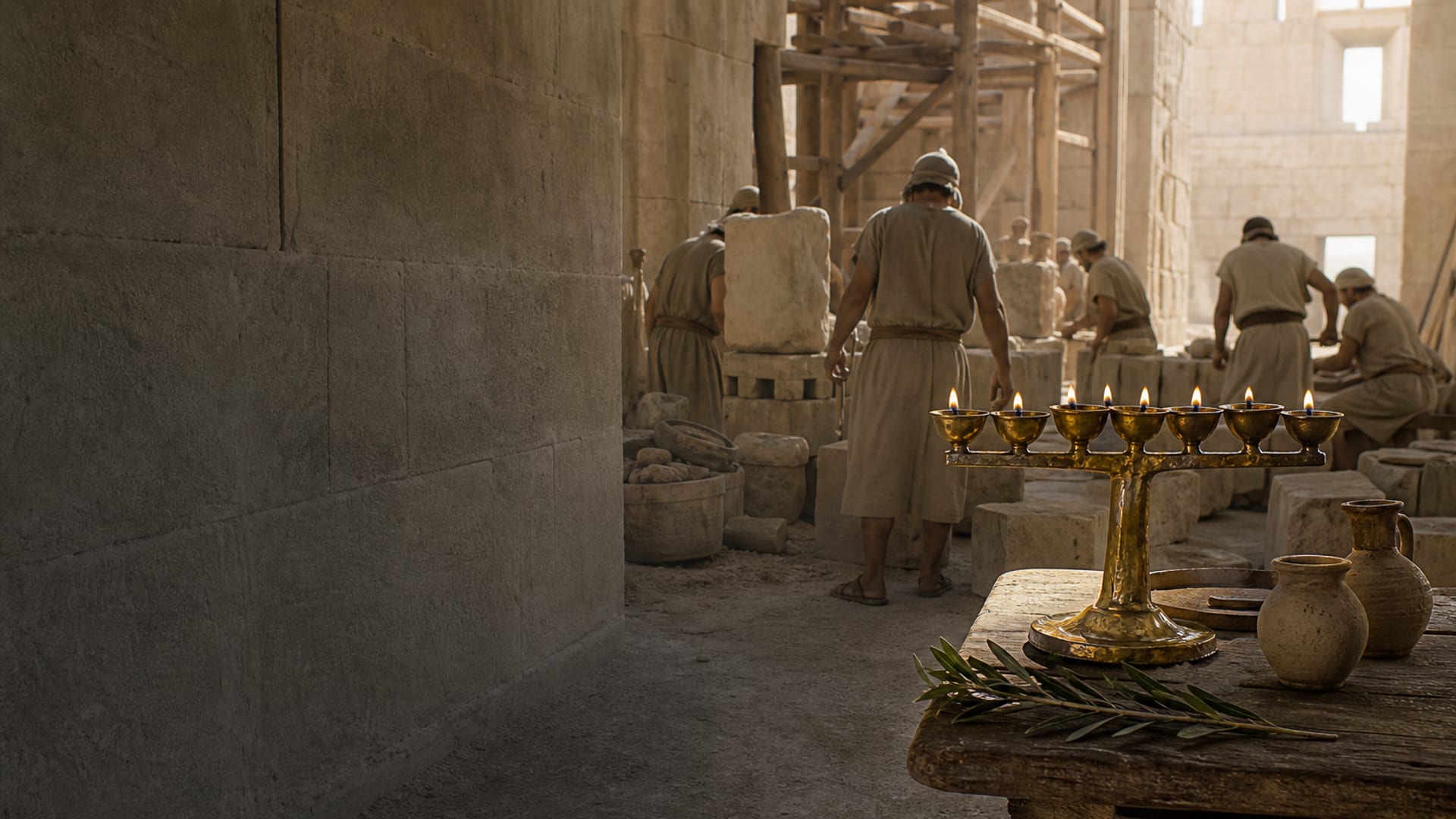
The angel asks what Zechariah sees, and the prophet describes a gold lampstand with a bowl above it, seven lamps, and olive trees on either side. The image naturally recalls the lampstand of the tabernacle and temple tradition, where light burned before the LORD. Yet this lampstand is more than sanctuary furniture copied into a vision. It has a bowl and spouts. The scene also includes trees and branches, with pipes carrying oil. The exact mechanics are not easy to reconstruct, and interpreters differ on the visual details.
That uncertainty should not distract us from the force of the picture. The lamp is supplied. The light does not depend on someone anxiously carrying a little oil to keep it from dying. The olive trees stand beside it. Later Zechariah sees golden oil pouring through pipes. The vision is full of provision.
Zechariah does not pretend to understand it at once. He asks, “What are these, my lord?” His question is part of the passage’s humility. Prophetic vision does not make the prophet omniscient. He must ask, receive, and ask again.
The first answer does not explain each object. It gives the word the whole vision serves: “This is the word of the LORD to Zerubbabel: Not by might nor by power, but by My Spirit, says the LORD of Hosts.”
The lampstand vision is not a puzzle meant to satisfy curiosity about symbolic machinery. It is an embodied word to a leader with an unfinished temple in front of him. Oil, light, and supply are gathered into one announcement: the decisive resource for completion is the Spirit of the LORD.
Zerubbabel and the limits of visible strength
Zerubbabel is not presented here as a heroic self-made builder. He is the addressed servant, the man whose hands are named, the governor whose work must be completed under the word of the LORD. Historically, he belongs to the generation after the exile. The community has returned, but its political life is limited. There is no independent Davidic monarchy. The old symbols of strength are absent.
That is why the word about might and power must not be flattened into a general suspicion of effort and planning, or of the ordinary responsibilities of public leadership. In context, the phrase speaks to the insufficiency of coercive strength and human capacity to secure God’s promise. The returned community cannot rebuild the kingdom by military force. Zerubbabel cannot turn the temple into a monument to his own competence. The work will be finished because the LORD supplies His Spirit.
At the same time, the Spirit does not erase Zerubbabel from the passage. The next words are striking: “The hands of Zerubbabel have laid the foundation of this house, and his hands will complete it. Then you will know that the LORD of Hosts has sent me to you.”
Hands laid the foundation. Hands will finish the house. The promise does not float above labor; it takes hold of labor and carries it to completion. Zechariah’s vision gives us a deeply biblical pattern: divine power does not make faithful human work unnecessary. It makes faithful work possible, durable, and fruitful beyond what visible resources would suggest.
This is one reason the passage is so searching for discouraged people. Some discouragement is honest. The walls are broken and the money is thin. The workers are tired, and the old people remember a greater house. The present obedience looks small. Zechariah does not scold the community for noticing weakness. He tells them weakness is not the measure of the LORD’s ability.
The mountain and the capstone
The word to Zerubbabel turns from supply to obstacle: “What are you, O great mountain? Before Zerubbabel you will become a plain. Then he will bring forth the capstone accompanied by shouts of ‘Grace, grace to it!’”
The mountain is not identified. It may gather into one image everything that stands against completion: local opposition and imperial pressure, poverty and weariness, internal discouragement and the sheer difficulty of rebuilding after judgment. The point is not that obstacles are imaginary. A mountain is large because it really stands in the way. The LORD’s word reduces it to level ground before the one He has appointed to finish the work.
The capstone marks completion. Some technical questions remain about the precise architectural term behind the translation, but the movement of the verse is clear. Zerubbabel will bring out the finishing stone, and the people will shout over it. The work that looked as though it might remain forever unfinished will reach its public end.
The shout is important. The people cry grace over the stone. The word translated grace carries the sense of favor and beauty. In this setting it is both celebration and confession. The finished temple will not stand as proof that the returned community finally became impressive. It will stand under the favor of God.
This is not triumphalism. The second temple, even when completed, did not restore everything at once. The Davidic throne did not reappear in ordinary political form. The community remained under foreign empires. Yet the temple’s completion mattered because the LORD had tied His name, worship, and promise to Zion. Small obedience in a diminished age was not meaningless.
The danger of despising small things
Verse 10 is the emotional center of the passage for many readers: “For who has despised the day of small things?”
The question exposes a sin that often dresses itself as realism. To despise small things is to look at what God has begun and treat it as contemptible because it lacks scale, polish, or immediate influence. The returned exiles were vulnerable to that temptation. The new temple did not look like Solomon’s temple. The community did not look like David’s kingdom. The worksite may have looked more like evidence of loss than evidence of promise.
The LORD does not deny the smallness. He names it. The day is small. The beginnings are unimpressive. The plumb line is in the governor’s hand, which means the work is still being measured and built. No one is looking at a finished sanctuary yet.
Then the verse shifts our attention from human contempt to divine joy: “But these seven eyes of the LORD, which scan the whole earth, will rejoice when they see the plumb line in the hand of Zerubbabel.”
In the previous vision, the LORD had set a stone before Joshua, and “on that one stone are seven eyes.” Here the eyes are identified with the LORD’s own searching sight. The language is symbolic, and it communicates complete watchfulness. The small project in Jerusalem is not hidden in a corner of history. The eyes that scan the whole earth notice a measuring line in Zerubbabel’s hand and rejoice.
That is a remarkable contrast. People may despise the small day, but the LORD rejoices to see the work in hand. He is not embarrassed by beginnings. He is not waiting for the dedication ceremony before He takes pleasure in obedience. The line in the hand matters because it belongs to the promised completion.
The olive trees and the anointed ones
Zechariah is not finished asking. He returns to the image that framed the lampstand: “What are the two olive trees on the right and left of the lampstand?” Then he presses further: “What are the two olive branches beside the two gold pipes from which the golden oil pours?”
The repeated question slows the reader down. The oil matters. The supply matters. The relation between the lampstand and the trees matters. The vision is not only about a lamp that shines. It is about a lamp that is continually furnished with what it needs.
The angel finally answers, “These are the two anointed ones who are standing beside the Lord of all the earth.”
The wording behind anointed ones belongs to the passage’s oil language. In the immediate context, the most natural identification is Joshua and Zerubbabel, or the priestly and royal-governing offices they represent. Chapter 3 has addressed Joshua. Chapter 4 addresses Zerubbabel. Together they stand in the restored order of worship and leadership, not as independent sources of power, but as servants standing beside the universal Lord.
There is room for caution here. The vision is larger than the personalities of one priest and one governor. Later Scripture, especially Revelation 11, takes up the imagery of two olive trees in a new setting. Still, Zechariah’s first audience would have heard encouragement for their own moment. The LORD is supplying His people through anointed service, and those servants stand before Him.
The final title matters. The Lord in view is not a local deity with influence over a ruined hill town. He is Lord over all the earth. Persia may govern the province. Local opponents may make trouble. The work may look administratively fragile and politically small. The One before whom Joshua and Zerubbabel stand is not small.
How the vision is commonly misread
The best-known line in the chapter is often lifted away from the unfinished temple and used as a general slogan for private success. That misses the weight of the passage. The Spirit is promised for the rebuilding of God’s house, the restoration of worship, and the confirmation of the LORD’s word through His prophet. The vision is not a blank check for whatever project we have already chosen.
Another misreading treats the word to Zerubbabel as if it devalues ordinary means. Yet the chapter gives us foundations and hands; it also gives us a capstone and a measuring line. Zerubbabel must work. The people must build. The prophetic word gives courage to labor; it does not baptize passivity.
A third mistake is to romanticize smallness itself. Zechariah does not say small things are automatically faithful. Smallness can come from fear, negligence, or disobedience. In this passage, the smallness is the visible condition of a real obedience that God has commanded and promised to complete. The question is not whether small things are always holy. The question is whether we despise what God has begun because it does not yet look glorious.
The passage also resists a harsh reading of discouragement. Some in the returned community had reasons to grieve. They had inherited ruins. They had memories, or family memories, of loss. They had enemies. The LORD’s answer is not shame for weakness. It is a vision of supply and a promise of completion.
The lampstand in the wider story
The lampstand reaches back to Israel’s sanctuary life. In the tabernacle and later the temple, light before the LORD belonged to ordered worship. Zechariah’s lampstand, with its extraordinary supply, speaks to the renewal of that worship after exile. The temple will again be a place where the LORD’s presence and Israel’s calling are visibly remembered.
The chapter also holds together priestly and royal hopes. Joshua is cleansed in chapter 3. Zerubbabel is commissioned in chapter 4. The Branch promise in the previous vision reaches beyond both men, and Christians rightly read that hope in light of Christ. That connection should be made carefully. Zechariah 4 is not a secret code in which every pipe and spout must be assigned to a detail in the life of Jesus. Its first word is to Zerubbabel and to the returned community. Within the larger canon, however, the restoration of priesthood, temple, and Davidic hope belongs to the long road that leads to the Messiah.
The New Testament’s later use of olive tree imagery in Revelation shows that Zechariah’s vision continued to shape the biblical imagination for witness in hard times. That later use does not erase the old setting. It confirms that God’s people have often been called to shine when outward power is limited and opposition is real.
A lampstand is made for light, but in Zechariah 4 the deeper comfort is the oil. God does not command light and then leave the lamp empty.
Faithful work when the beginning looks small
Zechariah 4 asks a reader to examine both discouragement and contempt.
Discouragement looks at an unfinished work and says it may never be completed. Contempt looks at the same work and says it is not worth much unless it becomes impressive soon. The vision answers both by turning our eyes to the Spirit of the LORD, the promised completion, and the divine joy over a plumb line in a faithful hand.
There are churches and families that feel like this scene. So do some ministries and some first acts of repentance. A congregation tries to rebuild trust after conflict. A parent begins to pray again with a child after a long silence. A pastor teaches a small room without the energy that comes from visible momentum. A believer takes the first honest step out of a hidden sin, and it looks painfully slight compared with the damage already done.
The passage does not ask such people to pretend that small beginnings feel grand. It asks them not to despise what God has given them to do. It also asks them not to confuse dependence on the Spirit with refusal to take up the tools at hand.
Zerubbabel’s comfort was not that the work would become easy. His comfort was that the same hands that began under God’s command would finish under God’s Spirit. If your obedience is small today, the question is not whether it impresses anyone. The question is whether it belongs to the work God has actually put before you.
So pray for the Spirit without embarrassment, and keep your hand on the line He has given you to hold. The day may be small. The LORD who sees the whole earth is able to rejoice over faithful work before anyone else calls it significant.
Sources and notes
Consulted while writing this piece. Nothing is listed here that was not used.
- Berean Standard Bible, Zechariah 4:1–14 primary text
Scripture in English is from the Berean Standard Bible, placed in the public domain by its publisher on 30 April 2023.